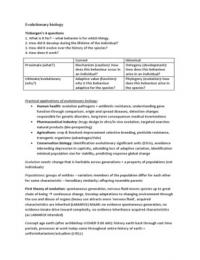
Evolutionary biology
Tinbergen’s 4 questions
1. What is it for? – what behavior is for which thingy.
2. How did it develop during the lifetime of the individual?
3. How did it evolve over the history of the species?
4. How does it work?
Current Historical
Proximate (what?) Mechanism (caution): How Ontogeny (development):
does this behaviour occur in How does this behaviour
an individual? arise in an individual?
Ultimate/evolutionary Adaptive value (function): Phylogeny (evolution): how
(why?) why is this behaviour does this behaviour arise in
adaptive for the species? the species?
Practical applications of evolutionary biology:
Human health: evolution pathogens + antibiotic resistance, understanding gene
function through comparison, origin and spread diseases, detection changes
responsible for genetic disorders, long-term consequences medical invertentions
Pharmaceutical industry: Drugs design in vitro/in vivo evolution, targeted searches
natural products (bio-prospecting)
Agriculture: crop & livestock improvement selective breeding, pesticide resistance,
transgenic organisms (advantages/risks)
Conservation biology: identification evolutionary significant units (ESUs), avoidance
inbreeding depression in captivity, advoiding loss of adaptive variation, identification
minimal population size for viability, predicting response global change
Evolution needs: change that is heritable across generations + a property of populations (not
individuals)
Populations: groups of entities – variation: members of the population differ for each other
for some characteristic – hereditary similarity: offspring resemble parents
First theory of evolution: spontaneous generation, nervous fluid moves species up to great
chain of being continuous change. Develop adaptations to changing environment through
the use and disuse of organs (heavy use attracts more ‘nervous fluid’, acquired
characteristics are inherited (LAMARCK) MAAR: no evidence spontaneous generation, no
evidence innate drive toward complexity, no evidence inheritance acquired characteristics
(as LAMARCK intended)
Concept age earth (after archbishop USSHER 9.00 AM): history earth back through vast time
periods, processes at work today same throughout entire history of earth =
uniformitarianism/actualism (LYELL)
, DARWINs observations:
Closely related species occupy different ecological settings tend to have different
characteristics
Populations that are physically isolated tend to differ
High levels of variability within a species (SPORTS)
Variants can pass these characteristics to offspring
Artificial selection can rapidly alter the characteristics of a breed
Principle of populations (1798): populations produce exponentially, large capacity to
reproduce and if left unchecked they will increase at a rapid rate, many more organisms
born than can possibly survive (MALTHUS)
DARWIN four theories of evolution:
Evolution has occurred: species evolve over time, devire from very different species
living in the past
The primary cause of evolutionary change is natural selection: species change over
time because bearers of different traits have different probabilities of contributing
offspring to the next generation
Splitting of single species into two or more species has occurred: life originated with
or a few species must have been a process whereby one species can split into at
least two species CONCLUSION: all species share common ancestors
Evolutionary change is gradual: evolution occurs by the gradual transformation of
populations over long periods of time rather than by a species changing nearly
instantaneously into something different.
Elements for natural selection:
Competition: more individuals are born than survive
Variation: individuals vary in traits directly related to their ability to survive and
reproduce
Heritability: advantageous traits passed on to offspring
Iteration: this process is repeated generation after generation over long periods of
time
Natural selection law:
Mechanism, as mechanical as any physical law
Acts on individuals, but only populations evolve
Opportunistic, not goal seeking, backward-looking, not anticipatory
Not only mechanism of evolution
Tinbergen’s 4 questions
1. What is it for? – what behavior is for which thingy.
2. How did it develop during the lifetime of the individual?
3. How did it evolve over the history of the species?
4. How does it work?
Current Historical
Proximate (what?) Mechanism (caution): How Ontogeny (development):
does this behaviour occur in How does this behaviour
an individual? arise in an individual?
Ultimate/evolutionary Adaptive value (function): Phylogeny (evolution): how
(why?) why is this behaviour does this behaviour arise in
adaptive for the species? the species?
Practical applications of evolutionary biology:
Human health: evolution pathogens + antibiotic resistance, understanding gene
function through comparison, origin and spread diseases, detection changes
responsible for genetic disorders, long-term consequences medical invertentions
Pharmaceutical industry: Drugs design in vitro/in vivo evolution, targeted searches
natural products (bio-prospecting)
Agriculture: crop & livestock improvement selective breeding, pesticide resistance,
transgenic organisms (advantages/risks)
Conservation biology: identification evolutionary significant units (ESUs), avoidance
inbreeding depression in captivity, advoiding loss of adaptive variation, identification
minimal population size for viability, predicting response global change
Evolution needs: change that is heritable across generations + a property of populations (not
individuals)
Populations: groups of entities – variation: members of the population differ for each other
for some characteristic – hereditary similarity: offspring resemble parents
First theory of evolution: spontaneous generation, nervous fluid moves species up to great
chain of being continuous change. Develop adaptations to changing environment through
the use and disuse of organs (heavy use attracts more ‘nervous fluid’, acquired
characteristics are inherited (LAMARCK) MAAR: no evidence spontaneous generation, no
evidence innate drive toward complexity, no evidence inheritance acquired characteristics
(as LAMARCK intended)
Concept age earth (after archbishop USSHER 9.00 AM): history earth back through vast time
periods, processes at work today same throughout entire history of earth =
uniformitarianism/actualism (LYELL)
, DARWINs observations:
Closely related species occupy different ecological settings tend to have different
characteristics
Populations that are physically isolated tend to differ
High levels of variability within a species (SPORTS)
Variants can pass these characteristics to offspring
Artificial selection can rapidly alter the characteristics of a breed
Principle of populations (1798): populations produce exponentially, large capacity to
reproduce and if left unchecked they will increase at a rapid rate, many more organisms
born than can possibly survive (MALTHUS)
DARWIN four theories of evolution:
Evolution has occurred: species evolve over time, devire from very different species
living in the past
The primary cause of evolutionary change is natural selection: species change over
time because bearers of different traits have different probabilities of contributing
offspring to the next generation
Splitting of single species into two or more species has occurred: life originated with
or a few species must have been a process whereby one species can split into at
least two species CONCLUSION: all species share common ancestors
Evolutionary change is gradual: evolution occurs by the gradual transformation of
populations over long periods of time rather than by a species changing nearly
instantaneously into something different.
Elements for natural selection:
Competition: more individuals are born than survive
Variation: individuals vary in traits directly related to their ability to survive and
reproduce
Heritability: advantageous traits passed on to offspring
Iteration: this process is repeated generation after generation over long periods of
time
Natural selection law:
Mechanism, as mechanical as any physical law
Acts on individuals, but only populations evolve
Opportunistic, not goal seeking, backward-looking, not anticipatory
Not only mechanism of evolution