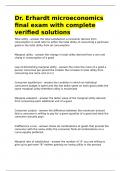
Dr. Erhardt microeconomics
final exam with complete
verified solutions
Total utility - answer the total satisfaction a consumer derives from
consumption it could refer to either the total utility of consuming a particular
good or the total utility from all consumption
Marginal utility - answer the change in total utility derived from a one unit
chang in consumption of a good
Law of diminishing marginal utility - answer the more the more of a good a
person consumes per period the smaller the increase in total utility from
consuming one more unit (o.t.c)
Consumer equilibrium - answer the condition in which an individual
consumers budget is spent and the last dollar spent on each good yields the
same marginal utility therefore utility is maximized
Marginal valuation - answer the dollar value of the marginal utility derived
from consuming each additional unit of a good
Consumer surplus - answer the difference between the maximum amount
that a consumer is willing to pay for a given quantity of a good and what the
consumer actually pays
Indifference curve - answer shows all combinations of goods that provide the
consumer with the same utility the consumer finds all combinations on a
curve equally preferred
Marginal rate of substitution - answer the number of "A" you are willing to
give up to get more "B" neither gaining nor losing utility in the process
,The law of diminishing rate of substitution - answer as your consumption of
"A" increases the amount of "B" you are willing to give up to get another "A"
declines
Indifference map - answer A graphical representation of consumers taste
each curve reflects a different level of utility
Explicit cost - answer opportunity cost of resources employed by a firm that
takes the form of cash payments
Implicit costs - answer a firms' opportunity cost of using its own resources or
those provided by its owners without a corresponding cash payment
Accounting profit - answer a firms' total revenue minus its explicit costs
Economic profit - answer a firms' total revenue minus its explicit and implicit
costs
Normal profit - answer the accounting profit earns when all resources earn
their opportunity costs
Variable resources - answer any resource that can be varied in the short run
(3 months) to increase or decrease production (labor)
Fixed resource - answer any resource that cannot be varied in the short run
(capital)
Short run - answer a period during which one of the firms' resources is fixed
, Long run - answer a period during which all resources under the firms' control
are variable
Total product - answer the total output produced by a firm
Production function - answer the relationship between the amount of
resources employed and a firms' total product
Marginal production - answer the change in total product that occurs when
the use of a particular resource increases by one unit all other resources
constant
Increasing marginal returns - answer the product of a variable resource
increases as each additional unit of that resource is employed
Law of diminishing marginal returns - answer : as more of a variable resource
is added to a given amount of a fixed resource marginal product eventually
declines and could become negative
Fixed cost - answer any production cost that is independent of the firms' rate
of output
Variable cost - answer any production cost that changes as the rate of output
changes
Total cost - answer the sum of fixed cost and variable cost or TC=FC+VC
Average variable cost - answer variable cost divided by output or AVC=VC/q
Average total cost - answer total cost divided by output or ATC=TC/q the sum
of average fixed cost and average variable cost or ATC=AFC+AVC
final exam with complete
verified solutions
Total utility - answer the total satisfaction a consumer derives from
consumption it could refer to either the total utility of consuming a particular
good or the total utility from all consumption
Marginal utility - answer the change in total utility derived from a one unit
chang in consumption of a good
Law of diminishing marginal utility - answer the more the more of a good a
person consumes per period the smaller the increase in total utility from
consuming one more unit (o.t.c)
Consumer equilibrium - answer the condition in which an individual
consumers budget is spent and the last dollar spent on each good yields the
same marginal utility therefore utility is maximized
Marginal valuation - answer the dollar value of the marginal utility derived
from consuming each additional unit of a good
Consumer surplus - answer the difference between the maximum amount
that a consumer is willing to pay for a given quantity of a good and what the
consumer actually pays
Indifference curve - answer shows all combinations of goods that provide the
consumer with the same utility the consumer finds all combinations on a
curve equally preferred
Marginal rate of substitution - answer the number of "A" you are willing to
give up to get more "B" neither gaining nor losing utility in the process
,The law of diminishing rate of substitution - answer as your consumption of
"A" increases the amount of "B" you are willing to give up to get another "A"
declines
Indifference map - answer A graphical representation of consumers taste
each curve reflects a different level of utility
Explicit cost - answer opportunity cost of resources employed by a firm that
takes the form of cash payments
Implicit costs - answer a firms' opportunity cost of using its own resources or
those provided by its owners without a corresponding cash payment
Accounting profit - answer a firms' total revenue minus its explicit costs
Economic profit - answer a firms' total revenue minus its explicit and implicit
costs
Normal profit - answer the accounting profit earns when all resources earn
their opportunity costs
Variable resources - answer any resource that can be varied in the short run
(3 months) to increase or decrease production (labor)
Fixed resource - answer any resource that cannot be varied in the short run
(capital)
Short run - answer a period during which one of the firms' resources is fixed
, Long run - answer a period during which all resources under the firms' control
are variable
Total product - answer the total output produced by a firm
Production function - answer the relationship between the amount of
resources employed and a firms' total product
Marginal production - answer the change in total product that occurs when
the use of a particular resource increases by one unit all other resources
constant
Increasing marginal returns - answer the product of a variable resource
increases as each additional unit of that resource is employed
Law of diminishing marginal returns - answer : as more of a variable resource
is added to a given amount of a fixed resource marginal product eventually
declines and could become negative
Fixed cost - answer any production cost that is independent of the firms' rate
of output
Variable cost - answer any production cost that changes as the rate of output
changes
Total cost - answer the sum of fixed cost and variable cost or TC=FC+VC
Average variable cost - answer variable cost divided by output or AVC=VC/q
Average total cost - answer total cost divided by output or ATC=TC/q the sum
of average fixed cost and average variable cost or ATC=AFC+AVC