BIOLOGY FINAL EXAM QUESTIONS
WITH COMPLETE ANSWERS
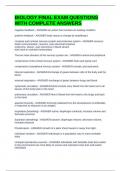
negative feedback - ANSWER-an action that counters an existing condition
positive feedback - ANSWER-body reacts to change by amplifying it
compare and contrast nervous system and endocrine system - ANSWER-nervous-
faster communication, neurons, uses electrical impulses
endocrine- slower, uses hormones in blood stream
both work to maintain homeostasis
The two main divisions of the nervous system are - ANSWER-central and peripheral
components of the central nervous system - ANSWER-brain and spinal cord
components of peripheral nervous system - ANSWER-somatic and autonomic
internal respiration - ANSWER-Exchange of gases between cells of the body and the
blood
external respiration - ANSWER-exchange of gases between lungs and blood
systemetic circulation - ANSWER-blood vessels carry blood from the heart out to all
tissues of the body back to the heart
pulmonary circulation - ANSWER-flow of blood from the heart to the lungs and back
to the heart
aquired immunity - ANSWER-Immunity obtained from the development of antibodies
in response to exposure to an antigen.
Inspiration (breathing) - ANSWER-active; diaphragm contracts; increase volume and
decrease pressure
Expiration (breathing) - ANSWER-passive; diaphragm relaxes; decrease volume,
increase pressure
Phototropism - ANSWER-Growth of a plant shoot toward or away from light.
individual variation - ANSWER-individuals in a population vary in many heritable
traits
Unequal reproductive success - ANSWER-individuals with heritable traits best suited
to the environment are more likely to survive and reproduce than less well-suited
individuals
, Species - ANSWER-A group of similar organisms that can breed and produce fertile
offspring.
limitations to species concept - ANSWER-biological- offspring of 2 species mating,
extinct organisms, asexually reproducing species
allopatric speciation - ANSWER-The formation of new species in populations that are
geographically isolated from one another.
sympatric speciation - ANSWER-The formation of new species in populations that
live in the same geographic area
modern synthesis - ANSWER-the fusion of genetics with evolutionary biology
Prokaryote - ANSWER-A unicellular organism that lacks a nucleus and membrane
bound organelles
Eukaryote - ANSWER-A cell that contains a nucleus and membrane bound
organelles
Anatomy - ANSWER-The study of body structure
Physiology - ANSWER-The study of body function
Homeostasis - ANSWER-process by which organisms maintain a relatively stable
internal environment
Photoperiodism - ANSWER-A plant's response to seasonal changes in length of
night and day
in monocots vascular bundles are - ANSWER-Scattered throughout the stem
Eudicots vascular bundles are - ANSWER-single rings of bundles around the outer
edge.
Plant Vascular Tissue - ANSWER-Conduct water and minerals from the root to
leaves and leaves to roots.
Cool Season Plants - ANSWER-relish cool temperatures, growing best in spring or
fall. (less efficient growth at elevated temperatures)
Warm Season Plants - ANSWER-mild temperatures (above 50F), cant grow in
freezing or cool conditions.
short day plants - ANSWER-plants that flower when nights are longer than a critical
length
long-day plants - ANSWER-plants that bloom only when the period of day is longer
than a specific period of darkness
WITH COMPLETE ANSWERS
negative feedback - ANSWER-an action that counters an existing condition
positive feedback - ANSWER-body reacts to change by amplifying it
compare and contrast nervous system and endocrine system - ANSWER-nervous-
faster communication, neurons, uses electrical impulses
endocrine- slower, uses hormones in blood stream
both work to maintain homeostasis
The two main divisions of the nervous system are - ANSWER-central and peripheral
components of the central nervous system - ANSWER-brain and spinal cord
components of peripheral nervous system - ANSWER-somatic and autonomic
internal respiration - ANSWER-Exchange of gases between cells of the body and the
blood
external respiration - ANSWER-exchange of gases between lungs and blood
systemetic circulation - ANSWER-blood vessels carry blood from the heart out to all
tissues of the body back to the heart
pulmonary circulation - ANSWER-flow of blood from the heart to the lungs and back
to the heart
aquired immunity - ANSWER-Immunity obtained from the development of antibodies
in response to exposure to an antigen.
Inspiration (breathing) - ANSWER-active; diaphragm contracts; increase volume and
decrease pressure
Expiration (breathing) - ANSWER-passive; diaphragm relaxes; decrease volume,
increase pressure
Phototropism - ANSWER-Growth of a plant shoot toward or away from light.
individual variation - ANSWER-individuals in a population vary in many heritable
traits
Unequal reproductive success - ANSWER-individuals with heritable traits best suited
to the environment are more likely to survive and reproduce than less well-suited
individuals
, Species - ANSWER-A group of similar organisms that can breed and produce fertile
offspring.
limitations to species concept - ANSWER-biological- offspring of 2 species mating,
extinct organisms, asexually reproducing species
allopatric speciation - ANSWER-The formation of new species in populations that are
geographically isolated from one another.
sympatric speciation - ANSWER-The formation of new species in populations that
live in the same geographic area
modern synthesis - ANSWER-the fusion of genetics with evolutionary biology
Prokaryote - ANSWER-A unicellular organism that lacks a nucleus and membrane
bound organelles
Eukaryote - ANSWER-A cell that contains a nucleus and membrane bound
organelles
Anatomy - ANSWER-The study of body structure
Physiology - ANSWER-The study of body function
Homeostasis - ANSWER-process by which organisms maintain a relatively stable
internal environment
Photoperiodism - ANSWER-A plant's response to seasonal changes in length of
night and day
in monocots vascular bundles are - ANSWER-Scattered throughout the stem
Eudicots vascular bundles are - ANSWER-single rings of bundles around the outer
edge.
Plant Vascular Tissue - ANSWER-Conduct water and minerals from the root to
leaves and leaves to roots.
Cool Season Plants - ANSWER-relish cool temperatures, growing best in spring or
fall. (less efficient growth at elevated temperatures)
Warm Season Plants - ANSWER-mild temperatures (above 50F), cant grow in
freezing or cool conditions.
short day plants - ANSWER-plants that flower when nights are longer than a critical
length
long-day plants - ANSWER-plants that bloom only when the period of day is longer
than a specific period of darkness