Okay, I can present the detailed explanations of the Python concepts in a document-like format.
Here it is:
Detailed Explanation of Key Python Concepts
This document provides a detailed explanation of the fundamental Python concepts highlighted
in the referenced video.
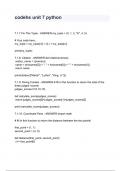
1. Python Files and the ".py" Extension
Python code is typically organized and stored in files that have the extension .py. These files are
essentially plain text files containing sequences of Python instructions. When you want to
execute a Python program, you run these .py files using a Python interpreter. The interpreter
reads the code in the file line by line and executes the instructions.
2. Variables
Variables act as symbolic names that you assign to values or objects within your Python
program. Think of them as labels that point to specific locations in your computer's memory
where data is stored.
● Dynamic Typing: Python employs dynamic typing, which means you don't need to
explicitly declare the data type of a variable when you assign a value to it. The Python
interpreter automatically infers the type based on the value being assigned.
● Naming Conventions: While Python is flexible with variable names, it's best practice to
follow certain conventions for readability and maintainability:
○ Variable names should be descriptive and indicate the purpose of the stored data.
○ They should start with a letter or an underscore (_).
○ They can contain letters, numbers, and underscores.
○ They are case-sensitive (myVariable is different from myvariable).
○ Avoid using Python keywords (e.g., if, else, for) as variable names.
3. Basic Data Types
Data types classify the kind of values that a variable can hold. Python offers a rich set of built-in
data types:
● Numeric Types:
○ int: Represents whole numbers (e.g., -5, 0, 100).
○ float: Represents floating-point numbers, which have a decimal point (e.g., 3.14,
-0.5, 2.0).
○ complex: Represents complex numbers in the form a + bj, where a is the real part
and b is the imaginary part, and j is the imaginary unit.
● String Type:
○ str: Represents sequences of characters (textual data). Strings are immutable,
meaning their content cannot be changed after they are created (e.g., "hello",
"Python 101").
● Sequence Types:
○ list: An ordered collection of items. Lists are mutable, allowing you to add, remove,
, or change elements after creation. They are defined using square brackets [] (e.g.,
[1, 2, "apple", 3.14]).
○ tuple: An ordered collection of items, similar to lists, but tuples are immutable. They
are defined using parentheses () (e.g., (1, 2, "banana")).
○ range: Represents an immutable sequence of numbers, often used for iterating in
loops (e.g., range(5) generates the sequence 0, 1, 2, 3, 4).
● Binary Types:
○ bytes: Represents immutable sequences of single byte values (0-255).
○ bytearray: Represents mutable sequences of single byte values.
○ memoryview: Provides a memory view object that allows direct access to the
internal data of an object that supports the buffer protocol without making a copy.
● Mapping Type:
○ dict: Represents a collection of key-value pairs. Dictionaries are mutable and
unordered (as of Python 3.7+). Keys must be unique and immutable, while values
can be of any type. They are defined using curly braces {} (e.g., {"name": "Alice",
"age": 30}).
● Boolean Type:
○ bool: Represents truth values, either True or False. Boolean values are often the
result of logical operations.
● Set Types:
○ set: An unordered collection of unique elements. Sets are mutable and do not allow
duplicate values. They are defined using curly braces {} (e.g., {1, 2, 3}).
○ frozenset: An immutable version of a set.
4. Type Annotations
Type annotations, also known as type hints, are a way to add optional type information to your
Python code. They allow you to specify the expected data type of variables, function
parameters, and function return values.
● Benefits:
○ Improved Readability: Type annotations make it clearer what type of data is
expected, enhancing code understanding.
○ Early Error Detection: Static type checkers (like MyPy) can use type annotations
to identify potential type errors before runtime, leading to more robust code.
○ Enhanced Code Maintainability: Explicit type information can make it easier to
refactor and maintain larger codebases.
● Syntax: Type annotations are added using a colon : after the variable name or function
parameter, followed by the type. For function return values, -> is used after the parameter
list, followed by the return type.
name: str = "Bob"
age: int = 25
def greet(person: str) -> str:
return f"Hello, {person}!"
● Note: Python interpreters do not enforce type annotations at runtime by default. They are
primarily used by static analysis tools.
Here it is:
Detailed Explanation of Key Python Concepts
This document provides a detailed explanation of the fundamental Python concepts highlighted
in the referenced video.
1. Python Files and the ".py" Extension
Python code is typically organized and stored in files that have the extension .py. These files are
essentially plain text files containing sequences of Python instructions. When you want to
execute a Python program, you run these .py files using a Python interpreter. The interpreter
reads the code in the file line by line and executes the instructions.
2. Variables
Variables act as symbolic names that you assign to values or objects within your Python
program. Think of them as labels that point to specific locations in your computer's memory
where data is stored.
● Dynamic Typing: Python employs dynamic typing, which means you don't need to
explicitly declare the data type of a variable when you assign a value to it. The Python
interpreter automatically infers the type based on the value being assigned.
● Naming Conventions: While Python is flexible with variable names, it's best practice to
follow certain conventions for readability and maintainability:
○ Variable names should be descriptive and indicate the purpose of the stored data.
○ They should start with a letter or an underscore (_).
○ They can contain letters, numbers, and underscores.
○ They are case-sensitive (myVariable is different from myvariable).
○ Avoid using Python keywords (e.g., if, else, for) as variable names.
3. Basic Data Types
Data types classify the kind of values that a variable can hold. Python offers a rich set of built-in
data types:
● Numeric Types:
○ int: Represents whole numbers (e.g., -5, 0, 100).
○ float: Represents floating-point numbers, which have a decimal point (e.g., 3.14,
-0.5, 2.0).
○ complex: Represents complex numbers in the form a + bj, where a is the real part
and b is the imaginary part, and j is the imaginary unit.
● String Type:
○ str: Represents sequences of characters (textual data). Strings are immutable,
meaning their content cannot be changed after they are created (e.g., "hello",
"Python 101").
● Sequence Types:
○ list: An ordered collection of items. Lists are mutable, allowing you to add, remove,
, or change elements after creation. They are defined using square brackets [] (e.g.,
[1, 2, "apple", 3.14]).
○ tuple: An ordered collection of items, similar to lists, but tuples are immutable. They
are defined using parentheses () (e.g., (1, 2, "banana")).
○ range: Represents an immutable sequence of numbers, often used for iterating in
loops (e.g., range(5) generates the sequence 0, 1, 2, 3, 4).
● Binary Types:
○ bytes: Represents immutable sequences of single byte values (0-255).
○ bytearray: Represents mutable sequences of single byte values.
○ memoryview: Provides a memory view object that allows direct access to the
internal data of an object that supports the buffer protocol without making a copy.
● Mapping Type:
○ dict: Represents a collection of key-value pairs. Dictionaries are mutable and
unordered (as of Python 3.7+). Keys must be unique and immutable, while values
can be of any type. They are defined using curly braces {} (e.g., {"name": "Alice",
"age": 30}).
● Boolean Type:
○ bool: Represents truth values, either True or False. Boolean values are often the
result of logical operations.
● Set Types:
○ set: An unordered collection of unique elements. Sets are mutable and do not allow
duplicate values. They are defined using curly braces {} (e.g., {1, 2, 3}).
○ frozenset: An immutable version of a set.
4. Type Annotations
Type annotations, also known as type hints, are a way to add optional type information to your
Python code. They allow you to specify the expected data type of variables, function
parameters, and function return values.
● Benefits:
○ Improved Readability: Type annotations make it clearer what type of data is
expected, enhancing code understanding.
○ Early Error Detection: Static type checkers (like MyPy) can use type annotations
to identify potential type errors before runtime, leading to more robust code.
○ Enhanced Code Maintainability: Explicit type information can make it easier to
refactor and maintain larger codebases.
● Syntax: Type annotations are added using a colon : after the variable name or function
parameter, followed by the type. For function return values, -> is used after the parameter
list, followed by the return type.
name: str = "Bob"
age: int = 25
def greet(person: str) -> str:
return f"Hello, {person}!"
● Note: Python interpreters do not enforce type annotations at runtime by default. They are
primarily used by static analysis tools.