Unit 4 Textbook Notes
Chapter 1
• Benzene is resonance stabilized
o Will not react with Br2 bc cannot do addition rxn
o Benzene represents parent, unsaturation, and suffix so all groups attached are
substituents
o Ex: OH on benzene would be hydroxbenzene, not benzenol, bc benzene already
has a suffix
§ Methylbenzene, chlorobenzene, aminobenzene, …
§ If using phenol for OH on benzene, then add the other substituent as
prefix
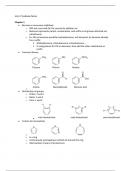
• Common Names
o
• Distribution of groups
o Ortho: 1 and 2
o Meta: 1 and 3
o Para: 1 and 4
§
• Criteria for Aromaticity
o
o Is a ring
o Continuously overlapping p orbitals all around the ring
o Odd number of pairs of pi electrons
, § Ex: 1,3,5 pairs
• Lone Pairs
o Not able to function as a base if in the aromatic structure
§ Would lose aromaticity
o If lone pair does not occupy a p orbital, then it can act as a base
§ Ex: pyridine
Chapter 4
• Double Bonds
o High-electron density
o Can function as Nuphile
o Induced dipole when Br2 is near an alkene
• Aromaticity
o Cannot add something Br2 to benzene or it will become unstable
o Can force benzene to react
§ Make Nuphile more electron rich
§ Make Ephile more electron poor
• Making a Stronger Nuphile
• Making a Nuphile into Ephile
o Empty orbital accepts electrons
§ Lewis acid
§ Ex: AlBr3, FeBr3
o Treat a Nuphile with a Lewis acid catalyst to make it an Ephile
§ Substitution reaction (electrophilic aromatic substitution)
§ Aromatic destroyed in intermediate but comes back in product
§ Base removes extra proton created
§ Lewis acid regenerated at the end
• Nitration
o Need NO2+ as electrophile
o Form by mixing HNO3 with H2SO4
§ NO2Br is hard to work with but in theory could work
o Sulfuric acid is stronger so it gives the proton to nitric acid
§ Nitric acid acts as a base bc sulfuric acid is more acidic
o Proton transfers are reversible
§ Reversing constantly forms NO2+
• Friedel-Crafts Alkylation and Acylation
o E+ on the ring, H+ off the ring
o Alkylation
§ Mixture of products
§ Need a complex to serve as the source of CH3+
• Too unstable to form on its own
§ Methylate a benzene ring with CH3Cl and a Lewis acid
o Acylation
Chapter 1
• Benzene is resonance stabilized
o Will not react with Br2 bc cannot do addition rxn
o Benzene represents parent, unsaturation, and suffix so all groups attached are
substituents
o Ex: OH on benzene would be hydroxbenzene, not benzenol, bc benzene already
has a suffix
§ Methylbenzene, chlorobenzene, aminobenzene, …
§ If using phenol for OH on benzene, then add the other substituent as
prefix
• Common Names
o
• Distribution of groups
o Ortho: 1 and 2
o Meta: 1 and 3
o Para: 1 and 4
§
• Criteria for Aromaticity
o
o Is a ring
o Continuously overlapping p orbitals all around the ring
o Odd number of pairs of pi electrons
, § Ex: 1,3,5 pairs
• Lone Pairs
o Not able to function as a base if in the aromatic structure
§ Would lose aromaticity
o If lone pair does not occupy a p orbital, then it can act as a base
§ Ex: pyridine
Chapter 4
• Double Bonds
o High-electron density
o Can function as Nuphile
o Induced dipole when Br2 is near an alkene
• Aromaticity
o Cannot add something Br2 to benzene or it will become unstable
o Can force benzene to react
§ Make Nuphile more electron rich
§ Make Ephile more electron poor
• Making a Stronger Nuphile
• Making a Nuphile into Ephile
o Empty orbital accepts electrons
§ Lewis acid
§ Ex: AlBr3, FeBr3
o Treat a Nuphile with a Lewis acid catalyst to make it an Ephile
§ Substitution reaction (electrophilic aromatic substitution)
§ Aromatic destroyed in intermediate but comes back in product
§ Base removes extra proton created
§ Lewis acid regenerated at the end
• Nitration
o Need NO2+ as electrophile
o Form by mixing HNO3 with H2SO4
§ NO2Br is hard to work with but in theory could work
o Sulfuric acid is stronger so it gives the proton to nitric acid
§ Nitric acid acts as a base bc sulfuric acid is more acidic
o Proton transfers are reversible
§ Reversing constantly forms NO2+
• Friedel-Crafts Alkylation and Acylation
o E+ on the ring, H+ off the ring
o Alkylation
§ Mixture of products
§ Need a complex to serve as the source of CH3+
• Too unstable to form on its own
§ Methylate a benzene ring with CH3Cl and a Lewis acid
o Acylation