Unit 1 Notes
Systems Basics Notes
• Systems
o Relationships that exchange energy, matter, etc.
o Lithosphere is upper mantle and crust
o Atmosphere
o Hydrosphere
o Biosphere
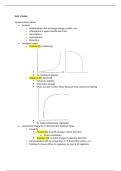
• Feedback Loops
o Positive (R): reinforcing
§ or
§ Ex: melting of glaciers
o Negative (B): balancing
§ Enhances stability
§ Diminishes change
§ Often we don’t notice these because they control everything
§
§ Ex: body temperature regulation
• Causal loop diagrams to demonstrate feedback loops
o Linearity
§ Positive (S): A and B change in same direction
• Direct correlation
§ Negative (O): A and B change in opposite direction
o Demonstrated with an arrow from A à B and then either + or -
o Positive FL means either no negatives or even # of negatives
, § Negative FL has odd # of negatives
o Rebound Effect
§ Increase in material = decrease in price = increase in usage = increase in
how much material is produced
§ Reinforcing feedback loop
• Hydrogeological studies
o Not integrated into water policies
o Look at solutions
o Do not look at interactions or effects
o Bouchet et al. framework
§ Complex adaptive systems
§ Resilience thinking
• Basins of attraction (stable states)
• Tipping points
• Ecosystem services
• Potential loss between stable states
§ Strategic adaptive management
• Bouchet
o Narau
o Anthropogenic activities impact water quality in Nauru
§ Groundwater called “brackish water” and is dirty
§ Health risks
§ Reinforcing feedback that low quality = do not protect the water = gets
worse
§ Disturbances from climate change, population growth, politics
§ E. coli
o NRPC improved water quality until its closure
§ Regulations and government policies can improve the conditions
o More food production = income saved = can improve water = more water to
produce more food
§ Issues with food production due to poor water quality
o Feedback loops associated with social aspect not environmental
§ Everyone’s activity affects the freshwater lens
• Freshwater lens is some freshwater sitting atop saltwater
§ If wells are too deep, saltwater intrusion
• More brackish (salt) water = lower quality of water = stop using
the well
o Proxy variable: even when multiple variables are present, choose to evaluate
only one (the proxy) and use it to estimate the other variables
§ Choosing E. coli instead of measuring all bacteria and assume that as it
increases, other bacteria increase too
• Gallopin
o Cities are dissipative systems
, § Maintained based on flow of materials, energy, information
§ Not at equilibrium
• Destroys gradient
• Constant influx
§ Non-linear because many feedback loops
§ Open system
§ Dense packing
• Favors high concentration
§ Hypercycles or autocatalytic cycles
• Self-organizing
• Evolving
• Complex
• Adaptive
§ Consumes more than produces
o 75% of CO2 emissions globally
§ Ecology and environment issues
o Too small = boundary effects
§ Need perfect balance to form new dissipative structure
o Cities are getting bigger
§ Urban systems are 3% of land, but hold >50% of the population
§ Cities are only sustainable if the provider is sustainable (theoretical)
• Provider of food, energy, materials
• Cities are not sustainable
• Bigger city = more entropy
§ Global connectedness
o Smart cities can either focus on information and communications technology or
sustainable growth and life quality
§ City is sustainable if net value stays same over time
o Global Scenarios
§ Conventional worlds
• Without deviating from present
§ Barbarization
• Possibility of deterioration in civilization
• Many problems
§ Great Transitions
• Visionary solutions
• Fundamental changes
• Bifurcate (reorganize) after turbulence
o Change is unpredictable
• Systems at equilibrium
o Equilibrium = death
§ Inflow of energy required to maintain equilibrium
§ Systems at equilibrium have no gradient and do not function
Systems Basics Notes
• Systems
o Relationships that exchange energy, matter, etc.
o Lithosphere is upper mantle and crust
o Atmosphere
o Hydrosphere
o Biosphere
• Feedback Loops
o Positive (R): reinforcing
§ or
§ Ex: melting of glaciers
o Negative (B): balancing
§ Enhances stability
§ Diminishes change
§ Often we don’t notice these because they control everything
§
§ Ex: body temperature regulation
• Causal loop diagrams to demonstrate feedback loops
o Linearity
§ Positive (S): A and B change in same direction
• Direct correlation
§ Negative (O): A and B change in opposite direction
o Demonstrated with an arrow from A à B and then either + or -
o Positive FL means either no negatives or even # of negatives
, § Negative FL has odd # of negatives
o Rebound Effect
§ Increase in material = decrease in price = increase in usage = increase in
how much material is produced
§ Reinforcing feedback loop
• Hydrogeological studies
o Not integrated into water policies
o Look at solutions
o Do not look at interactions or effects
o Bouchet et al. framework
§ Complex adaptive systems
§ Resilience thinking
• Basins of attraction (stable states)
• Tipping points
• Ecosystem services
• Potential loss between stable states
§ Strategic adaptive management
• Bouchet
o Narau
o Anthropogenic activities impact water quality in Nauru
§ Groundwater called “brackish water” and is dirty
§ Health risks
§ Reinforcing feedback that low quality = do not protect the water = gets
worse
§ Disturbances from climate change, population growth, politics
§ E. coli
o NRPC improved water quality until its closure
§ Regulations and government policies can improve the conditions
o More food production = income saved = can improve water = more water to
produce more food
§ Issues with food production due to poor water quality
o Feedback loops associated with social aspect not environmental
§ Everyone’s activity affects the freshwater lens
• Freshwater lens is some freshwater sitting atop saltwater
§ If wells are too deep, saltwater intrusion
• More brackish (salt) water = lower quality of water = stop using
the well
o Proxy variable: even when multiple variables are present, choose to evaluate
only one (the proxy) and use it to estimate the other variables
§ Choosing E. coli instead of measuring all bacteria and assume that as it
increases, other bacteria increase too
• Gallopin
o Cities are dissipative systems
, § Maintained based on flow of materials, energy, information
§ Not at equilibrium
• Destroys gradient
• Constant influx
§ Non-linear because many feedback loops
§ Open system
§ Dense packing
• Favors high concentration
§ Hypercycles or autocatalytic cycles
• Self-organizing
• Evolving
• Complex
• Adaptive
§ Consumes more than produces
o 75% of CO2 emissions globally
§ Ecology and environment issues
o Too small = boundary effects
§ Need perfect balance to form new dissipative structure
o Cities are getting bigger
§ Urban systems are 3% of land, but hold >50% of the population
§ Cities are only sustainable if the provider is sustainable (theoretical)
• Provider of food, energy, materials
• Cities are not sustainable
• Bigger city = more entropy
§ Global connectedness
o Smart cities can either focus on information and communications technology or
sustainable growth and life quality
§ City is sustainable if net value stays same over time
o Global Scenarios
§ Conventional worlds
• Without deviating from present
§ Barbarization
• Possibility of deterioration in civilization
• Many problems
§ Great Transitions
• Visionary solutions
• Fundamental changes
• Bifurcate (reorganize) after turbulence
o Change is unpredictable
• Systems at equilibrium
o Equilibrium = death
§ Inflow of energy required to maintain equilibrium
§ Systems at equilibrium have no gradient and do not function