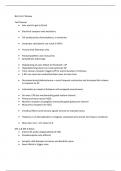
Bio Unit 2 Review
Test Review
• Ions want to get to E(ion)
• Electrical synapses only excitatory
• CSF produced by choroid plexus, in ventricles
• Ionotropic stimulation can result in IPSPs
• H-zone thick filaments only
• Parasympathetic uses muscarinic
• Sympathetic adrenergic
• Depolarizing of axon hillock to threshold = AP
• Hyperpolarizing alone can never generate AP
• Tonic sensory receptor triggers AP for entire duration of stimulus
• 2 APs can never be conducted down axon at same time
• Decreased acetylcholinesterase = more frequent contraction and increased Ach release
in response to AP
• Internodes are made of Schwann cells wrapped around axons
• On axon, CNS has mechanically-gated sodium channel
• Primary sensory neuron VGSC
• Nicotinic receptor on ganglion chemically-gated potassium channel
• Muscarinic receptor has VGCC
• Intrafusal fibers send sensory signals to brain to maintain tonus
• Thalamus is in diencephalon to integrate somatosensory stimuli and relay to cerebrum
• More Na+ ions = Vm closer to 0
M3-1 & M3-2 Notes
• Enteric NS works independently of CNS
• Pseudounipolar only afferent
• Synaptic cleft between terminus and dendritic spine
• Axon hillock is trigger zone
,• Collateral is branch of axon that leads to axon terminus
• CNS
o Interneurons = multipolar and anaxonic
• PNS
o Sensory = pseudounipolar and bipolar
o Motor = multipolar
• ICF slight excess of anions
• ECF slight excess of cations
• Hyperpolarize is more negative
• Depolarize is closer to 0
• Repolarize is return to RMP
o From K+ exiting cell
• Action potentials are regenerative
o Trigger downwards, amplitude same, non dissipative w distance
o Not summable
• When action potential reaches axon terminus, activates VG Ca2+ channels
o Depolarization, Ca2+ enters cell
o Vesicles fuse with cell membrane
• Hypokalemia = decreased [K+] = hyperpolarization
• Hyperkalemia = increased [K+] = depolarization
• Termination of signal
o Back to glial cells or axon terminus
o Enzymes inactivate neurotransmitters
o Diffuse out of synaptic cleft
• Electrical synapses cannot transmit IPSPs
• 6 connexins = 1 connexon/hemichannel
o 2 connexons = 1 gap junction
• Gap junctions are hydrophilic pores
• Direct electrical connection between neurons
• Neurotransmitter/neuromodulator released into synaptic cleft
• Neurohormone released into blood
• EPSP = closes K+ channel or opens Na+ channel
• IPSP = closes Na+ channel or opens K+/Cl- channel
, • Acetylcholine controls skeletal/smooth muscle and glands
• (Nor)epinephrine controls smooth muscle and glands
• GABA controls CNS (inhibitory)
o GABAa opens Cl- channel
o GABAb opens K+, closes Ca2+
• Glutamate controls CNS (excitatory)
o Glutamate ionotropic opens Na+/Ca2+ channels
o Glutamate metabotropic closes K+ channels
• Cholinergic relates to acetylcholine
• Adrenergic relates to (nor)epinephrine
• Botulinum blocks acetylcholine release
• Black widow venom increases intracellular [Ca2+] and neurotransmitter release
• Nicotine mimics acetylcholine and binds to nicotinic cholinergic receptors
• Morphine blocks neurotransmitter release at pain synapses
M3-3 Notes
• Somatosensory neurons part of PNS
• Somatosensory nuclei part of spinal cord
• Cancer usually glial because glial cells rapidly divide
• Neurons do not divide easily
• Oligodendrocytes form myelin sheaths
• Microglia are scavengers
• Ventricles all filled with CSF
• Ventricles connected (contiguous)
• Dorsal root à dorsal horn à ventral/lateral horn à ventral root
• Horns: regions of gray matter within spinal cord
• Roots: cables of efferent axons
• Efferent à visceral use lateral horn
• Efferent à somatic use ventral horn
• Cerebellum does not initiate; cerebrum does
• Cerebellar agenesis born without cerebellum
o Survive because of neuroplasticity
• Cerebrum gray matter
• Gyri are convolutions
• Sulci are grooves
Test Review
• Ions want to get to E(ion)
• Electrical synapses only excitatory
• CSF produced by choroid plexus, in ventricles
• Ionotropic stimulation can result in IPSPs
• H-zone thick filaments only
• Parasympathetic uses muscarinic
• Sympathetic adrenergic
• Depolarizing of axon hillock to threshold = AP
• Hyperpolarizing alone can never generate AP
• Tonic sensory receptor triggers AP for entire duration of stimulus
• 2 APs can never be conducted down axon at same time
• Decreased acetylcholinesterase = more frequent contraction and increased Ach release
in response to AP
• Internodes are made of Schwann cells wrapped around axons
• On axon, CNS has mechanically-gated sodium channel
• Primary sensory neuron VGSC
• Nicotinic receptor on ganglion chemically-gated potassium channel
• Muscarinic receptor has VGCC
• Intrafusal fibers send sensory signals to brain to maintain tonus
• Thalamus is in diencephalon to integrate somatosensory stimuli and relay to cerebrum
• More Na+ ions = Vm closer to 0
M3-1 & M3-2 Notes
• Enteric NS works independently of CNS
• Pseudounipolar only afferent
• Synaptic cleft between terminus and dendritic spine
• Axon hillock is trigger zone
,• Collateral is branch of axon that leads to axon terminus
• CNS
o Interneurons = multipolar and anaxonic
• PNS
o Sensory = pseudounipolar and bipolar
o Motor = multipolar
• ICF slight excess of anions
• ECF slight excess of cations
• Hyperpolarize is more negative
• Depolarize is closer to 0
• Repolarize is return to RMP
o From K+ exiting cell
• Action potentials are regenerative
o Trigger downwards, amplitude same, non dissipative w distance
o Not summable
• When action potential reaches axon terminus, activates VG Ca2+ channels
o Depolarization, Ca2+ enters cell
o Vesicles fuse with cell membrane
• Hypokalemia = decreased [K+] = hyperpolarization
• Hyperkalemia = increased [K+] = depolarization
• Termination of signal
o Back to glial cells or axon terminus
o Enzymes inactivate neurotransmitters
o Diffuse out of synaptic cleft
• Electrical synapses cannot transmit IPSPs
• 6 connexins = 1 connexon/hemichannel
o 2 connexons = 1 gap junction
• Gap junctions are hydrophilic pores
• Direct electrical connection between neurons
• Neurotransmitter/neuromodulator released into synaptic cleft
• Neurohormone released into blood
• EPSP = closes K+ channel or opens Na+ channel
• IPSP = closes Na+ channel or opens K+/Cl- channel
, • Acetylcholine controls skeletal/smooth muscle and glands
• (Nor)epinephrine controls smooth muscle and glands
• GABA controls CNS (inhibitory)
o GABAa opens Cl- channel
o GABAb opens K+, closes Ca2+
• Glutamate controls CNS (excitatory)
o Glutamate ionotropic opens Na+/Ca2+ channels
o Glutamate metabotropic closes K+ channels
• Cholinergic relates to acetylcholine
• Adrenergic relates to (nor)epinephrine
• Botulinum blocks acetylcholine release
• Black widow venom increases intracellular [Ca2+] and neurotransmitter release
• Nicotine mimics acetylcholine and binds to nicotinic cholinergic receptors
• Morphine blocks neurotransmitter release at pain synapses
M3-3 Notes
• Somatosensory neurons part of PNS
• Somatosensory nuclei part of spinal cord
• Cancer usually glial because glial cells rapidly divide
• Neurons do not divide easily
• Oligodendrocytes form myelin sheaths
• Microglia are scavengers
• Ventricles all filled with CSF
• Ventricles connected (contiguous)
• Dorsal root à dorsal horn à ventral/lateral horn à ventral root
• Horns: regions of gray matter within spinal cord
• Roots: cables of efferent axons
• Efferent à visceral use lateral horn
• Efferent à somatic use ventral horn
• Cerebellum does not initiate; cerebrum does
• Cerebellar agenesis born without cerebellum
o Survive because of neuroplasticity
• Cerebrum gray matter
• Gyri are convolutions
• Sulci are grooves