100% de satisfacción garantizada Inmediatamente disponible después del pago Tanto en línea como en PDF No estas atado a nada 4,6 TrustPilot
logo-home
Examen

Spanish 103 Exam Questions With Well Elaborated Answers.

Puntuación
-
Vendido
-
Páginas
3
Grado
A+
Subido en
21-04-2025
Escrito en
2024/2025

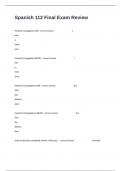
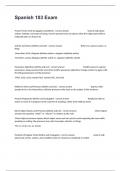
Present Tense Verb (Conjugate and Define) - correct answer -Used to talk about actions, feelings, and states of being. Use the present tense to express what the subject generally or habitually does or doesn't do Articles and Nouns (Define and List) - correct answer -Refers to a person, place, or thing -Masculine: El/Un (Singular definite article vs singular indefinite article) -Feminine: La/Una (Singular definite article vs. singular indefinite article) Possessive Adjectives (Define and List) - correct answer -Modify nouns to express possession; always proceed the noun they modify; possessive adjectives change number to agree with the things possessed, not the possessor -Mi(s), tu(s), su(s), nuestro/a(s), vuestro/a(s), and su(s) Reflexive Verbs and Pronouns (Define and List) - correct answer -Express what people do to or for themselves; reflexive pronouns refer back to the subject of the sentence Present Progressive (Define and Conjugate) - correct answer -Emphasize that an action or event is in progress at the moment of speaking, rather than habitual action Direct Object Nouns and Pronouns (Define and List) - correct answer -Direct object answers the question "what?" or "whom?" in relation to the verb -Direct object pronouns replace direct object nouns and are used to avoid repeating the noun while speaking or writing; the pronouns may refer to people, animals, or things -Me, te, lo/la, nos, os, los/las Preterite of Regular Verbs (Define and Conjugate) - correct answer -Used to talk about past events, actions, and conditions that are viewed as completed or ended Indirect Objects Nouns and Pronouns (Define and List) - correct answer -Tell "to whom" or "for whom" an action is done. In other words, who is affected by an action? -Me, te, le, nos, os, les Preterite of Reflexive Verbs and Pronouns (Define and Conjugate) - correct answer -Express what people do to/for themselves; same rules that applied to the reflexive in the present apply in the past The Imperfect (Define and Conjugate) - correct answer -Focuses on how things used to be years ago; if the sentence were talking about a specific, completed action, like something that was done yesterday, the PRETERITE would be used -Imperfect is used to express habitual or repeated actions in the past (w/out focus on the completion of the action); express an action or state that was in progress in the past; to describe characteristics and conditions in the past; express someone's ago in the past When to use the Preterite vs the Imperfect - correct answer -Preterite: express a sequence of actions completed in the past (forward movement of narrative time); talk about the beginning or ending of an event, action, or condition that occurred over a specific period of time; talk about the beginning of an event, action, or condition -Imperfect: Talk about habitual actions, events, or conditions in the past; express an ongoing part of an event, action of condition Comparisons of Inequality (Define and list) - correct answer -Use "mas... que" or "menos... que" to express comparisons of inequality. -Mas/menos [adjective] que.... Comparisons of Equality (Define and List) - correct answer -Indicares that two people, activities or things are alike in some way -Tan [adj/adv] como (as...as) -Tanto/a [noun] como (as much... as] -Tantos/as [noun] como (as many... as) -Tanto como (as much as) Present Perfect (Define and Conjugate) - correct answer -Perfect tense refers to past events, actions, and conditions -Present perfect refers to a past even, action, or condition that has some relation to the present Present Subjunctive (Define and Conjugate) - correct answer -Used to express expectations and hopes

Mostrar más Leer menos
Institución
SPANISH.
Grado
SPANISH.

Vista previa del contenido

Spanish 103 Exam

Present Tense Verb (Conjugate and Define) - correct answer -Used to talk about
actions, feelings, and states of being. Use the present tense to express what the subject generally or
habitually does or doesn't do


Articles and Nouns (Define and List) - correct answer -Refers to a person, place, or
thing

-Masculine: El/Un (Singular definite article vs singular indefinite article)

-Feminine: La/Una (Singular definite article vs. singular indefinite article)


Possessive Adjectives (Define and List) - correct answer -Modify nouns to express
possession; always proceed the noun they modify; possessive adjectives change number to agree with
the things possessed, not the possessor

-Mi(s), tu(s), su(s), nuestro/a(s), vuestro/a(s), and su(s)


Reflexive Verbs and Pronouns (Define and List) - correct answer -Express what
people do to or for themselves; reflexive pronouns refer back to the subject of the sentence


Present Progressive (Define and Conjugate) - correct answer -Emphasize that an
action or event is in progress at the moment of speaking, rather than habitual action


Direct Object Nouns and Pronouns (Define and List) - correct answer -Direct object
answers the question "what?" or "whom?" in relation to the verb

-Direct object pronouns replace direct object nouns and are used to avoid repeating the noun while
speaking or writing; the pronouns may refer to people, animals, or things

-Me, te, lo/la, nos, os, los/las


Preterite of Regular Verbs (Define and Conjugate) - correct answer -Used to talk
about past events, actions, and conditions that are viewed as completed or ended

Escuela, estudio y materia

Institución
SPANISH.
Grado
SPANISH.

Información del documento

Subido en
21 de abril de 2025
Número de páginas
3
Escrito en
2024/2025
Tipo
Examen
Contiene
Preguntas y respuestas

Temas

$14.49
Accede al documento completo:

100% de satisfacción garantizada
Inmediatamente disponible después del pago
Tanto en línea como en PDF
No estas atado a nada


Documento también disponible en un lote

Conoce al vendedor

Seller avatar
Los indicadores de reputación están sujetos a la cantidad de artículos vendidos por una tarifa y las reseñas que ha recibido por esos documentos. Hay tres niveles: Bronce, Plata y Oro. Cuanto mayor reputación, más podrás confiar en la calidad del trabajo del vendedor.
RealGrades Nursing
Seguir Necesitas iniciar sesión para seguir a otros usuarios o asignaturas
Vendido
170
Miembro desde
2 año
Número de seguidores
52
Documentos
11733
Última venta
1 mes hace

4.0

26 reseñas

5
12
4
5
3
7
2
1
1
1

Recientemente visto por ti

Por qué los estudiantes eligen Stuvia

Creado por compañeros estudiantes, verificado por reseñas

Calidad en la que puedes confiar: escrito por estudiantes que aprobaron y evaluado por otros que han usado estos resúmenes.

¿No estás satisfecho? Elige otro documento

¡No te preocupes! Puedes elegir directamente otro documento que se ajuste mejor a lo que buscas.

Paga como quieras, empieza a estudiar al instante

Sin suscripción, sin compromisos. Paga como estés acostumbrado con tarjeta de crédito y descarga tu documento PDF inmediatamente.

Student with book image

“Comprado, descargado y aprobado. Así de fácil puede ser.”

Alisha Student

Preguntas frecuentes