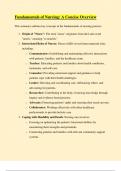
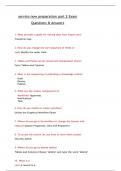
Fundamentals of Nursing: A Concise Overview
This summary outlines key concepts in the fundamentals of nursing practice.
1. Origin of "Nurse": The term "nurse" originates from the Latin word
"nutrix," meaning "to nourish."
2. Interrelated Roles of Nurses: Nurses fulfill several interconnected roles,
including:
o Communicator: Establishing and maintaining effective interactions
with patients, families, and the healthcare team.
o Teacher: Educating patients and families about health conditions,
treatments, and self-care.
o Counselor: Providing emotional support and guidance to help
patients cope with their health challenges.
o Leader: Directing and coordinating care, influencing others, and
advocating for patients.
o Researcher: Contributing to the body of nursing knowledge through
inquiry and evidence-based practice.
o Advocate: Protecting patients' rights and ensuring their needs are met.
o Collaborator: Working effectively with other healthcare
professionals to provide holistic care.
3. Coping with Disability and Death: Nursing care involves:
o Focusing on optimizing the patient's functional abilities by
maximizing their strengths and potentials.
o Connecting patients and families with relevant community support
systems.
, o Providing compassionate care to patients and their families during
end-of-life, including hospice care.
4. The Nursing Process: This systematic, patient-centered approach is a
fundamental guideline for nursing practice. It:
o Provides a framework for nurses to implement their various roles.
o Integrates the art (caring and compassion) and science (knowledge
and evidence) of nursing.
o Facilitates critical thinking and clinical reasoning in care delivery.
o Defines the scope of nursing practice and the areas of patient care
within the nurse's domain.
5. Nurse Practice Acts: These legal documents:
o Define the legal boundaries of nursing practice within each state.
o Establish a state board of nursing with the authority to create and
enforce rules and regulations.
o Define essential terms and nursing activities, including legal
requirements and titles for Registered Nurses (RNs) and Licensed
Practical Nurses (LPNs).
o Set criteria for nursing education and licensure.
6. Five Vital Signs: These fundamental physiological indicators are routinely
assessed:
o Respirations (breathing rate)
o Pulse rate (heart rate)
o Blood pressure (force of blood against artery walls)
o Temperature (body heat)
o Pain (subjective sensation of discomfort)
7. Criteria for Nursing as a Profession: Nursing is recognized as a profession
based on several criteria:
, o A well-defined body of specific and unique knowledge.
o A strong orientation towards service to others.
o Recognition of authority by a professional group, such as the
American Nurses Association (ANA).
o A code of ethics to guide professional conduct.
o A professional organization that establishes standards of practice.
o An ongoing commitment to research and the advancement of
knowledge.
o Autonomy and self-regulation within the scope of practice.
8. Florence Nightingale (1820-1910): A pivotal figure in nursing history, she:
o Defined nursing as both an art and a science, emphasizing both
compassionate care and evidence-based practice.
o Differentiated nursing from medicine, establishing it as a distinct
healthcare discipline.
o Established the first freestanding nursing education institutions,
advocating for formal training.
o Published influential books on nursing practice and hospital reform.
o Is widely recognized as the founder of modern nursing.
9. Clara Barton (1821-1912): A significant contributor to nursing and
humanitarian aid, she:
o Established the American Red Cross.
o Volunteered as a nurse during the American Civil War, providing care
for wounded soldiers and distributing supplies.
o Served as the supervisor of nurses for the Army of the James.
10.Sources of Knowledge in Nursing: Nurses draw upon various sources of
knowledge:
, o Traditional Knowledge: Practices and beliefs passed down through
generations.
o Authoritative Knowledge: Information derived from experts and
accepted as truth based on their perceived expertise.
o Scientific Knowledge: Knowledge obtained through the scientific
method and research.
11.Objective Data: Information that is observable and measurable by the nurse
(e.g., a rash, a blood pressure reading).
12.Subjective Data: Information reported by the patient, reflecting their
feelings and perceptions (e.g., pain level, nausea).
13.Types of Knowledge in Nursing: Nursing knowledge encompasses various
forms:
o Science: A systematic process of observing, identifying, describing,
investigating, and explaining phenomena in the world.
o Philosophy: The study of wisdom, fundamental knowledge, and the
processes used to develop perspectives on life.
o Process: A series of actions, changes, or functions intended to achieve
a desired outcome (e.g., the nursing process).
14.Goals of Nursing Research: Nursing research aims to:
o Improve the quality and effectiveness of care in clinical settings.
o Study individuals and the nursing process, including education, policy
development, ethics, and nursing history.
o Develop greater autonomy and professional strength for the nursing
discipline.
o Provide evidence-based practices to guide nursing interventions.
15.Deductive Reasoning: A logical process that examines a general principle
and then applies it to specific situations or ideas.
This summary outlines key concepts in the fundamentals of nursing practice.
1. Origin of "Nurse": The term "nurse" originates from the Latin word
"nutrix," meaning "to nourish."
2. Interrelated Roles of Nurses: Nurses fulfill several interconnected roles,
including:
o Communicator: Establishing and maintaining effective interactions
with patients, families, and the healthcare team.
o Teacher: Educating patients and families about health conditions,
treatments, and self-care.
o Counselor: Providing emotional support and guidance to help
patients cope with their health challenges.
o Leader: Directing and coordinating care, influencing others, and
advocating for patients.
o Researcher: Contributing to the body of nursing knowledge through
inquiry and evidence-based practice.
o Advocate: Protecting patients' rights and ensuring their needs are met.
o Collaborator: Working effectively with other healthcare
professionals to provide holistic care.
3. Coping with Disability and Death: Nursing care involves:
o Focusing on optimizing the patient's functional abilities by
maximizing their strengths and potentials.
o Connecting patients and families with relevant community support
systems.
, o Providing compassionate care to patients and their families during
end-of-life, including hospice care.
4. The Nursing Process: This systematic, patient-centered approach is a
fundamental guideline for nursing practice. It:
o Provides a framework for nurses to implement their various roles.
o Integrates the art (caring and compassion) and science (knowledge
and evidence) of nursing.
o Facilitates critical thinking and clinical reasoning in care delivery.
o Defines the scope of nursing practice and the areas of patient care
within the nurse's domain.
5. Nurse Practice Acts: These legal documents:
o Define the legal boundaries of nursing practice within each state.
o Establish a state board of nursing with the authority to create and
enforce rules and regulations.
o Define essential terms and nursing activities, including legal
requirements and titles for Registered Nurses (RNs) and Licensed
Practical Nurses (LPNs).
o Set criteria for nursing education and licensure.
6. Five Vital Signs: These fundamental physiological indicators are routinely
assessed:
o Respirations (breathing rate)
o Pulse rate (heart rate)
o Blood pressure (force of blood against artery walls)
o Temperature (body heat)
o Pain (subjective sensation of discomfort)
7. Criteria for Nursing as a Profession: Nursing is recognized as a profession
based on several criteria:
, o A well-defined body of specific and unique knowledge.
o A strong orientation towards service to others.
o Recognition of authority by a professional group, such as the
American Nurses Association (ANA).
o A code of ethics to guide professional conduct.
o A professional organization that establishes standards of practice.
o An ongoing commitment to research and the advancement of
knowledge.
o Autonomy and self-regulation within the scope of practice.
8. Florence Nightingale (1820-1910): A pivotal figure in nursing history, she:
o Defined nursing as both an art and a science, emphasizing both
compassionate care and evidence-based practice.
o Differentiated nursing from medicine, establishing it as a distinct
healthcare discipline.
o Established the first freestanding nursing education institutions,
advocating for formal training.
o Published influential books on nursing practice and hospital reform.
o Is widely recognized as the founder of modern nursing.
9. Clara Barton (1821-1912): A significant contributor to nursing and
humanitarian aid, she:
o Established the American Red Cross.
o Volunteered as a nurse during the American Civil War, providing care
for wounded soldiers and distributing supplies.
o Served as the supervisor of nurses for the Army of the James.
10.Sources of Knowledge in Nursing: Nurses draw upon various sources of
knowledge:
, o Traditional Knowledge: Practices and beliefs passed down through
generations.
o Authoritative Knowledge: Information derived from experts and
accepted as truth based on their perceived expertise.
o Scientific Knowledge: Knowledge obtained through the scientific
method and research.
11.Objective Data: Information that is observable and measurable by the nurse
(e.g., a rash, a blood pressure reading).
12.Subjective Data: Information reported by the patient, reflecting their
feelings and perceptions (e.g., pain level, nausea).
13.Types of Knowledge in Nursing: Nursing knowledge encompasses various
forms:
o Science: A systematic process of observing, identifying, describing,
investigating, and explaining phenomena in the world.
o Philosophy: The study of wisdom, fundamental knowledge, and the
processes used to develop perspectives on life.
o Process: A series of actions, changes, or functions intended to achieve
a desired outcome (e.g., the nursing process).
14.Goals of Nursing Research: Nursing research aims to:
o Improve the quality and effectiveness of care in clinical settings.
o Study individuals and the nursing process, including education, policy
development, ethics, and nursing history.
o Develop greater autonomy and professional strength for the nursing
discipline.
o Provide evidence-based practices to guide nursing interventions.
15.Deductive Reasoning: A logical process that examines a general principle
and then applies it to specific situations or ideas.