

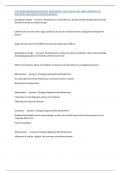
EPPP DEVELOPMENTAL PSYCHOLOGY EXAM NEWEST 2024-2025 ACTUAL EXAM COMPLETE 120
QUESTIONS AND CORRECT DETAILED ANSWERS
Qualitative Change - (answer) Development is discontinuous, periods of little change alternate with
periods of abrupt and rapid change
Children who do not master stage specific issues are at increased risk for subsequent development
failures
Stage theorists assert that differences between adults and children
Quantitative Change - (answer) Development is continuous with new abilities, skills, and knowledge
developing gradually and relatively uniformly over time
Differences between adults and children are because of maturation of neurological processes
Microsystem - (answer) Ecological Approach-Bronfenbrenner
the everyday environment the person encounters (home, school)
Bi-directional relationships
Mesosystem - (answer) Ecological Approach-Bronfenbrenner
Interaction or links between various microsystems
Child parents meet with teacher
Exosystem - (answer) Ecological Approach-Bronfenbrenner
Relationship between two or more settings, at least one of which does not contain the person, but
indirectly affects him
Parents workplace
Macrosystem - (answer) Ecological Approach-Bronfenbrenner
Influences of culture, religion, the economy, and political system
,EPPP DEVELOPMENTAL PSYCHOLOGY EXAM NEWEST 2024-2025 ACTUAL EXAM COMPLETE 120
QUESTIONS AND CORRECT DETAILED ANSWERS
Chronosystem - (answer) Ecological Approach-Bronfenbrenner
Role of the passage of time in the person's life
Normative influence on development - (answer) Occur in a similar way for most people
Age-graded normative events - (answer) event commonly experienced by people of a particular age
group (puberty, menopause, retirement)
History-graded normative events - (answer) event that is common to a particular cohort (Great
Depression, Vietnam War)
Non-normative influences on development - (answer) unusual events that have a major impact on an
individual's life (death of a parent, birth defect)
Critical periods - (answer) A specific time during an organism's life span when it is most sensitive to
environmental influences or stimulation
A specific structure or phenomenon must occur during this time, or it will not occur at all
Sensitive periods - (answer) Stimulation and learning has more of an impact that it will at any other
time
Genes - (answer) 23 pairs of chromosomes
Composed of DNA and RNA
Genotype - (answer) genetic makeup of the person
Phenotype - (answer) observable characteristics of the person
, EPPP DEVELOPMENTAL PSYCHOLOGY EXAM NEWEST 2024-2025 ACTUAL EXAM COMPLETE 120
QUESTIONS AND CORRECT DETAILED ANSWERS
Twin studies - (answer) Most commonly used to assess the relative genetic, biological, or dispositional
contribution to a variable
Klinefelter's Syndrome - (answer) Sex Chromosome Abnormalities
Occurs only in men XXY
Tend to be taller, IQ 90, abnormal development of secondary sex characteristics
Turner's Syndrome - (answer) Sex Chromosome Abnormalities
Occurs only in women X0, missing X chromosome
Normal IQ, abnormal development of secondary sex characteristics
Down's Syndrome - (answer) Sex Chromosome Abnormalities
3 chromosomes on chromosome 21
MR, slanted eyes, physical deformities
PKU (Phenylketonuria) - (answer) Sex Chromosome Abnormalities
Autosomal Recessive Disorder
Affects metabolism
Severe mental deficiency
Hemophilia - (answer) Sex-linked recessive disorder that causes excessive bleeding
Found predominantly in males
Frequent transfusion of blood with clotting factors
Sickle-cell amemia - (answer) Autosomal recessive disorder
Occurs primarily in African Americans
Deformed, fragile red blood cells that can clog the blood vessels
QUESTIONS AND CORRECT DETAILED ANSWERS
Qualitative Change - (answer) Development is discontinuous, periods of little change alternate with
periods of abrupt and rapid change
Children who do not master stage specific issues are at increased risk for subsequent development
failures
Stage theorists assert that differences between adults and children
Quantitative Change - (answer) Development is continuous with new abilities, skills, and knowledge
developing gradually and relatively uniformly over time
Differences between adults and children are because of maturation of neurological processes
Microsystem - (answer) Ecological Approach-Bronfenbrenner
the everyday environment the person encounters (home, school)
Bi-directional relationships
Mesosystem - (answer) Ecological Approach-Bronfenbrenner
Interaction or links between various microsystems
Child parents meet with teacher
Exosystem - (answer) Ecological Approach-Bronfenbrenner
Relationship between two or more settings, at least one of which does not contain the person, but
indirectly affects him
Parents workplace
Macrosystem - (answer) Ecological Approach-Bronfenbrenner
Influences of culture, religion, the economy, and political system
,EPPP DEVELOPMENTAL PSYCHOLOGY EXAM NEWEST 2024-2025 ACTUAL EXAM COMPLETE 120
QUESTIONS AND CORRECT DETAILED ANSWERS
Chronosystem - (answer) Ecological Approach-Bronfenbrenner
Role of the passage of time in the person's life
Normative influence on development - (answer) Occur in a similar way for most people
Age-graded normative events - (answer) event commonly experienced by people of a particular age
group (puberty, menopause, retirement)
History-graded normative events - (answer) event that is common to a particular cohort (Great
Depression, Vietnam War)
Non-normative influences on development - (answer) unusual events that have a major impact on an
individual's life (death of a parent, birth defect)
Critical periods - (answer) A specific time during an organism's life span when it is most sensitive to
environmental influences or stimulation
A specific structure or phenomenon must occur during this time, or it will not occur at all
Sensitive periods - (answer) Stimulation and learning has more of an impact that it will at any other
time
Genes - (answer) 23 pairs of chromosomes
Composed of DNA and RNA
Genotype - (answer) genetic makeup of the person
Phenotype - (answer) observable characteristics of the person
, EPPP DEVELOPMENTAL PSYCHOLOGY EXAM NEWEST 2024-2025 ACTUAL EXAM COMPLETE 120
QUESTIONS AND CORRECT DETAILED ANSWERS
Twin studies - (answer) Most commonly used to assess the relative genetic, biological, or dispositional
contribution to a variable
Klinefelter's Syndrome - (answer) Sex Chromosome Abnormalities
Occurs only in men XXY
Tend to be taller, IQ 90, abnormal development of secondary sex characteristics
Turner's Syndrome - (answer) Sex Chromosome Abnormalities
Occurs only in women X0, missing X chromosome
Normal IQ, abnormal development of secondary sex characteristics
Down's Syndrome - (answer) Sex Chromosome Abnormalities
3 chromosomes on chromosome 21
MR, slanted eyes, physical deformities
PKU (Phenylketonuria) - (answer) Sex Chromosome Abnormalities
Autosomal Recessive Disorder
Affects metabolism
Severe mental deficiency
Hemophilia - (answer) Sex-linked recessive disorder that causes excessive bleeding
Found predominantly in males
Frequent transfusion of blood with clotting factors
Sickle-cell amemia - (answer) Autosomal recessive disorder
Occurs primarily in African Americans
Deformed, fragile red blood cells that can clog the blood vessels


