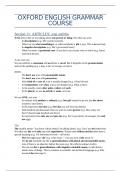
OXFORD ENGLISH GRAMMAR
COURSE
Section 11: ARTICLES: a/an and the
A/An shows that we are talking about one person or thing. We often use a/an:
- In descriptions (e.g. She’s a kind woman).
- When we say what something is, or what somebody’s job is (e.g. This is an earring).
- In singular descriptions (e.g. She’s got a small nose).
- When we mean ‘a particular one’ if you don’t say exactly who or which (e.g. James
married a doctor).
A/an and one
We use a before a consonant and an before a vowel. But it depends on the pronunciation
and not the spelling (e.g. a dog, a hat, an orange, an hour).
NOTE:
- We don’t use a/an with uncountable nouns.
- We don’t use a/an with possessives.
- After kind of or sort of, a/an is usually dropped (e.g. A kind of tree).
- In exclamations with what, a/an is not dropped (e.g. What a pity!).
- A/An usually comes after quite, rather and such.
- In the plural, we use no article or some, not a/an.
We use ONE, not a/an:
- In contrast with another or other(s) (e.g. One girl wanted to go out, but the others
wanted to stay home).
- In the expression one day (e.g. One day you will meet my family).
- With hundred and thousand when we want to sound precise (e.g. How many are
there? Exactly one hundred and three).
- In expressions like only one and just one (e.g. We’ve got plenty of sausages, but only
one egg).
The
The usually means ‘You know which one(s) I’m talking about’ (e.g. Can I use the bathroom).
We often use the with only and with superlatives. Nouns used without articles often have a
special meaning (e.g. I’m interested in birds > all birds).
- The does not mean ‘all’ (e.g. I like music > Can you turn of the music?).
- We do not normally use the in generalisations with plural and uncountable nouns,
even if there is an adjective before the noun (e.g. He collects antique clocks).
- We can use the in generalisations with singular countable nouns, to talk about a
whole class of things. This is common in scientific and technical language (e.g. Who
invented the telescope?).
, - We can use the when a description with ‘of’ follows the noun (e.g. She’s studying
the history of China).
Place names
Place names with NO article:
Continents, most countries Africa, Peru, Germany (but The Netherlands)
States, counties, etc. Texas, Oxfordshire
Towns Ottowa, Prague, Sidney (but The Hague)
Most streets Fifth Avenue, Westgate Street
Lakes, most mountains Lake Superiour, Everest, Mont Blanc
Town + building Oxford University, York Airport, Reading Station
Place names with THE:
Seas, rivers, deserts the Atlantic, the Sahara
Mountain and island groups the Alps, the Himalayas, the West Indies
Name includes common noun the Czech Republic, the United States, the Far East
Most buildings the British Museum, the Ritz, the Playhouse
Some common expressions with no article after a preposition:
- To/at/from school/university/college.
- To/in/out of church/prison/hospital/bed (e.g. She’s in prison > She works as a cook in
the prison).
- At home.
- To/at/from work.
- On holiday.
- By car/bus/bicycle/plane/train/underground/boat.
- On foot.
Other special cases
Some other expressions with no article:
He was elected President, She became Queen, They made her Manager, What’s on TV,
Let’s watch television.
Note that we don’t usually drop articles after with, without, as or what.
Note also: the same, on the right/left, a hundred, etc.
Section 14: NOUNS
English nouns can be countable (e.g. two dogs) or uncountable.
Countable nouns have plurals (e.g. dogs), and we can use a/an with them (e.g. a dog, an
apology).
Uncountable nouns have no plurals, and we can’t use a/an before them.
We can join two nouns:
- With a possessive ‘s or s’ (e.g. my sister’s car, my parents’ house).
- With a preposition (e.g. the top of the hill).
- Directly one after the other (e.g. orange juice, flower shop).
COURSE
Section 11: ARTICLES: a/an and the
A/An shows that we are talking about one person or thing. We often use a/an:
- In descriptions (e.g. She’s a kind woman).
- When we say what something is, or what somebody’s job is (e.g. This is an earring).
- In singular descriptions (e.g. She’s got a small nose).
- When we mean ‘a particular one’ if you don’t say exactly who or which (e.g. James
married a doctor).
A/an and one
We use a before a consonant and an before a vowel. But it depends on the pronunciation
and not the spelling (e.g. a dog, a hat, an orange, an hour).
NOTE:
- We don’t use a/an with uncountable nouns.
- We don’t use a/an with possessives.
- After kind of or sort of, a/an is usually dropped (e.g. A kind of tree).
- In exclamations with what, a/an is not dropped (e.g. What a pity!).
- A/An usually comes after quite, rather and such.
- In the plural, we use no article or some, not a/an.
We use ONE, not a/an:
- In contrast with another or other(s) (e.g. One girl wanted to go out, but the others
wanted to stay home).
- In the expression one day (e.g. One day you will meet my family).
- With hundred and thousand when we want to sound precise (e.g. How many are
there? Exactly one hundred and three).
- In expressions like only one and just one (e.g. We’ve got plenty of sausages, but only
one egg).
The
The usually means ‘You know which one(s) I’m talking about’ (e.g. Can I use the bathroom).
We often use the with only and with superlatives. Nouns used without articles often have a
special meaning (e.g. I’m interested in birds > all birds).
- The does not mean ‘all’ (e.g. I like music > Can you turn of the music?).
- We do not normally use the in generalisations with plural and uncountable nouns,
even if there is an adjective before the noun (e.g. He collects antique clocks).
- We can use the in generalisations with singular countable nouns, to talk about a
whole class of things. This is common in scientific and technical language (e.g. Who
invented the telescope?).
, - We can use the when a description with ‘of’ follows the noun (e.g. She’s studying
the history of China).
Place names
Place names with NO article:
Continents, most countries Africa, Peru, Germany (but The Netherlands)
States, counties, etc. Texas, Oxfordshire
Towns Ottowa, Prague, Sidney (but The Hague)
Most streets Fifth Avenue, Westgate Street
Lakes, most mountains Lake Superiour, Everest, Mont Blanc
Town + building Oxford University, York Airport, Reading Station
Place names with THE:
Seas, rivers, deserts the Atlantic, the Sahara
Mountain and island groups the Alps, the Himalayas, the West Indies
Name includes common noun the Czech Republic, the United States, the Far East
Most buildings the British Museum, the Ritz, the Playhouse
Some common expressions with no article after a preposition:
- To/at/from school/university/college.
- To/in/out of church/prison/hospital/bed (e.g. She’s in prison > She works as a cook in
the prison).
- At home.
- To/at/from work.
- On holiday.
- By car/bus/bicycle/plane/train/underground/boat.
- On foot.
Other special cases
Some other expressions with no article:
He was elected President, She became Queen, They made her Manager, What’s on TV,
Let’s watch television.
Note that we don’t usually drop articles after with, without, as or what.
Note also: the same, on the right/left, a hundred, etc.
Section 14: NOUNS
English nouns can be countable (e.g. two dogs) or uncountable.
Countable nouns have plurals (e.g. dogs), and we can use a/an with them (e.g. a dog, an
apology).
Uncountable nouns have no plurals, and we can’t use a/an before them.
We can join two nouns:
- With a possessive ‘s or s’ (e.g. my sister’s car, my parents’ house).
- With a preposition (e.g. the top of the hill).
- Directly one after the other (e.g. orange juice, flower shop).