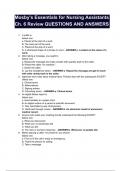
Mosby's Essentials for Nursing Assistants
Ch. 6 Review QUESTIONS AND ANSWERS
1. A suffix is
Select one:
a. Placed at the start of a word.
B. The main part of the word.
C. Placed at the stop of a word.
D. A shortened shape of a phrase or word. - ANSWER-c. Located on the cease of a
word.
2. After taking a message, you ought to
Select one:
a. Repeat the message and make contact with quantity back to the caller.
B. Placed the caller "on maintain."
c. Switch the caller.
D. Lay the smartphone down. - ANSWER-a. Repeat the message and get in touch
with wide variety back to the caller.
3. Agencies have rules about medical facts. Policies deal with the subsequent EXCEPT
Select one:
a. Clinical terms.
B. Abbreviations.
C. Signing entries.
D. Correcting errors. - ANSWER-a. Clinical terms.
4. An digital fitness report is
Select one:
a. Used similarly to a paper chart.
B. An digital version of a person's scientific document.
C. Only reachable by way of physicians.
D. Used best through nurses. - ANSWER-b. An electronic model of someone's
medical record.
5. Anyone who reads your charting should understand the following EXCEPT
Select one:
a. What you discovered.
B. What your co-employees did.
C. What you did.
D. The man or woman's response. - ANSWER-b. What your co-people did.
6. Before placing a caller "on preserve" you should
Select one:
a. Find out if the call is ready an emergency.
B. Thank the person for calling.
C. Take a message.
, D. Ask how long the caller can wait. - ANSWER-a. Find out if the call is ready an
emergency.
7. Communication is
Select one:
a. The verbal account of care and observations.
B. The written account of care and observations.
C. The exchange of statistics.
D. The medical record. - ANSWER-c. The trade of records.
8. Dys method
Select one:
a. Without, not, lack of.
B. Slow.
C. Terrible, tough, ordinary.
D. Internal, internal. - ANSWER-c. Awful, hard, strange.
9. Information that you may see, hear, experience, or odor is
Select one:
a. Evaluation.
B. Observation.
C. Objective information.
D. Subjective information. - ANSWER-c. Goal information.
10.Lateral approach
Select one:
a. Closer to the the front.
B. In the direction of the back.
C. Faraway from mid-line.
D. Near mid-line. - ANSWER-c. Away from the mid-line.
11.Symptoms are
Select one:
a. Objective records.
B. Subjective information.
C. Visible, felt, touched, or heard.
D. Discovered. - ANSWER-b. Subjective facts.
12.The employer lets in you to record on charts. Which is INCORRECT?
Select one:
a. Ink is used, now not pencil.
B. Only agency-accredited abbreviations are used.
C. Errors are erased.
D. All entries are signed with your call and title. - ANSWER-c. Errors are erased.
13.The health group exchanges facts. They ship and get hold of messages. This is
Select one:
a. Gossip.
B. Communique.
C. Reporting.
D. Resolving battle. - ANSWER-b. Verbal exchange.
Ch. 6 Review QUESTIONS AND ANSWERS
1. A suffix is
Select one:
a. Placed at the start of a word.
B. The main part of the word.
C. Placed at the stop of a word.
D. A shortened shape of a phrase or word. - ANSWER-c. Located on the cease of a
word.
2. After taking a message, you ought to
Select one:
a. Repeat the message and make contact with quantity back to the caller.
B. Placed the caller "on maintain."
c. Switch the caller.
D. Lay the smartphone down. - ANSWER-a. Repeat the message and get in touch
with wide variety back to the caller.
3. Agencies have rules about medical facts. Policies deal with the subsequent EXCEPT
Select one:
a. Clinical terms.
B. Abbreviations.
C. Signing entries.
D. Correcting errors. - ANSWER-a. Clinical terms.
4. An digital fitness report is
Select one:
a. Used similarly to a paper chart.
B. An digital version of a person's scientific document.
C. Only reachable by way of physicians.
D. Used best through nurses. - ANSWER-b. An electronic model of someone's
medical record.
5. Anyone who reads your charting should understand the following EXCEPT
Select one:
a. What you discovered.
B. What your co-employees did.
C. What you did.
D. The man or woman's response. - ANSWER-b. What your co-people did.
6. Before placing a caller "on preserve" you should
Select one:
a. Find out if the call is ready an emergency.
B. Thank the person for calling.
C. Take a message.
, D. Ask how long the caller can wait. - ANSWER-a. Find out if the call is ready an
emergency.
7. Communication is
Select one:
a. The verbal account of care and observations.
B. The written account of care and observations.
C. The exchange of statistics.
D. The medical record. - ANSWER-c. The trade of records.
8. Dys method
Select one:
a. Without, not, lack of.
B. Slow.
C. Terrible, tough, ordinary.
D. Internal, internal. - ANSWER-c. Awful, hard, strange.
9. Information that you may see, hear, experience, or odor is
Select one:
a. Evaluation.
B. Observation.
C. Objective information.
D. Subjective information. - ANSWER-c. Goal information.
10.Lateral approach
Select one:
a. Closer to the the front.
B. In the direction of the back.
C. Faraway from mid-line.
D. Near mid-line. - ANSWER-c. Away from the mid-line.
11.Symptoms are
Select one:
a. Objective records.
B. Subjective information.
C. Visible, felt, touched, or heard.
D. Discovered. - ANSWER-b. Subjective facts.
12.The employer lets in you to record on charts. Which is INCORRECT?
Select one:
a. Ink is used, now not pencil.
B. Only agency-accredited abbreviations are used.
C. Errors are erased.
D. All entries are signed with your call and title. - ANSWER-c. Errors are erased.
13.The health group exchanges facts. They ship and get hold of messages. This is
Select one:
a. Gossip.
B. Communique.
C. Reporting.
D. Resolving battle. - ANSWER-b. Verbal exchange.