1
Unit 3: Systems for looking into space
2. Systems for looking into space
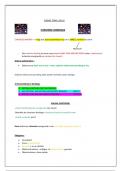
• telescopes are used to look into space and gather information
• South Africa has built and uses some of the largest telescopes
1.1. Optical Telescope
SALT in South Africa’s largest optical telescope.
Optical telescopes must be placed away from the city.
Design and construction of optical telescope.
1.2. Radio Telescope
South Africa has some of the best radio telescopes like the KAT-7, MeerKAT and
SKA
Must be placed in country sides.
Has a bowl shape.
1.3. Magnification
The amount of times an object has been enlarged.
1.4. Arrays
Group of radio telescopes together.
KEY QUESTIONS
• The stars we see at night - are
those all the stars there are? • How
do scientists find out what stars are
like? • How come you can't see
other planets when looking up at
the sky, but we have some
beautiful close- up photographs
Systems for looking into space
NATURAL SCIENCE AND TECHNOLOGY GRADE 6 TERM 4
, 2
Human beings are fascinated by the objects they see in the sky. For most of history,
they could only look at the object with their eyes and use their imagination to think about
what they saw. The invention of the telescope allowed people to see objects in space
that they had not been able to see before.
Teacher notes:
Additional pictures and videos can be shown.
The Bubble Space Telescope Story goo.gl/vHZAV
Real-time views from webcamsatS1LT goo.gl/9mYji
ACTIVITY: WHAT DO YOU ALREADY KNOW ABOUT THE MOON.
NATURAL SCIENCE AND TECHNOLOGY GRADE 6 TERM 4
, 3
1. What do you know about the Moon?
2. What can you see on the Moon by only looking with your eyes?
3. Do you know more about the Moon than you can see? How?
4. If you could see the Moon better, what would you hope to see?
5. How do you think scientists know so much about the Moon?
Teacher notes:
Learners should demonstrate their prior
knowledge gain in grade 4 and 5.
Telescope
NATURAL SCIENCE AND TECHNOLOGY GRADE 6 TERM 4
Unit 3: Systems for looking into space
2. Systems for looking into space
• telescopes are used to look into space and gather information
• South Africa has built and uses some of the largest telescopes
1.1. Optical Telescope
SALT in South Africa’s largest optical telescope.
Optical telescopes must be placed away from the city.
Design and construction of optical telescope.
1.2. Radio Telescope
South Africa has some of the best radio telescopes like the KAT-7, MeerKAT and
SKA
Must be placed in country sides.
Has a bowl shape.
1.3. Magnification
The amount of times an object has been enlarged.
1.4. Arrays
Group of radio telescopes together.
KEY QUESTIONS
• The stars we see at night - are
those all the stars there are? • How
do scientists find out what stars are
like? • How come you can't see
other planets when looking up at
the sky, but we have some
beautiful close- up photographs
Systems for looking into space
NATURAL SCIENCE AND TECHNOLOGY GRADE 6 TERM 4
, 2
Human beings are fascinated by the objects they see in the sky. For most of history,
they could only look at the object with their eyes and use their imagination to think about
what they saw. The invention of the telescope allowed people to see objects in space
that they had not been able to see before.
Teacher notes:
Additional pictures and videos can be shown.
The Bubble Space Telescope Story goo.gl/vHZAV
Real-time views from webcamsatS1LT goo.gl/9mYji
ACTIVITY: WHAT DO YOU ALREADY KNOW ABOUT THE MOON.
NATURAL SCIENCE AND TECHNOLOGY GRADE 6 TERM 4
, 3
1. What do you know about the Moon?
2. What can you see on the Moon by only looking with your eyes?
3. Do you know more about the Moon than you can see? How?
4. If you could see the Moon better, what would you hope to see?
5. How do you think scientists know so much about the Moon?
Teacher notes:
Learners should demonstrate their prior
knowledge gain in grade 4 and 5.
Telescope
NATURAL SCIENCE AND TECHNOLOGY GRADE 6 TERM 4