WGU Educational Psychology & Development of
Children and Adolescents Verified Questions with
Correct Answers.
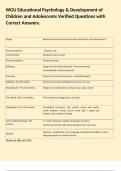
Piaget Believed we learn from interaction with peers and environment
Preconventional All about me
Conventional All about rules or laws
Postconventional All about others
Kohlberg Stages of Moral Development- Preconventional,
Conventional, Postconventional
Chomsky Theory of Universal Grammar- Innate/Biological
Babbling- 6 to 8 months Consonant-vowel combinations (ba-ba, ma-ma)
Holophrastic- 9 to 18 months Single words represent a sentence (up, juice, mine)
Two-Word- 18 to 24 months Mini sentences (doggy bark, me play)
Telegraphic- 24 to 30 months Vocabulary increases. Use mostly nouns and verbs,
omits auxiliary words (Carrie want ball, I good boy
today)- early multiword stage
Later multiword stage- 30+ 5+ word sentences, fastest vocabulary increase.
months Sentences formed with improving grammar, structure
Operant conditioning and language developmentchildren learn
Skinner
language based on reinforcement
Terms in this set (51)
, Operant Conditioning and Children learn language based on reinforcement, learn
Language Development language through imitating, prompting, shaping, they
associate words with meanings, correct utterances are
positively reinforced- Skinner
Vygotsky Social approach to language development
Social Approach to language develops through social interactions, children need
Language Development interpersonal interactions, Zone of Proximal Development
(ZPD), scaffolding (temp support), Private speech (talking to
yourself)
Spearman General intelligence (g factor)
Thurnstone 7 factor intelligence
Sternberg successful intelligence
Gardner Multiple intelligences
Behavioral theory teacher directed, basic skills, direct instruction, immediate
feedback & correction, reinforcementpositive/negative,
punishment- time-out, shaping, token economy, computer-
based tutorials
Constructivist Theory Student-centered, building knowledge, lego builders, build
schema- student constructs own knowledge, real world,
learn from others, scaffolding, ZPD, project based learning,
virtual learning
Cooperative Collaborative learning together, social butterflies, interacting, mixed
Theory groups, encourage each other, individual accountability,
equal opportunity for success, model social behaviors
Informationprocessing/Social Memory, metacognitive knowledge, sensory register, working
Cognitive memory, Self-regulation/control, modeling, attention getting
devices, chunking, concept mapping
Children and Adolescents Verified Questions with
Correct Answers.
Piaget Believed we learn from interaction with peers and environment
Preconventional All about me
Conventional All about rules or laws
Postconventional All about others
Kohlberg Stages of Moral Development- Preconventional,
Conventional, Postconventional
Chomsky Theory of Universal Grammar- Innate/Biological
Babbling- 6 to 8 months Consonant-vowel combinations (ba-ba, ma-ma)
Holophrastic- 9 to 18 months Single words represent a sentence (up, juice, mine)
Two-Word- 18 to 24 months Mini sentences (doggy bark, me play)
Telegraphic- 24 to 30 months Vocabulary increases. Use mostly nouns and verbs,
omits auxiliary words (Carrie want ball, I good boy
today)- early multiword stage
Later multiword stage- 30+ 5+ word sentences, fastest vocabulary increase.
months Sentences formed with improving grammar, structure
Operant conditioning and language developmentchildren learn
Skinner
language based on reinforcement
Terms in this set (51)
, Operant Conditioning and Children learn language based on reinforcement, learn
Language Development language through imitating, prompting, shaping, they
associate words with meanings, correct utterances are
positively reinforced- Skinner
Vygotsky Social approach to language development
Social Approach to language develops through social interactions, children need
Language Development interpersonal interactions, Zone of Proximal Development
(ZPD), scaffolding (temp support), Private speech (talking to
yourself)
Spearman General intelligence (g factor)
Thurnstone 7 factor intelligence
Sternberg successful intelligence
Gardner Multiple intelligences
Behavioral theory teacher directed, basic skills, direct instruction, immediate
feedback & correction, reinforcementpositive/negative,
punishment- time-out, shaping, token economy, computer-
based tutorials
Constructivist Theory Student-centered, building knowledge, lego builders, build
schema- student constructs own knowledge, real world,
learn from others, scaffolding, ZPD, project based learning,
virtual learning
Cooperative Collaborative learning together, social butterflies, interacting, mixed
Theory groups, encourage each other, individual accountability,
equal opportunity for success, model social behaviors
Informationprocessing/Social Memory, metacognitive knowledge, sensory register, working
Cognitive memory, Self-regulation/control, modeling, attention getting
devices, chunking, concept mapping