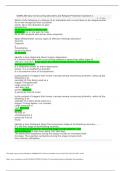
Pathophysiology Midterm - Jersey College Study
guide, Pathophysiology Midterm - Jersey College
correctly answered already passed
1. Pathophysiology the study of functional or pathologic changes in the body that result
from disease processes
2. Pathology the laboratory study of cell and tissue changes associated with disease.
3. Steps for Be a nonsmoker and avoid second-hand smoke, Eat 5-10 servings of
better health vegetables and fruit a day, Be physically active on a regular basis, Protect
yourself and your family from the sun, Follow cancer screening
guidelines, Visit your doctor or dentist is you notice any change in your
normal state of health, and Follow health and safety instructions at home
and at work
4. Primary level
of prevention Protect healthy people from developing a disease or experiencing an injury
in the first place
5. Secondary
level of Happens after an illness or serious risk factors have already been diagnose
prevention
6. Tertiary level Focuses on helping people manage complicated, long-term health
of protection problems
7. Biopsy Examination of living tissue
8. Prognosis The probability of specific outcomes
9. Etiology study of the cause of disease
10. Epidemiology The science of tracking the pattern or occurrence of disease
11. Latent Stage "silent stage" No clinical signs are evident, characterizes some diseases
12. Acute Stage Short-term that develops quickly with marked signs
1/
49
,Pathophysiology Midterm - Jersey College Study
guide, Pathophysiology Midterm - Jersey College
correctly answered already passed
13. Chronic Stage Often milder developing gradually
2/
49
,Pathophysiology Midterm - Jersey College Study
guide, Pathophysiology Midterm - Jersey College
correctly answered already passed
14. Morbidity The disease rates within a group
15. Mortality Indicate the relative number of deaths resulting from a particular disease
16. Symptoms Subjective feelings, such as pain or nausea
17. Precipitating condition that triggers an acute episode (seizure)
Fac- tor
18. Remission mark the course or progress of a disease; manifestations subside
19. Complication new, secondary or additional problems that arise after the original disease
begin
20. Apoptosis Cell death
21. Atrophy Decrease in the size of cells
22. Anaplasia cells that are unditterentiated with variable nuclear and cell structures
23. What is An area of necrotic tissue that has been invaded by bacteria.
gan-
grene?
May cause a buildup of gases with tissue and further reduce blood suppl
24. Why does
gan- grene
smell?
25. Hypertrophy Increase in the size of individual cells
26. Dysplasia cells vary in size and shape, large nuclei are frequently present
27. Signs & Symp- dehydra- tion
toms of
3/
49
,Pathophysiology Midterm - Jersey College Study
guide, Pathophysiology Midterm - Jersey College
correctly answered already passed
Dry mucous membranes, Low pulse, fatigue, Increased HCT, decreased mental function, confusion,
decreased skin turgor, Low BP, and loss of consciousness
28. 135-145 mEq/L
4/
49
guide, Pathophysiology Midterm - Jersey College
correctly answered already passed
1. Pathophysiology the study of functional or pathologic changes in the body that result
from disease processes
2. Pathology the laboratory study of cell and tissue changes associated with disease.
3. Steps for Be a nonsmoker and avoid second-hand smoke, Eat 5-10 servings of
better health vegetables and fruit a day, Be physically active on a regular basis, Protect
yourself and your family from the sun, Follow cancer screening
guidelines, Visit your doctor or dentist is you notice any change in your
normal state of health, and Follow health and safety instructions at home
and at work
4. Primary level
of prevention Protect healthy people from developing a disease or experiencing an injury
in the first place
5. Secondary
level of Happens after an illness or serious risk factors have already been diagnose
prevention
6. Tertiary level Focuses on helping people manage complicated, long-term health
of protection problems
7. Biopsy Examination of living tissue
8. Prognosis The probability of specific outcomes
9. Etiology study of the cause of disease
10. Epidemiology The science of tracking the pattern or occurrence of disease
11. Latent Stage "silent stage" No clinical signs are evident, characterizes some diseases
12. Acute Stage Short-term that develops quickly with marked signs
1/
49
,Pathophysiology Midterm - Jersey College Study
guide, Pathophysiology Midterm - Jersey College
correctly answered already passed
13. Chronic Stage Often milder developing gradually
2/
49
,Pathophysiology Midterm - Jersey College Study
guide, Pathophysiology Midterm - Jersey College
correctly answered already passed
14. Morbidity The disease rates within a group
15. Mortality Indicate the relative number of deaths resulting from a particular disease
16. Symptoms Subjective feelings, such as pain or nausea
17. Precipitating condition that triggers an acute episode (seizure)
Fac- tor
18. Remission mark the course or progress of a disease; manifestations subside
19. Complication new, secondary or additional problems that arise after the original disease
begin
20. Apoptosis Cell death
21. Atrophy Decrease in the size of cells
22. Anaplasia cells that are unditterentiated with variable nuclear and cell structures
23. What is An area of necrotic tissue that has been invaded by bacteria.
gan-
grene?
May cause a buildup of gases with tissue and further reduce blood suppl
24. Why does
gan- grene
smell?
25. Hypertrophy Increase in the size of individual cells
26. Dysplasia cells vary in size and shape, large nuclei are frequently present
27. Signs & Symp- dehydra- tion
toms of
3/
49
,Pathophysiology Midterm - Jersey College Study
guide, Pathophysiology Midterm - Jersey College
correctly answered already passed
Dry mucous membranes, Low pulse, fatigue, Increased HCT, decreased mental function, confusion,
decreased skin turgor, Low BP, and loss of consciousness
28. 135-145 mEq/L
4/
49