The chapters in this document are displayed in reversed order, with the last chapter appearing first.
This change ensures all chapters are included in the Solutions.
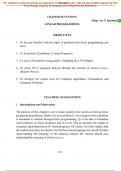
CHAPTER SEVENTEEN
Chap 1 to 17 included ✅
LINEAR PROGRAMMING
OBJECTIVES
1. To become familiar with the types of problems that linear programming can
solve.
2. To formulate LP problems. (Linear Programs)
3. To solve LP problems using graphs. (Graphing the LP Problem)
4. To relate LP to marginal analysis through the concept of shadow prices.
(Shadow Prices)
5. To interpret the output from LP computer algorithms. (Formulation and
Computer Solution)
TEACHING SUGGESTIONS
I. Introduction and Motivation
The purpose of this chapter is not to make students into experts at solving linear
programming problems. Rather it is to teach them (1) to recognize when a problem
is amenable to solution through linear programming, (2) to be able to formulate
such problems as linear programs and (3) to be able to interpret the output of
computer algorithms that solve linear programs. Of course, all of this implies that
the student must have an intuitive feel for how linear programs are solved. Besides
understanding the meaning of the optimal solution the student should also
understand the meaning of shadow prices.
17-1
,II. Teaching the “Nuts and Bolts”
The chapter is quite straightforward and therefore our comments are brief. One
pedagogical issue is how much time to spend on graphical analysis. The easiest
examples using graphical analysis involve putting the decision variables on the
axes such as in our PC example. Of course, this requires having exactly two
decision variables. Still it provides all of the intuition necessary. From here it is
possible to proceed to a discussion of more complex problems for which graphical
solutions are not possible. In other words, you may want to skip the sections
entitled “Production for Maximum Output” and “Production For Minimum
Cost” and go straight to “Computer Solutions.” Although these two examples
provide a graphical analysis for cases where there are only two constraints but
more than two decision variables, they add nothing to the explanation of larger
problems (and they may require an inordinate amount of class time to explain.) In
courses where time is at a premium they can be dropped. They are included
because these standard applications of graphical analysis are taught in many
courses.
Bonus Spreadsheet Problems
1. A manufacturer produces six products from six inputs. Each product requires
different amounts of inputs. The following table shows the profit and raw
materials requirements for each product. The last column shows the total
amounts of raw materials available.
Products
1 2 3 4 5 6
Profits 60 70 48 52 48 60 Total Amounts
Inputs required of Inputs
Aluminum .5 2 - 2 1 - 400
Steel 2 2.5 1.5 - .5 - 580
Plastic - 1.5 4 - .5 - 890
Rubber 1 - .5 1 .5 2.5 525
Glass 1 2 1.5 .4 1 2 650
Chrome .5 2 .5 2 1.5 2 620
17-2
, a. Formulate the appropriate linear program.
b. Find the company’s most profitable production plan using a spreadsheet
optimizer.
Answer
a. The LP formulation is:
maximize p = 60x1 + 70x2 + 48x3 + 52x4 + 48x5 + 60x6
subject to: .5x1 + 2x2 + 2x4 + x5 ≤ 400
2x1 + 2.5x2 + 1.5x3 + .5x5 ≤ 580
1.5x2 + 4x3 + .5x5 ≤ 890
x1 + .5x3+ x4 + .5x5 + 2.5x6 ≤ 525
x1 + 2x2 + 1.5x3+ .4x4 + x5 + 2x6 ≤ 650
.5x1 + 2x2 + .5x3+ 2x4 + 1.5x5 + 2x6 ≤ 620
b. From the spreadsheet optimizer, the optimal solution is:
x1 = 120, x2 = 0, x3 = 220, x4 = 160, x5 = 20, and x6 = 50.
2. The accompanying spreadsheet is based on Chapter 6’s example of comparative
advantage in trading digital watches and pharmaceuticals between the United
States and Japan. The costs per unit for each good (Japanese costs are expressed
in yen) are listed in row 8 and are the same as in that example. Additional
information has been provided concerning the countries’ demands for the two
goods (row 7) where demand is expressed in terms of monetary values per unit.
(Note that for the United States, each watch is more than four times as valuable
as each pill bottle. For Japan, the value ratio is two to one.)
a. The United States has $45 billion (cell E16) to spend between the goods.
Note that the default output levels of the goods (cells C9 and D9) cost only
$37.5 billion as computed in cell E17. In turn, cell E18 computes the total
value ($54 billion) of these production levels. Without the option to trade
17-3
, A B C D E F G H I J K
1
2 Trade & Comparative Advantage
3
4 United States Japan
5 Watches Drugs Watches Drugs
6
7 Value 22 5 Value 1,600 800
8 Cost 15 3.75 Cost 1,250 500
9 Output 2 2 Output 1 1
10 Consumption 2 2 Consumption 1 1
11
12 EX/IM 0 0
13 Trade Price 12.50 3.75
14 Trade Balance 0.0 0.0
15
16 Income: 45 Income: 2,500
17 Global Value Expenditure: 37.5 Expenditure: 1,750
18 78.00 Total Value: 54.0 Total Value: 2,400
19 .
with Japan, what output levels generate the maximum total value for the
United States? Does the United States specialize in a single good? Explain
why or why not.
b. Given ¥ 2,500 to spend, find Japan’s value-maximizing output levels. Does
Japan specialize in a single good? Explain.
c. Now suppose that trade is possible between the countries. Cells C13 and
D13 list the competitive trading prices for watches and drugs. (For each
good, the lowest cost per unit worldwide, whether in the United States or
Japan, sets the trading price.) Trade based on comparative advantage will
maximize global value (cell B18) computed as the sum of the national values
(cells E18 and J18) after converting yen into dollars at ¥ 100 per dollar.
Using your spreadsheet’s optimizer, find the optimal pattern of global
production and trade to maximize cell B18. Do the countries specialize
according to comparative advantage? What is the direction of trade for each
17-4
This change ensures all chapters are included in the Solutions.
CHAPTER SEVENTEEN
Chap 1 to 17 included ✅
LINEAR PROGRAMMING
OBJECTIVES
1. To become familiar with the types of problems that linear programming can
solve.
2. To formulate LP problems. (Linear Programs)
3. To solve LP problems using graphs. (Graphing the LP Problem)
4. To relate LP to marginal analysis through the concept of shadow prices.
(Shadow Prices)
5. To interpret the output from LP computer algorithms. (Formulation and
Computer Solution)
TEACHING SUGGESTIONS
I. Introduction and Motivation
The purpose of this chapter is not to make students into experts at solving linear
programming problems. Rather it is to teach them (1) to recognize when a problem
is amenable to solution through linear programming, (2) to be able to formulate
such problems as linear programs and (3) to be able to interpret the output of
computer algorithms that solve linear programs. Of course, all of this implies that
the student must have an intuitive feel for how linear programs are solved. Besides
understanding the meaning of the optimal solution the student should also
understand the meaning of shadow prices.
17-1
,II. Teaching the “Nuts and Bolts”
The chapter is quite straightforward and therefore our comments are brief. One
pedagogical issue is how much time to spend on graphical analysis. The easiest
examples using graphical analysis involve putting the decision variables on the
axes such as in our PC example. Of course, this requires having exactly two
decision variables. Still it provides all of the intuition necessary. From here it is
possible to proceed to a discussion of more complex problems for which graphical
solutions are not possible. In other words, you may want to skip the sections
entitled “Production for Maximum Output” and “Production For Minimum
Cost” and go straight to “Computer Solutions.” Although these two examples
provide a graphical analysis for cases where there are only two constraints but
more than two decision variables, they add nothing to the explanation of larger
problems (and they may require an inordinate amount of class time to explain.) In
courses where time is at a premium they can be dropped. They are included
because these standard applications of graphical analysis are taught in many
courses.
Bonus Spreadsheet Problems
1. A manufacturer produces six products from six inputs. Each product requires
different amounts of inputs. The following table shows the profit and raw
materials requirements for each product. The last column shows the total
amounts of raw materials available.
Products
1 2 3 4 5 6
Profits 60 70 48 52 48 60 Total Amounts
Inputs required of Inputs
Aluminum .5 2 - 2 1 - 400
Steel 2 2.5 1.5 - .5 - 580
Plastic - 1.5 4 - .5 - 890
Rubber 1 - .5 1 .5 2.5 525
Glass 1 2 1.5 .4 1 2 650
Chrome .5 2 .5 2 1.5 2 620
17-2
, a. Formulate the appropriate linear program.
b. Find the company’s most profitable production plan using a spreadsheet
optimizer.
Answer
a. The LP formulation is:
maximize p = 60x1 + 70x2 + 48x3 + 52x4 + 48x5 + 60x6
subject to: .5x1 + 2x2 + 2x4 + x5 ≤ 400
2x1 + 2.5x2 + 1.5x3 + .5x5 ≤ 580
1.5x2 + 4x3 + .5x5 ≤ 890
x1 + .5x3+ x4 + .5x5 + 2.5x6 ≤ 525
x1 + 2x2 + 1.5x3+ .4x4 + x5 + 2x6 ≤ 650
.5x1 + 2x2 + .5x3+ 2x4 + 1.5x5 + 2x6 ≤ 620
b. From the spreadsheet optimizer, the optimal solution is:
x1 = 120, x2 = 0, x3 = 220, x4 = 160, x5 = 20, and x6 = 50.
2. The accompanying spreadsheet is based on Chapter 6’s example of comparative
advantage in trading digital watches and pharmaceuticals between the United
States and Japan. The costs per unit for each good (Japanese costs are expressed
in yen) are listed in row 8 and are the same as in that example. Additional
information has been provided concerning the countries’ demands for the two
goods (row 7) where demand is expressed in terms of monetary values per unit.
(Note that for the United States, each watch is more than four times as valuable
as each pill bottle. For Japan, the value ratio is two to one.)
a. The United States has $45 billion (cell E16) to spend between the goods.
Note that the default output levels of the goods (cells C9 and D9) cost only
$37.5 billion as computed in cell E17. In turn, cell E18 computes the total
value ($54 billion) of these production levels. Without the option to trade
17-3
, A B C D E F G H I J K
1
2 Trade & Comparative Advantage
3
4 United States Japan
5 Watches Drugs Watches Drugs
6
7 Value 22 5 Value 1,600 800
8 Cost 15 3.75 Cost 1,250 500
9 Output 2 2 Output 1 1
10 Consumption 2 2 Consumption 1 1
11
12 EX/IM 0 0
13 Trade Price 12.50 3.75
14 Trade Balance 0.0 0.0
15
16 Income: 45 Income: 2,500
17 Global Value Expenditure: 37.5 Expenditure: 1,750
18 78.00 Total Value: 54.0 Total Value: 2,400
19 .
with Japan, what output levels generate the maximum total value for the
United States? Does the United States specialize in a single good? Explain
why or why not.
b. Given ¥ 2,500 to spend, find Japan’s value-maximizing output levels. Does
Japan specialize in a single good? Explain.
c. Now suppose that trade is possible between the countries. Cells C13 and
D13 list the competitive trading prices for watches and drugs. (For each
good, the lowest cost per unit worldwide, whether in the United States or
Japan, sets the trading price.) Trade based on comparative advantage will
maximize global value (cell B18) computed as the sum of the national values
(cells E18 and J18) after converting yen into dollars at ¥ 100 per dollar.
Using your spreadsheet’s optimizer, find the optimal pattern of global
production and trade to maximize cell B18. Do the countries specialize
according to comparative advantage? What is the direction of trade for each
17-4