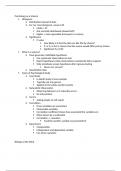
Psychology as a Science
Histogram
o Distribution/spread of data
o For our class histogram, mean is 85
Mode = 95
Not normally distributed (skewed left)
Higher = more agreeable that psych is a science
o Significance
P-value
How likely is it that the data are like this by chance?
P, in %, is the % chance that the means would differ just by chance
Significant if p<0.05
What is a science?
o Must generate a falsifiable hypothesis
Use systematic observations to test
Reject hypotheses when observations consistently fail to support
Only tentatively accept hypothesis after rigorous testing
Never use “proven”
o Quantitative data
Types of Psychological Study
o Case Study
In depth study of one example
Typically just one person
Applied to the whole world/a society
o Naturalistic Observation
Observing behavior as it naturally occurs
No intervention
o Survey
Asking people to self-report
o Correlation
If two variables are associated
Measurable variables
Correlation coefficient shows how associated the variables are
Often shown by a scatterplot
Correlation causation
Could be another variable unaccounted for
o Experiment
Manipulation
Independent and dependent variable
Can show causation
Biology of the Mind
, Neurons
o Brain cells
o ~80 billion in the brain
o ~1000 synapses per neuron
~80 trillion synapses in the brain
o Structure
Cell body
Axon
Sends messages/action potentials
Dendrite
Receives messages
o Communication
Electrochemically
Action potential
Electrical impulse that travels down axon
Prompts neurotransmitter release
Neurons come close but do not touch
Synaptic gap crossed chemically by neurotransmitter
-70mV electronegativity
Permeable membrane
Ion channels open to allow cations in
-55mV or higher causes the action potential
o Depolarization from -70mV to -55mV
o Releases neurotransmitter
Release of neurotransmitter
Pre-synaptic cells send
Post-synaptic cells receive
o Adds all of its inputs together to decide whether to fire an
action potential
Excitatory = positive
o Excited means closer to firing an action potential
Inhibitory = negative
o Inhibited means farther from firing an action potential
Brain Regions
o Brainstem
Where spinal cord swells at the skull (medulla)
Controls heartbeat and breathing
o Thalamus
Attached to top of brainstem
Sensory control center
o Reticular formation
Inside brainstem, between ears
o Cerebellum
Histogram
o Distribution/spread of data
o For our class histogram, mean is 85
Mode = 95
Not normally distributed (skewed left)
Higher = more agreeable that psych is a science
o Significance
P-value
How likely is it that the data are like this by chance?
P, in %, is the % chance that the means would differ just by chance
Significant if p<0.05
What is a science?
o Must generate a falsifiable hypothesis
Use systematic observations to test
Reject hypotheses when observations consistently fail to support
Only tentatively accept hypothesis after rigorous testing
Never use “proven”
o Quantitative data
Types of Psychological Study
o Case Study
In depth study of one example
Typically just one person
Applied to the whole world/a society
o Naturalistic Observation
Observing behavior as it naturally occurs
No intervention
o Survey
Asking people to self-report
o Correlation
If two variables are associated
Measurable variables
Correlation coefficient shows how associated the variables are
Often shown by a scatterplot
Correlation causation
Could be another variable unaccounted for
o Experiment
Manipulation
Independent and dependent variable
Can show causation
Biology of the Mind
, Neurons
o Brain cells
o ~80 billion in the brain
o ~1000 synapses per neuron
~80 trillion synapses in the brain
o Structure
Cell body
Axon
Sends messages/action potentials
Dendrite
Receives messages
o Communication
Electrochemically
Action potential
Electrical impulse that travels down axon
Prompts neurotransmitter release
Neurons come close but do not touch
Synaptic gap crossed chemically by neurotransmitter
-70mV electronegativity
Permeable membrane
Ion channels open to allow cations in
-55mV or higher causes the action potential
o Depolarization from -70mV to -55mV
o Releases neurotransmitter
Release of neurotransmitter
Pre-synaptic cells send
Post-synaptic cells receive
o Adds all of its inputs together to decide whether to fire an
action potential
Excitatory = positive
o Excited means closer to firing an action potential
Inhibitory = negative
o Inhibited means farther from firing an action potential
Brain Regions
o Brainstem
Where spinal cord swells at the skull (medulla)
Controls heartbeat and breathing
o Thalamus
Attached to top of brainstem
Sensory control center
o Reticular formation
Inside brainstem, between ears
o Cerebellum