
Introduction: Theoretical Framing & How to Search Literature (practical)
(1) Research Methods
Research Methods: the collection of tools that allow one to update beliefs through rational and
empirical means
● In social sciences, involves formulating theories that allow one to describe, explain, predict
(and often control) human behaviour (lecture 3)
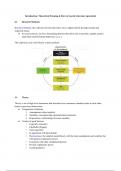
The empirical cycle: from theory to data and back
1.1 Theory
Theory: a set of high-level statements that describes how constructs/variables relate to each other
based on previous observations
● Components of theories
1. Assumptions (often implicit)
2. Variables: conceptual and operationalised constructs
3. Propositions: relationships between variables
● Criteria of good theories
○ Logically consistent
○ Falsifiable (Popper)
○ Clear (specific)
○ In agreement with data (Kuhn)
○ Parsimonious: the simplest model/theory with the least assumptions and variables but
with greatest explanatory power
○ Consistent with other established theories
○ Provide explanatory power
○ Useful/predictive
,Difference between Theory and Model
● Variables: operational definitions (in models) describe how conceptual constructs (in theory)
are manipulated and/or measured
● Propositions: theories are plausible explanatory propositions devised to link possible causes to
their effects. Generally, models are schematic representations of reality or of one's view of a
possible world, constructed to improve one's understanding about the world and/or to make
predictions
Difference between Theory and Hypotheses
● Theories describe established relationships based on existing data / previous research
→ often conceptual
● Hypotheses describe hypothesised relationships that have not yet been tested
→ operationalised
1.2 Hypotheses
In an experiment, we test hypotheses about operational definitions
● independent/explanatory variables (A)
● dependent/response variable (B)
● Mediating variable (C)
→ explains relationship between IV and DV
● Moderating variable (C)
→ changes relationship between IV and DV
1.2.1 Mediator Hypothesis: Why?
→ The effect of teacher quality on school achievement is mediated by motivation: better teacher
quality results in higher motivation, which results in higher school achievement
Mediator Analysis
Typical analysis: multiple regression
● When A exerts the same influence on B even when C is added as a predictor, this suggests the
mediator hypothesis is wrong
● When effect of A on B suffers when including C as a predictor, this suggests that C at least
partially mediates the relationship between A and B
, 1.2.2 Moderator Hypothesis: Subgroups?
A moderator is a variable that affects or modifies the relationship between x and y
→ Motivation high: intelligence correlates with school achievement
→ Motivation low: no correlation between intelligence and achievement
Moderator Analysis
Typical analysis: ANOVA/ANCOVA or multiple regression with categorical moderator
● When C interacts with A, this might suggest that C moderates the relationship between A and
B
1.3 Formulating Research Question
1. Select topic
2. Review literature
3. Formulate problem/question
4. Review literature
5. Formulate hypothesis
1.3.1 Select Topic
● Informal knowledge (your own experience)
● Formal background (previous research, existing theories, available methods)
● Is it interesting? (increases your motivation and other’s interest)
● Is it feasible? (specific population? equipment? sufficient money? sufficient time?)
(2) Literature Review
Article Selection Criteria
● Topic (fit with the selected topic/question?)
● Consider article quality and impact (eg peer reviewed)
● Identify key articles (citation classics)
● Consider article type (empirical or review/opinion)
Indicators of Quality and Impact
● Number of citations is often an indication of both quality and impact on the scientific
community
● Journal type can be an indication of quality and impact
● Note: Quality ≠ Impact
, Search
● Your primary source should be scientific (peer reviewed) articles or books
● Use search terms in scientific search engines:
‣ https://scholar.google.nl
○ ‣ https://vu.on.worldcat.org/discovery (restrict to psychology literature by selecting
PsycINFO)
● You can use advanced search to better specify your search criteria
2.1 Article Types
1. Empirical/research article
○ States research question, method, results and conclusion in the abstract
○ The main body has a typical organisation of introduction - methods - results -
conclusion
2. Review article/Opinion article
○ Reviews summarise research from many studies
‣ Typically no methods/results (unless it contains a meta-analysis)
‣ Can be very useful to obtain a quick overview of the field and/or identify
relevant references (eg Annual review of Psychology/Trends in Cognitive
Sciences etc)
○ Opinions also have a strong theoretical and/or critical reference frame and/or a clear
hypothesis (eg Behavioural and Brain Sciences)
3. Commentary
○ A comment on somebody else’s article, often outlining dissent and/or flaws in the
target article
○ Typically does not contain an abstract, and no methods/results
○ Often the original authors are allowed to respond to a commentary
4. Peer-reviewed vs non peer-reviewed article
Opinion Article Commentary Article
To present the author's personal viewpoints on a To provide an in-depth analysis or critique of
psychological theory, practice, or issue; aim to recent research, theories, or practices in
stimulate discussion or bring attention to a psychology; aim to offer a well-informed
specific perspective or concern within the field. perspective that contributes to the academic and
professional discourse.
● Can be informal or formal, depending ● Formal and scholarly, adhering to
on the publication. academic standards.
● Emphasises the author's personal ● Analytical, providing a balanced
experiences, beliefs, and interpretations. perspective supported by evidence.
● Focuses on the author's perspective on a ● Offers critical insights into recent
psychological topic, which could be developments in psychological research
based on personal experiences, clinical or practice; with existing literature,
observations, or philosophical stances. data, and expert opinions to support the
● May not always include extensive analysis; includes references to studies,
empirical evidence but can be based on theoretical frameworks, and empirical
theoretical or anecdotal evidence. evidence.
● Aims to provoke thought, discussion, or ● May address the implications, strengths,
change in the field. and weaknesses of a study or theory
(1) Research Methods
Research Methods: the collection of tools that allow one to update beliefs through rational and
empirical means
● In social sciences, involves formulating theories that allow one to describe, explain, predict
(and often control) human behaviour (lecture 3)
The empirical cycle: from theory to data and back
1.1 Theory
Theory: a set of high-level statements that describes how constructs/variables relate to each other
based on previous observations
● Components of theories
1. Assumptions (often implicit)
2. Variables: conceptual and operationalised constructs
3. Propositions: relationships between variables
● Criteria of good theories
○ Logically consistent
○ Falsifiable (Popper)
○ Clear (specific)
○ In agreement with data (Kuhn)
○ Parsimonious: the simplest model/theory with the least assumptions and variables but
with greatest explanatory power
○ Consistent with other established theories
○ Provide explanatory power
○ Useful/predictive
,Difference between Theory and Model
● Variables: operational definitions (in models) describe how conceptual constructs (in theory)
are manipulated and/or measured
● Propositions: theories are plausible explanatory propositions devised to link possible causes to
their effects. Generally, models are schematic representations of reality or of one's view of a
possible world, constructed to improve one's understanding about the world and/or to make
predictions
Difference between Theory and Hypotheses
● Theories describe established relationships based on existing data / previous research
→ often conceptual
● Hypotheses describe hypothesised relationships that have not yet been tested
→ operationalised
1.2 Hypotheses
In an experiment, we test hypotheses about operational definitions
● independent/explanatory variables (A)
● dependent/response variable (B)
● Mediating variable (C)
→ explains relationship between IV and DV
● Moderating variable (C)
→ changes relationship between IV and DV
1.2.1 Mediator Hypothesis: Why?
→ The effect of teacher quality on school achievement is mediated by motivation: better teacher
quality results in higher motivation, which results in higher school achievement
Mediator Analysis
Typical analysis: multiple regression
● When A exerts the same influence on B even when C is added as a predictor, this suggests the
mediator hypothesis is wrong
● When effect of A on B suffers when including C as a predictor, this suggests that C at least
partially mediates the relationship between A and B
, 1.2.2 Moderator Hypothesis: Subgroups?
A moderator is a variable that affects or modifies the relationship between x and y
→ Motivation high: intelligence correlates with school achievement
→ Motivation low: no correlation between intelligence and achievement
Moderator Analysis
Typical analysis: ANOVA/ANCOVA or multiple regression with categorical moderator
● When C interacts with A, this might suggest that C moderates the relationship between A and
B
1.3 Formulating Research Question
1. Select topic
2. Review literature
3. Formulate problem/question
4. Review literature
5. Formulate hypothesis
1.3.1 Select Topic
● Informal knowledge (your own experience)
● Formal background (previous research, existing theories, available methods)
● Is it interesting? (increases your motivation and other’s interest)
● Is it feasible? (specific population? equipment? sufficient money? sufficient time?)
(2) Literature Review
Article Selection Criteria
● Topic (fit with the selected topic/question?)
● Consider article quality and impact (eg peer reviewed)
● Identify key articles (citation classics)
● Consider article type (empirical or review/opinion)
Indicators of Quality and Impact
● Number of citations is often an indication of both quality and impact on the scientific
community
● Journal type can be an indication of quality and impact
● Note: Quality ≠ Impact
, Search
● Your primary source should be scientific (peer reviewed) articles or books
● Use search terms in scientific search engines:
‣ https://scholar.google.nl
○ ‣ https://vu.on.worldcat.org/discovery (restrict to psychology literature by selecting
PsycINFO)
● You can use advanced search to better specify your search criteria
2.1 Article Types
1. Empirical/research article
○ States research question, method, results and conclusion in the abstract
○ The main body has a typical organisation of introduction - methods - results -
conclusion
2. Review article/Opinion article
○ Reviews summarise research from many studies
‣ Typically no methods/results (unless it contains a meta-analysis)
‣ Can be very useful to obtain a quick overview of the field and/or identify
relevant references (eg Annual review of Psychology/Trends in Cognitive
Sciences etc)
○ Opinions also have a strong theoretical and/or critical reference frame and/or a clear
hypothesis (eg Behavioural and Brain Sciences)
3. Commentary
○ A comment on somebody else’s article, often outlining dissent and/or flaws in the
target article
○ Typically does not contain an abstract, and no methods/results
○ Often the original authors are allowed to respond to a commentary
4. Peer-reviewed vs non peer-reviewed article
Opinion Article Commentary Article
To present the author's personal viewpoints on a To provide an in-depth analysis or critique of
psychological theory, practice, or issue; aim to recent research, theories, or practices in
stimulate discussion or bring attention to a psychology; aim to offer a well-informed
specific perspective or concern within the field. perspective that contributes to the academic and
professional discourse.
● Can be informal or formal, depending ● Formal and scholarly, adhering to
on the publication. academic standards.
● Emphasises the author's personal ● Analytical, providing a balanced
experiences, beliefs, and interpretations. perspective supported by evidence.
● Focuses on the author's perspective on a ● Offers critical insights into recent
psychological topic, which could be developments in psychological research
based on personal experiences, clinical or practice; with existing literature,
observations, or philosophical stances. data, and expert opinions to support the
● May not always include extensive analysis; includes references to studies,
empirical evidence but can be based on theoretical frameworks, and empirical
theoretical or anecdotal evidence. evidence.
● Aims to provoke thought, discussion, or ● May address the implications, strengths,
change in the field. and weaknesses of a study or theory

