CHILD GROWTH AND 2025
DEVELOPMENT CGDR DCF
ANSWER ALL QUESTIONS IN THIS SECTION
QUESTION 1
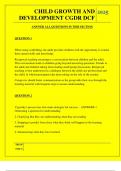
When using scaffolding, the adult provides children with the opportunity to extend
their current skills and knowledge.
Reciprocal teaching encourages a conversation between children and the adult.
This conversation leads to children going beyond answering questions. It leads to
the adult and children taking turns leading small group discussions. Reciprocal
teaching is best understood as a dialogue between the child care professional and
the child, in which participants take turns taking on the role of the teacher.
Caregivers should foster communication so the group talks their way through the
learning material with frequent stops to ensure understanding.
QUESTION 2
Vygotsky's process has four main strategies for success: - ANSWERS-1.
Generating a question for understanding
2. Clarifying that they are understanding what they are reading
3. Stopping to predict from clues what they think will happen in the learning
material
4. Summarizing what they have learned
END OF
PAGE 1
, CHILD GROWTH AND 2025
DEVELOPMENT CGDR DCF
QUESTION 3
Vygotsky's sociocultural theory of cognitive development - ANSWERS-focuses on
the connections between people and the culture in which they interact.
QUESTION 4
Maria Montessori's theory focuses - ANSWERS-Maria Montessori's theory
focuses on the child's independence in order to engage them in a developmentally
appropriate learning environment so they can advance their developmental skills.
QUESTION 5
Maria Montessori's theories: - ANSWERS-Emphasis is placed on the preparation
of the learning environment. This includes the space children use; and the
furnishings, materials, children, and adults who occupy the environment.
The learning environment should be beautiful and orderly. This allows children to
learn about order from the learning environment.
Furniture, tools, materials, and toys should be child-sized.
Children learn best by having sensory experiences.
Children should be provided with tools that work.
Materials should be organized and accessible to children. They should be allowed
to find what they need and return it when finished.
END OF
PAGE 2
, CHILD GROWTH AND 2025
DEVELOPMENT CGDR DCF
QUESTION 6
Module 3: Influences Affecting Child Growth and Development - ANSWERS-
developmental - ANSWERS-A ______ disability is a chronic condition that is
diagnosed in childhood and substantially limits major life activities in adulthood.
QUESTION 7
What should a child care professional do if they suspect a child has an undiagnosed
developmental disability? - ANSWERS-A child care professional's role in the
intervention process is to recognize the signs of the most prevalent developmental
disabilities; ensure families are aware of intervention services; and provide
individualized, compassionate, and developmentally appropriate care at the child
care program.
QUESTION 8
Prevention - ANSWERS-is a strategy that stops challenging behaviors before they
begin, and it is the primary method child care professionals use to encourage
children to discard these behaviors.
END OF
PAGE 3
DEVELOPMENT CGDR DCF
ANSWER ALL QUESTIONS IN THIS SECTION
QUESTION 1
When using scaffolding, the adult provides children with the opportunity to extend
their current skills and knowledge.
Reciprocal teaching encourages a conversation between children and the adult.
This conversation leads to children going beyond answering questions. It leads to
the adult and children taking turns leading small group discussions. Reciprocal
teaching is best understood as a dialogue between the child care professional and
the child, in which participants take turns taking on the role of the teacher.
Caregivers should foster communication so the group talks their way through the
learning material with frequent stops to ensure understanding.
QUESTION 2
Vygotsky's process has four main strategies for success: - ANSWERS-1.
Generating a question for understanding
2. Clarifying that they are understanding what they are reading
3. Stopping to predict from clues what they think will happen in the learning
material
4. Summarizing what they have learned
END OF
PAGE 1
, CHILD GROWTH AND 2025
DEVELOPMENT CGDR DCF
QUESTION 3
Vygotsky's sociocultural theory of cognitive development - ANSWERS-focuses on
the connections between people and the culture in which they interact.
QUESTION 4
Maria Montessori's theory focuses - ANSWERS-Maria Montessori's theory
focuses on the child's independence in order to engage them in a developmentally
appropriate learning environment so they can advance their developmental skills.
QUESTION 5
Maria Montessori's theories: - ANSWERS-Emphasis is placed on the preparation
of the learning environment. This includes the space children use; and the
furnishings, materials, children, and adults who occupy the environment.
The learning environment should be beautiful and orderly. This allows children to
learn about order from the learning environment.
Furniture, tools, materials, and toys should be child-sized.
Children learn best by having sensory experiences.
Children should be provided with tools that work.
Materials should be organized and accessible to children. They should be allowed
to find what they need and return it when finished.
END OF
PAGE 2
, CHILD GROWTH AND 2025
DEVELOPMENT CGDR DCF
QUESTION 6
Module 3: Influences Affecting Child Growth and Development - ANSWERS-
developmental - ANSWERS-A ______ disability is a chronic condition that is
diagnosed in childhood and substantially limits major life activities in adulthood.
QUESTION 7
What should a child care professional do if they suspect a child has an undiagnosed
developmental disability? - ANSWERS-A child care professional's role in the
intervention process is to recognize the signs of the most prevalent developmental
disabilities; ensure families are aware of intervention services; and provide
individualized, compassionate, and developmentally appropriate care at the child
care program.
QUESTION 8
Prevention - ANSWERS-is a strategy that stops challenging behaviors before they
begin, and it is the primary method child care professionals use to encourage
children to discard these behaviors.
END OF
PAGE 3