

WGU C215 Study Guide 2025 - Dr. Thomas
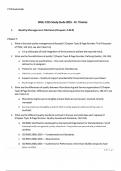
I. Quality Management Methods (Chapters 5 & 6) Chapter 5 1. What is the total quality management philosophy? (Chapter Topic & Page Number: The Philosophy of TQM, 143-154; see also Table 5.3) a. It is a philosophy of total integration of the business to achieve the required result. 2. What are the five definitions of quality? (Chapter Topic & Page Number: Defining Quality, 135-136) a. Conformance to specifications – How well a product/service meet targets and tolerances defined by its designers b. Fitness for use – Evaluates performance for intended use c. Value for price paid – Evaluation of usefulness vs. price paid d. Support services – Quality of support provided after the product/service is purchased e. Psychological criteria – Judgmental evaluation of what constitutes product/service quality 3. What are the differences of quality between Manufacturing and Service organizations? (Chapter Topic & Page Number: Differences between Manufacturing and Service Organizations, 136-137; see also Table 5.1) a. Manufacturing focuses on tangible product features (can be seen, touched, directly managed) b. Service produces intangible products that must be experienced (cannot be seen or touched): 4. What are the different quality standards outlined in the text and what does each represent? (Chapter Topic & Page Number: Quality Awards and Standards, 154-156) a. ISO 9000: Certification developed by International Organization for Standardization. Set of internationally recognized quality standards. Companies are periodically audited and certified. b. ISO 9000:2008, QMS — Fundamentals and Standards. c. ISO 9001:2008, QMS — Requirements. d. ISO 9004:2008, QMS — Guidelines for Performance. More than 40,000 companies have been certified. C215 Study Guide 2 | P a g e e. ISO 14000: Focuses on a company’s environmental responsibility. f. ISO 26000: Help organizations evaluate and address their social responsibility. 5. Who are the quality gurus and what were their contributions to the TQM concept? (Chapter Topic & Page Number: Quality Gurus, 140; see also table 5.2) C215 Study Guide 3 | P a g e a. Walter A. Shewhart – Contributed to understanding of process variability; developed concept of statistical control charts. b. W. Edwards Deming – Stressed management’s responsibility for quality; developed “14 Points” to guide companies in quality improvement. c. Joseph M. Juran – Defined quality as “fitness for use”; developed concept of cost of quality. d. Armand V. Feigenbaum – Introduced concept of total quality control. e. Philip B. Crosby – Coined phrase “quality is free”; introduced concept of zero defects. f. Kaoru Ishikawa – Developed cause-and-effect diagrams; identified concept of “internal customer.” g. Genichi Taguchi – Focused on product design quality; developed Taguchi loss function. 6. What are the seven quality control tools management uses to analyze quality problems? Make sure to highlight how each tool can be used. (Chapter Topic & Page Number: Use of Quality Tools, 146- 148) a. Cause-and-effect diagrams (Fishbone) – Focused on identifying potential causes of quality problems b. Flowcharts – Schematic diagrams used to document the detailed steps in a process c. Checklists – Designed to identify type of quality problems at each work station; per shift, per machine, per operator. d. Control charts – Control charts are used to evaluate whether a process is operating within expectations relative to some measured value such as weight, width, or volume e. Scatter diagrams – Scatter diagrams are graphs that show how two variables are related to one another f. Pareto analyses – Pareto analysis is a technique used to identify quality problems based on their degree of importance. g. Histograms – A chart that shows the frequency distribution of observed values of a variable (e.g., service time at a bank drive-up window). 7. What are the different costs of quality? (List and define). (Chapter Topic & Page Number: Cost of Quality, 138-139; see also Figure 5.1) a. Prevention costs – Costs of preparing and implementing a quality plan b. Appraisal costs – Costs of testing, evaluating, and inspecting quality c. Internal failure costs – Costs of scrap, rework, and material losses C215 Study Guide 4 | P a g e d. External failure costs – Costs of failure at customer site, including returns, repairs, and recalls 8. What is the Plan-Do-Study-Act cycle and what is it used for? (Chapter Topic & Page Number: The Plan–Do–Study–Act Cycle, 144) a. The plan–do–study–act (PDSA) cycle describes the activities a company needs to perform in order to incorporate continuous improvement in its operation b. Plan: Evaluate current process. Document current procedures, collect data, and identify problems. Develop an improvement plan, performance objectives. c. Do: Implement the plan — trial basis. d. Study: Collect data and evaluate against objectives. e. Act: Communicate the results from the trial. If successful, implement new process. 9. How does total quality management impact other functional areas of the company? (Be sure to identify each functional area, for example, Accounting). (Chapter Topic & Page Number: Total Quality Management (TQM) across the Organization, 157-158) a. Accounting, information systems b. Marketing: providing key inputs of customer information c. Finance: evaluating and monitoring financial impact d. Accounting: providing exact costing e. Engineering: translating customer requirements into specific engineering terms f. Purchasing: acquiring materials to support product development g. Human resources: hiring employees with necessary skills h. Information systems: fulfilling increased need for accessible information Chapter 6 1. What is statistical quality control (SQC)? (Chapter Topic & Page Number: What Is Statistical Quality Control, 167-168) a. The term used to describe the set of statistical tools used by quality professionals to evaluate organizational quality. 2. Explain the two causes of variation (common and assignable). (Chapter Topic & Page Number: Sources of Variation: Common and Assignable Causes, 168) C215 Study Guide 5 | P a g e a. Common, or random, causes of variation – Random causes that we cannot identify. Unavoidable and due to slight differences in processing. b. Assignable causes of variation – Causes that can be identified and corrected. a. Examples: poor employee training, worn tool, machine needing repair. 3. What do you understand by process capability? (Chapter Topic & Page Number: Process Capability, 184-185) a. The ability of a production process to meet or exceed preset specifications. 4. What is process capability index (Cpk) used for? (Chapter Topic & Page Number: Measuring Process Capability, 185) a. Cpk helps to address a possible lack of centering of the process. a. Process capability – ability of a production process to meet or exceed preset specifications b. Process capability index – index used to measure process capability 5. What is the Six sigma concept? (Chapter Topic & Page Number: Six Sigma Quality, 188-189) a. A high level of quality associated with approximately 3.4 defective parts per million. 6. List the five-step plan of Six sigma (Chapter Topic & Page Number: Six Sigma Quality, 190) a. DMAIC, which stands for Define, Measure, Analyze, Improve, and Control. 1. Define the quality problem of the process 2. Measure the current performance of the process 3. Analyze the process to identify the root causes of the quality problem 4. Improve the process by eliminating the root cause of the problem 5. Control the process to ensure the improvements continue II. Capacity Planning and Location Analysis (Chapters 3, 9 & 10) Chapter 3 1. What are the characteristics of Repetitive operations and intermittent operations? (Show how the two operational processes differ) (Chapter Topic & Page Number: Process Selection, 58-59; see also Table 3.2) a. Intermittent operations: Processes used to produce a variety of products with different processing requirements in lower volumes (such as a healthcare facility). b. Repetitive operations: Processes used to produce one or a few standardized products in high volume (such as a cafeteria or car wash). C215 Study Guide 6 | P a g e 2. Give at least one example of each of the following processes: Batch Process, Project Process, Line Process, and Continuous Process. (Chapter Topic & Page Number: The Continuum of Process Types, 59; see also figure 3.6) a. Project process: make a one-at-a-time product exactly to customer specifications b. Batch process: small quantity of product in groups or batches based on customer orders or specifications c. Line process: large volume of a standardized product d. Continuous process: very high volumes of a fully standardized product 3. What is a process flowchart and what is it used for by an organization? (Chapter Topic & Page Number: Designing Processes, 60-62) a. A process flowchart is a diagram that shows the sequential steps of a process and the decisions needed to make the process work. Within the chart/visual representation, every step is indicated by a shape. These shapes are connected by lines and arrows to show the movement and direction of the process 4. Provide the measure, formula, and definition for the process performance metrics. (Chapter Topic & Page Number: Process Performance Metrics, 63; see also Table 3:3) a. Throughput time – Average amount of time product takes to move through the system b. Process velocity – Throughput time/value-added time ( A measure of wasted time in the system) c. Productivity – Output/input (A measure of how well a company uses its resources) d. Utilization – Time a resource used/time a resource available (The proportion of time a resource is actually used) e. Efficiency – Actual output/standard output (Measure performance relative to a standard) Chapter 9 1. Describe the concept of capacity planning and provide an example on how it is utilized in any business environment such as a hospital setting. (Chapter Topic & Page Number: Capacity Planning, 294-295) a. Capacity planning is the process of establishing the output rate that can be achieved at a facility. i. Hospital Input Measure: Available beds per month C215 Study Guide 7 | P a g e ii. Hospital Output Measure - Number of patients per month 2. Explain the concepts of design capacity and effective capacity. (Chapter Topic & Page Number: Measuring Available Capacity, 296) a. Design capacity: Maximum output rate under ideal conditions. b. Effective capacity: Maximum output rate under normal (realistic) conditions; usually lower than design capacity. 3. What are the steps involved in capacity planning and location analysis? (Chapter Topic & Page Number: Making Capacity Planning Decisions, 299-300) a. Steps for making capacity planning: i. Identify capacity requirements – identify the levels of capacity needed by the company ii. Develop capacity alternatives – company needs to develop a set of alternatives that would enable it to meet future capacity needs iii. Evaluate capacity alternatives – select the one alternative that will best meet the company’s requirements b. Steps for location analysis i. Identify Dominant Location Factors – location factors that are dominant for business ii. Develop Location Alternatives – identify location alternatives that satisfy the selected factors iii. Evaluate location alternatives – identify the alternatives to make a final selection iv. 4. What are the factors involved in selecting an ideal location? (Chapter Topic & Page Number: Factors Affecting Location Decisions, 304-306) a. Proximity to sources of supply: reduce transportation costs of perishable or bulky raw materials b. Proximity to customers: high population areas, close to JIT partners c. Proximity to source of labor d. Community considerations: local wage rates, attitude toward unions, availability of special skills e. Site considerations f. Quality-of-Life Issues g. Other considerations C215 Study Guide 8 | P a g e 5. What are the decision support tools used in capacity planning? (Do not just list the tool - expound on it). (Chapter Topic & Page Number: Decision Trees, 301-302) a. Actor rating method: The procedure that can be used to evaluate multiple alternative locations based on a number of selected factors b. Load-distance model: The procedure for evaluating location alternatives based on distance. c. Center of gravity approach: The way to find other locations that may give lower load- distance score by testing the locations at the center of gravity of the target area. d. Break-even analysis: The technique used to compute the amount of goods that must be sold just to cover costs. e. Transportation method: The method relies on a specific algorithm to evaluate the cost impact of adding potential location sites to the network of existing facilities. 6. What are the decision tools used in location analysis? (Expound on each). (Chapter Topic & Page Number: Procedures for Evaluating Location Alternatives, 308-315) a. Several tools can be used to facilitate location analysis. Factor rating is a tool that helps managers evaluate qualitative factors. The load– distance model and center of gravity approach evaluate the location decision based on distance. Break-even analysis is used to evaluate location decisions based on cost values. The transportation method is an excellent tool for evaluating the cost impact of adding sites to the network of current facilities. Chapter 10 1. List and describe the four different types of facility layouts. (Chapter Topic & Page Number: Types of Layouts, 330-333) a. Intermittent operations resources are grouped based on similar processes or functions. There is no one typical product that is produced; rather, a large variety of items is produced in low volumes, each with its own unique processing needs b. Repetitive operations have resources arranged in sequence to allow for efficient production of a standardized product. Since only one product or a few highly similar products are being produced, all resources are arranged to efficiently meet production needs 2. What are the differences between process layout and product layout? (Chapter Topic & Page Number: See Table 10.1, 301) a. Product Layout is a type of layout design in which the resources needed to produce the product are arranged in one line, as per the sequence of operations. b. Process Layout refers to the type of layout design wherein the resources having homogeneous processes or functions are combined together.
Información del documento
- Subido en
- 9 de abril de 2025
- Número de páginas
- 18
- Escrito en
- 2024/2025
- Tipo
- Examen
- Contiene
- Preguntas y respuestas

