1
Assignments PHM2612
Module 13. Confounding & Effect Modification
Complete this quiz on Canvas by or before the due date listed on the calendar. Please note that
you will only have one attempt to complete the quiz; however, there is no time limit. Note that
this is NOT the document you will submit for a grade. You may use this document to answer
the questions prior to submitting your answers on Canvas. (100 points)
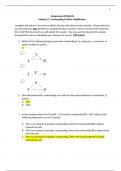
1. Which of the following images represents confounding? (e= exposure, o= outcome, v=
other variable) (2 points)
C.
2. Like information bias, confounding can result in inaccurate estimates of association. (2
points)
A. True
B. False
3. In the situation where the True RR = 0.70 and the confounded RR = 0.85, which of the
following statements is true? (2 points)
A. This is an example of positive confounding, where the confounded RR is biased
towards the null
B. This is an example of positive confounding, where the confounded RR is biased away
from the null
C. This is an example of negative confounding, where the confounded RR is biased
towards the null
, 2
D. This is an example of negative confounding, where the confounded RR is biased
away from the null
4. If an effect modifier is present, the stratum-specific ORs will be different from each
other. (2 points)
A. True
B. False
5. Confounding can be controlled only in the analysis phase of the study. (2 points)
A. True
B. False
6. According to the readings/lecture, what is considered to be one of the most important
problems in observational epidemiologic studies? (2 points)
A. Issues with external generalizability
B. Confounding
C. Interviewer bias
D. Random error
E. Effect measure modification
7. Under what type of bias is confounding classified? (2 points)
A. Selection Bias
B. Information Bias
C. Random Error
D. Systematic Error
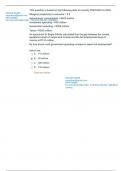
8. A research study looking at the association between head injury and hearing loss among
construction workers and office workers resulted in the following data. (2 points)
Crude OR: 0.9
- OR among those who are construction workers: 0.41
- OR among those who are office workers: 0.39
This is an example of _____
A. Confounding
B. Effect Modification
C. Selection bias
D. Unable to determine with the information provided
Assignments PHM2612
Module 13. Confounding & Effect Modification
Complete this quiz on Canvas by or before the due date listed on the calendar. Please note that
you will only have one attempt to complete the quiz; however, there is no time limit. Note that
this is NOT the document you will submit for a grade. You may use this document to answer
the questions prior to submitting your answers on Canvas. (100 points)
1. Which of the following images represents confounding? (e= exposure, o= outcome, v=
other variable) (2 points)
C.
2. Like information bias, confounding can result in inaccurate estimates of association. (2
points)
A. True
B. False
3. In the situation where the True RR = 0.70 and the confounded RR = 0.85, which of the
following statements is true? (2 points)
A. This is an example of positive confounding, where the confounded RR is biased
towards the null
B. This is an example of positive confounding, where the confounded RR is biased away
from the null
C. This is an example of negative confounding, where the confounded RR is biased
towards the null
, 2
D. This is an example of negative confounding, where the confounded RR is biased
away from the null
4. If an effect modifier is present, the stratum-specific ORs will be different from each
other. (2 points)
A. True
B. False
5. Confounding can be controlled only in the analysis phase of the study. (2 points)
A. True
B. False
6. According to the readings/lecture, what is considered to be one of the most important
problems in observational epidemiologic studies? (2 points)
A. Issues with external generalizability
B. Confounding
C. Interviewer bias
D. Random error
E. Effect measure modification
7. Under what type of bias is confounding classified? (2 points)
A. Selection Bias
B. Information Bias
C. Random Error
D. Systematic Error
8. A research study looking at the association between head injury and hearing loss among
construction workers and office workers resulted in the following data. (2 points)
Crude OR: 0.9
- OR among those who are construction workers: 0.41
- OR among those who are office workers: 0.39
This is an example of _____
A. Confounding
B. Effect Modification
C. Selection bias
D. Unable to determine with the information provided