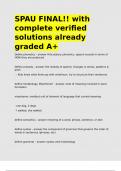
SPAU FINAL!! with
complete verified
solutions already
graded A+
Define phonetics - answer Articulatory phonetics: speech sounds in terms of
HOW they are produced
Define prosody - answer the melody of speech, changes in stress, patterns &
pitch
→ Kids know what items go with verb/noun, try to structure their sentences
define morphology. Morpheme? - answer units of meaning involved in word
formation
morpheme: smallest unit of element of language that carried meaning
- one dog, 2 dogs
- I walked, she walked
define semantics - answer meaning of a word, phrase, sentence, or text
define syntax - answer the component of grammar that governs the order of
words in sentences (phrases, etc)
define grammar - answer syntax and morphology
,Differentiate Chomsky's Universal Grammar approach - answer universal
grammar (UG) nature-inspired theories):
rules underlying structure of all languages. All basic grammar structure is the
same. Proposes that the ability to learn grammar is hard-wired into the brain.
Human minds are not simply blank slates, instead have an inherent
understanding regardless of language type. UG is a main tenet(principle) of
Chomsky's Nativist/Generativist approach to language.
Language acquisition depends on an innate, specific module that is
dedicated to language, and not other forms of learning
Language Acquisition Device (LAD):
innate human mechanism allowing for UG acquisition(learning). Language is
not a developmental phenomenon. Born with linguistic competence;
mistakes and omissions in speech are indicative of performance difficulties
and not a lack of competence (ability to do sth successfully)
Hypothetical module of the human mind posited(assume as a fact) to
account for children's innate predisposition for language acquisition. First
proposed by Chomsky in the 1960s, the LAD concept is an instinctive mental
capacity which enables an infant to acquire and produce language.
Chomsky's conclusion
+ With limited input we are able to learn grammar because we are
programmed, as humans, to do so
+ "Chomskyan revolution", very popular
→ part of the cognitive revolution away from behaviorism
+ Shift away from strong Chomskyism now
,Differentiate Skinner & behaviorist approaches - answer Skinner's "Verbal
Behavior" (1957) (Nurture) : language is learned through imitation, rewards
& punishment
→ Correct imitation is rewarded with social interactions
Dominant view was behaviorism (nurture)
→ reward & punishment for behavior, theory seeks to explain behavior in
terms of factors external to the mind
→ The environment shapes our behavior
+ Imitation, punishments & rewards
+ Focus on observable behaviors
Ex: Skinner was a scientist for behaviorism (all learning is the result of
operant conditioning) → consequences of behavior shape subsequent
behavior. Language is not a special behavior. Stimuli in the environment elicit
verbal responses, each step in the process serves to stimulate each
successive behavior
differentiate connectionist approaches - answer -a theoretical perspective
that holds that thinking consists of activating connections in a network of
interconnected nodes and of activation spreading in this network along paths
determined by the strengths of the connections among those nodes
-a network of interconnected nodes between which activation spreads to give
"cognition" or thoughts (associations and concepts)
-thought or concept = particular pattern of activation
- learning = strengthening connections between nodes (words or concepts)
+ Like statistical learning you learn through associations
, + But the end result of what language looks like is different.
→ No abstract categories (noun, verb, preposition) for grammatical rules to
apply to
differentiate nativist approaches - answer Nativism - Knowledge as Innate, as
opposed to being learned from Experience. Mind must have some preexisting
structure in order to organize and interpret experience
Describe nature/nurture debate in lang development - answer Nature =
infants arrive world pre-programmed to acquire language. Much of
knowledge is innate & genetically transmitted, rather than experience.
Language system is in place at birth
Nurture = infants learn through experiences. Empiricist theories, humans
gain all knowledge through experience "blank slate"
What is statistical learning in infancy?
Describe the experiments that showed these abilities in infants. How can it
account for abstract grammar acquisition?
Describe the experiment with infants that showed these abilities. - answer
Statistical learning:
-relating to the domain-general theory
-it suggests that language is NOT innate, and is an ability that we can learn
-counting the frequency with which one stimulus is followed by another
-it is a mechanism NOT a theory; it is what you think that they do with the
statistical learning is the theory
-learning of the co-occurrence probabilities of experienced stimuli
-one mechanism for learning the patterns in the input that could contribute
to learning language
complete verified
solutions already
graded A+
Define phonetics - answer Articulatory phonetics: speech sounds in terms of
HOW they are produced
Define prosody - answer the melody of speech, changes in stress, patterns &
pitch
→ Kids know what items go with verb/noun, try to structure their sentences
define morphology. Morpheme? - answer units of meaning involved in word
formation
morpheme: smallest unit of element of language that carried meaning
- one dog, 2 dogs
- I walked, she walked
define semantics - answer meaning of a word, phrase, sentence, or text
define syntax - answer the component of grammar that governs the order of
words in sentences (phrases, etc)
define grammar - answer syntax and morphology
,Differentiate Chomsky's Universal Grammar approach - answer universal
grammar (UG) nature-inspired theories):
rules underlying structure of all languages. All basic grammar structure is the
same. Proposes that the ability to learn grammar is hard-wired into the brain.
Human minds are not simply blank slates, instead have an inherent
understanding regardless of language type. UG is a main tenet(principle) of
Chomsky's Nativist/Generativist approach to language.
Language acquisition depends on an innate, specific module that is
dedicated to language, and not other forms of learning
Language Acquisition Device (LAD):
innate human mechanism allowing for UG acquisition(learning). Language is
not a developmental phenomenon. Born with linguistic competence;
mistakes and omissions in speech are indicative of performance difficulties
and not a lack of competence (ability to do sth successfully)
Hypothetical module of the human mind posited(assume as a fact) to
account for children's innate predisposition for language acquisition. First
proposed by Chomsky in the 1960s, the LAD concept is an instinctive mental
capacity which enables an infant to acquire and produce language.
Chomsky's conclusion
+ With limited input we are able to learn grammar because we are
programmed, as humans, to do so
+ "Chomskyan revolution", very popular
→ part of the cognitive revolution away from behaviorism
+ Shift away from strong Chomskyism now
,Differentiate Skinner & behaviorist approaches - answer Skinner's "Verbal
Behavior" (1957) (Nurture) : language is learned through imitation, rewards
& punishment
→ Correct imitation is rewarded with social interactions
Dominant view was behaviorism (nurture)
→ reward & punishment for behavior, theory seeks to explain behavior in
terms of factors external to the mind
→ The environment shapes our behavior
+ Imitation, punishments & rewards
+ Focus on observable behaviors
Ex: Skinner was a scientist for behaviorism (all learning is the result of
operant conditioning) → consequences of behavior shape subsequent
behavior. Language is not a special behavior. Stimuli in the environment elicit
verbal responses, each step in the process serves to stimulate each
successive behavior
differentiate connectionist approaches - answer -a theoretical perspective
that holds that thinking consists of activating connections in a network of
interconnected nodes and of activation spreading in this network along paths
determined by the strengths of the connections among those nodes
-a network of interconnected nodes between which activation spreads to give
"cognition" or thoughts (associations and concepts)
-thought or concept = particular pattern of activation
- learning = strengthening connections between nodes (words or concepts)
+ Like statistical learning you learn through associations
, + But the end result of what language looks like is different.
→ No abstract categories (noun, verb, preposition) for grammatical rules to
apply to
differentiate nativist approaches - answer Nativism - Knowledge as Innate, as
opposed to being learned from Experience. Mind must have some preexisting
structure in order to organize and interpret experience
Describe nature/nurture debate in lang development - answer Nature =
infants arrive world pre-programmed to acquire language. Much of
knowledge is innate & genetically transmitted, rather than experience.
Language system is in place at birth
Nurture = infants learn through experiences. Empiricist theories, humans
gain all knowledge through experience "blank slate"
What is statistical learning in infancy?
Describe the experiments that showed these abilities in infants. How can it
account for abstract grammar acquisition?
Describe the experiment with infants that showed these abilities. - answer
Statistical learning:
-relating to the domain-general theory
-it suggests that language is NOT innate, and is an ability that we can learn
-counting the frequency with which one stimulus is followed by another
-it is a mechanism NOT a theory; it is what you think that they do with the
statistical learning is the theory
-learning of the co-occurrence probabilities of experienced stimuli
-one mechanism for learning the patterns in the input that could contribute
to learning language