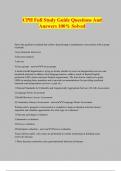
1. List the 7 most widely accepted characteristics of living organisms.
Order, Evolutionary adaptation, regulation, energy processing, growth and
development. response to the environment, reproduction
2. Describe evolutionary adaptation and give an example.
Evolutionary adaptation, often called generational evolution, specifically
refers to smaller, genetic changes that allow for better survival of an
organism. For instance, consider camouflage. Animals that are properly
camouflaged within their given environment will, theoretically, survive
longer and can thus reproduce more. Coat (such as fur) color genes with the
greatest survival rate will be strengthened and amplified within the
population. Over time, more and more animals will inherit these colors until
most of a population has the adaptive camouflage that allows for optimum
survival.
3. What is an adaptation? What characteristics of life would an adaptation fall
into?
Adaptation is a change or process that allows an organism to become better
suited for their environment. Adaptations can be physical or behavioral. For
example, a crab's hard shell is a physical adaptation, while a squirrel
hibernating through the winter is a behavioral adaption.
4. Compare and contrast sexual and asexual reproduction.
Sexual reproduction involves the fusion of two gametes (one from each
parent) that will unite and grow into a new offspring. Asexual reproduction,
in contrast, gives rise to new offspring from a single organism.
5. A group of one particular species living within defined boundaries of a
community best describes an:
Population
6. A system of living and non-living things in a region best describes an:
Ecosystem
7. What are the 3 domains that comprise the Linnaean Classification system?
Archaea, eubacteria, eukarya
8. What is the purpose of a phylogenic tree?
A phylogenic tree is a branching diagram that shows the relationship
between different levels of Linnaean classification taxa. Phylogenic trees
provide a visual representation of dichotomies concerning evolutionary
relationships and enables scientists to unite phylogeny with the classic
Linnaean classification systems. Each brand point represents where the two
organisms likely share a common ancestor.
9. True or False: Extremophile are a small sub-set of the Archaea domain that
live in extreme environments.
TRUE
10. Bacteria that neither benefits from nor harms its host and are often part of
the human flora are considered:
Commensal
11. Bacteria that cause illness are considered:
, Pathogenic or parasitic
Order, Evolutionary adaptation, regulation, energy processing, growth and
development. response to the environment, reproduction
2. Describe evolutionary adaptation and give an example.
Evolutionary adaptation, often called generational evolution, specifically
refers to smaller, genetic changes that allow for better survival of an
organism. For instance, consider camouflage. Animals that are properly
camouflaged within their given environment will, theoretically, survive
longer and can thus reproduce more. Coat (such as fur) color genes with the
greatest survival rate will be strengthened and amplified within the
population. Over time, more and more animals will inherit these colors until
most of a population has the adaptive camouflage that allows for optimum
survival.
3. What is an adaptation? What characteristics of life would an adaptation fall
into?
Adaptation is a change or process that allows an organism to become better
suited for their environment. Adaptations can be physical or behavioral. For
example, a crab's hard shell is a physical adaptation, while a squirrel
hibernating through the winter is a behavioral adaption.
4. Compare and contrast sexual and asexual reproduction.
Sexual reproduction involves the fusion of two gametes (one from each
parent) that will unite and grow into a new offspring. Asexual reproduction,
in contrast, gives rise to new offspring from a single organism.
5. A group of one particular species living within defined boundaries of a
community best describes an:
Population
6. A system of living and non-living things in a region best describes an:
Ecosystem
7. What are the 3 domains that comprise the Linnaean Classification system?
Archaea, eubacteria, eukarya
8. What is the purpose of a phylogenic tree?
A phylogenic tree is a branching diagram that shows the relationship
between different levels of Linnaean classification taxa. Phylogenic trees
provide a visual representation of dichotomies concerning evolutionary
relationships and enables scientists to unite phylogeny with the classic
Linnaean classification systems. Each brand point represents where the two
organisms likely share a common ancestor.
9. True or False: Extremophile are a small sub-set of the Archaea domain that
live in extreme environments.
TRUE
10. Bacteria that neither benefits from nor harms its host and are often part of
the human flora are considered:
Commensal
11. Bacteria that cause illness are considered:
, Pathogenic or parasitic