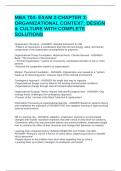
MBA 704- EXAM 2-CHAPTER 3:
ORGANIZATIONAL CONTEXT: DESIGN
& CULTURE WITH COMPLETE
SOLUTIONS
Organization Structure - ANSWER--Skeletal framework for OB
-"Pattern of interactions & coordination that links the technology, tasks, and human
components of the organization accomplishes its purposes."
Organizational Theory Foundation: Historical Roots: Chester Barnard - ANSWER--
Book: "The Functions of the Executive"
--"Formal Organization:" system of consciously coordinated activities of two or more
persons
-Stressed the cooperative aspects of organizations.
Modern Theoretical Foundation - ANSWER--Organization was viewed as a "system
made up of interacting parts;" stresses input of the external environment
Contingency Approach - ANSWER-No single best way to organize
-Organizational design must be fitted to the existing environmental conditions
-Organizations change through internal transformation/adaptation
Organizational Ecology Theory: Natural Selection/Ecological view - ANSWER--Org.
ecology theory challenges the contingency approach.
-Process of the "survival of the fittest"/selection & replacement
Information Processing & organizational learning - ANSWER-Based on systems theory
and emphasize the important of GENERATIVE over adaptive learning in rapid evolving
external environments
OB in Learning Org - ANSWER--Adaptive: employees' reacting to environmental
changes with routine, standard responses that often result in only short-run solutions.
-Generative: affect the way personnel defines and solves problems; employees taught
how to examine the effect of their decisions and change their behaviors as needed.
Learning Org's characterized by HUMAN-ORIENTED CULTURAL VALUES -
ANSWER--Everyone can be a source of useful ideas; dispensing access to valuable
info to personnel
-People closest to the problem have best ideas regarding how to solve it
-Learning flows up & down; managers & employees can benefit
, -Mistakes should be viewed as learning opportunities
Establishing a Learning Org - ANSWER--Breaking out of bureaucracies
-Develop systemic thinking among managers; identifying source of conflict and make
astute trade-offs
**Managers must learn to encourage their people to redirect energies towards
substance of disagreements rather than toward personality clashes or political
infighting.
-Develop creativity among personnel.
--Promote and help unlearn creativity: persona flexibility and willingness to take risks.
Also, willingness to accept failure!
--"Ready, fire, aim"
Horizontal Organizations - ANSWER--(Anand & Daft) Advocates the dispensing of
internal boundaries that are an impediment to effective business performance.
Learning Organization: Single Loop - ANSWER-Improving organization's capacity to
achieve known objectives
-Org is learning without significant change in its basic assumptions
Learning Organization: Double Loop - ANSWER-Reevaluates the nature of
organization's objectives and the values/beliefs surrounding them.
-Changing the organization's culture
-Org's learning "how to learn"
Adaptive Learning - ANSWER--first stage of learning organization
-adapting to environmental changes
-Adaptive Changes: Learn Six Sigma, TQM
Generative Learning - ANSWER--Creativity and innovation, going beyond just adapting
to change and being ahead of it.
-Total reframing of org's experiences and learning from that process
Three major dimensions/characteristics of learning organizations - ANSWER--Presence
of Tension: stems from the gap between org's vision & reality; suggest the learning org
continuous questions and challenges status quo.
-Systems Thinking: shared vision of employees throughout the whole org, and
openness of new ideas and external environment.
-Culture Facilitating Learning: org culture places a high value on process of learning and
goes beyond mere lip service by setting mechanisms in place for suggestions, teams,
empowerment, and empathy.
Guiding principles defining horizontal organization design - ANSWER--Organization
revolves around the process, not the task.
-The hierarchy is flattened
-Teams are used to manage everything
ORGANIZATIONAL CONTEXT: DESIGN
& CULTURE WITH COMPLETE
SOLUTIONS
Organization Structure - ANSWER--Skeletal framework for OB
-"Pattern of interactions & coordination that links the technology, tasks, and human
components of the organization accomplishes its purposes."
Organizational Theory Foundation: Historical Roots: Chester Barnard - ANSWER--
Book: "The Functions of the Executive"
--"Formal Organization:" system of consciously coordinated activities of two or more
persons
-Stressed the cooperative aspects of organizations.
Modern Theoretical Foundation - ANSWER--Organization was viewed as a "system
made up of interacting parts;" stresses input of the external environment
Contingency Approach - ANSWER-No single best way to organize
-Organizational design must be fitted to the existing environmental conditions
-Organizations change through internal transformation/adaptation
Organizational Ecology Theory: Natural Selection/Ecological view - ANSWER--Org.
ecology theory challenges the contingency approach.
-Process of the "survival of the fittest"/selection & replacement
Information Processing & organizational learning - ANSWER-Based on systems theory
and emphasize the important of GENERATIVE over adaptive learning in rapid evolving
external environments
OB in Learning Org - ANSWER--Adaptive: employees' reacting to environmental
changes with routine, standard responses that often result in only short-run solutions.
-Generative: affect the way personnel defines and solves problems; employees taught
how to examine the effect of their decisions and change their behaviors as needed.
Learning Org's characterized by HUMAN-ORIENTED CULTURAL VALUES -
ANSWER--Everyone can be a source of useful ideas; dispensing access to valuable
info to personnel
-People closest to the problem have best ideas regarding how to solve it
-Learning flows up & down; managers & employees can benefit
, -Mistakes should be viewed as learning opportunities
Establishing a Learning Org - ANSWER--Breaking out of bureaucracies
-Develop systemic thinking among managers; identifying source of conflict and make
astute trade-offs
**Managers must learn to encourage their people to redirect energies towards
substance of disagreements rather than toward personality clashes or political
infighting.
-Develop creativity among personnel.
--Promote and help unlearn creativity: persona flexibility and willingness to take risks.
Also, willingness to accept failure!
--"Ready, fire, aim"
Horizontal Organizations - ANSWER--(Anand & Daft) Advocates the dispensing of
internal boundaries that are an impediment to effective business performance.
Learning Organization: Single Loop - ANSWER-Improving organization's capacity to
achieve known objectives
-Org is learning without significant change in its basic assumptions
Learning Organization: Double Loop - ANSWER-Reevaluates the nature of
organization's objectives and the values/beliefs surrounding them.
-Changing the organization's culture
-Org's learning "how to learn"
Adaptive Learning - ANSWER--first stage of learning organization
-adapting to environmental changes
-Adaptive Changes: Learn Six Sigma, TQM
Generative Learning - ANSWER--Creativity and innovation, going beyond just adapting
to change and being ahead of it.
-Total reframing of org's experiences and learning from that process
Three major dimensions/characteristics of learning organizations - ANSWER--Presence
of Tension: stems from the gap between org's vision & reality; suggest the learning org
continuous questions and challenges status quo.
-Systems Thinking: shared vision of employees throughout the whole org, and
openness of new ideas and external environment.
-Culture Facilitating Learning: org culture places a high value on process of learning and
goes beyond mere lip service by setting mechanisms in place for suggestions, teams,
empowerment, and empathy.
Guiding principles defining horizontal organization design - ANSWER--Organization
revolves around the process, not the task.
-The hierarchy is flattened
-Teams are used to manage everything