Classical conditioning
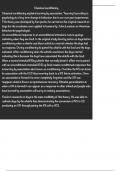
Classical conditioning explains learning by association. “learning”according to
psychology is a long term change in behaviour due to our own past experiences.
This theory was developed by Ivan pavlov, he carried out his original research on
dogs but the conclusion were applied to humans by John.b.watson an American
behaviourist psychologist.
An unconditioned response to an unconditioned stimulus is nature.eg:dogs
salivating when they see food. In the original study done by pavlov on dogs before
conditioning when a whistle was blown which is a neutral stimulus the dogs had
no response. During conditioning he paired the whistle with the food and the dogs
salivated. After conditioning when the whistle was blown the dogs started
salivating this is because the dogs have associated the whistle with the food.
When a neutral stimulus(NS)eg:whistle that normally doesn’t affect one is paired
with an unconditioned stumulus(UCS) eg:food creates conditioned responses this
is learning by association also known as conditioning. Overtime the NS can loose
its association with the UCS thus reverting back to a NS this is extinction. Once
an association is formed it is never completely forgotten and the CR can
reappear which is known as spontaneous recovery. Stimulus generalisation is
when a CR is formed it can appear as a response to other stimuli and people who
have learned by association will carry on making associations.
Pavlov’s research on dogs is the main credibility of this theory. He was able to
salivate dogs by the whistle thus demonstrating the conversion of NS to CS
producing an CR through pairing the NS with a UCS.
Classical conditioning explains learning by association. “learning”according to
psychology is a long term change in behaviour due to our own past experiences.
This theory was developed by Ivan pavlov, he carried out his original research on
dogs but the conclusion were applied to humans by John.b.watson an American
behaviourist psychologist.
An unconditioned response to an unconditioned stimulus is nature.eg:dogs
salivating when they see food. In the original study done by pavlov on dogs before
conditioning when a whistle was blown which is a neutral stimulus the dogs had
no response. During conditioning he paired the whistle with the food and the dogs
salivated. After conditioning when the whistle was blown the dogs started
salivating this is because the dogs have associated the whistle with the food.
When a neutral stimulus(NS)eg:whistle that normally doesn’t affect one is paired
with an unconditioned stumulus(UCS) eg:food creates conditioned responses this
is learning by association also known as conditioning. Overtime the NS can loose
its association with the UCS thus reverting back to a NS this is extinction. Once
an association is formed it is never completely forgotten and the CR can
reappear which is known as spontaneous recovery. Stimulus generalisation is
when a CR is formed it can appear as a response to other stimuli and people who
have learned by association will carry on making associations.
Pavlov’s research on dogs is the main credibility of this theory. He was able to
salivate dogs by the whistle thus demonstrating the conversion of NS to CS
producing an CR through pairing the NS with a UCS.