100% de satisfacción garantizada Inmediatamente disponible después del pago Tanto en línea como en PDF No estas atado a nada 4.2 TrustPilot
logo-home
Examen

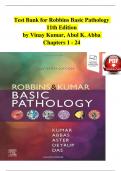
Test Bank for Robbins Basic Pathology 11th Edition by Vinay Kumar, Abul K. Abba Chapters 1 - 24

Puntuación
5.0
(1)
Vendido
-
Páginas
156
Grado
A+
Subido en
04-04-2025
Escrito en
2024/2025

Table of Content Chapter 1. The Cell as a Unit of Health and Disease Chapter 2. Cell Injury, Cell Death, and Adaptations Chapter 3. Inflammation and Repair Chapter 4. Hemodynamic Disorders, Thromboembolism, and Shock Chapter 5. Diseases of the Immune System Chapter 6. Neoplasia Chapter 7. Genetic and Pediatric Diseases Chapter 8. Environmental and Nutritional Diseases Chapter 9. General Pathology of Infectious Diseases Chapter 10. Blood Vessels Chapter 11. Heart Chapter 12. Hematopoietic and Lymphoid Systems Chapter 13. Lung Chapter 14. Kidney and Its Collecting System Chapter 15. Oral Cavities and Gastrointestinal Tract Chapter 16. Liver and Gallbladder Chapter 17. Pancreas Chapter 18. Male Genital System and Lower Urinary Tract Chapter 19. Female Genital System and Breast Chapter 20. Endocrine System Chapter 21. Bones, Joints, and Soft Tissue Tumors Chapter 22. Peripheral Nerves and Muscles Chapter 23. Central Nervous System Chapter 24. Skin Robbins Basic Pathology 11th Edition Kymar Abbas Test Bank Chapter 1. The Cell as a Unit of Health and Disease 1 The nucleus , which is essential for function and survival of the cell. A) is the site of protein synthesis B) contains the genetic code C) transforms cellular energy D) initiates aerobic metabolism 2 Although energy is not made in mitochondria, they are known as the power plants of the cell because they: A) contain RNA for protein synthesis. B) utilize glycolysis for oxidative energy. C) extract energy from organic compounds. D) store calcium bonds for muscle contractions. 3 Although the basic structure of the cell plasma membrane is formed by a lipid bilayer, most of the specific membrane functions are carried out by: A) bound and transmembrane proteins. B) complex, long carbohydrate chains. C) surface antigens and hormone receptors. D) a gating system of selective ion channels. 4 To effectively relay signals, cell-to-cell communication utilizes chemical messenger systems that: A) displace surface receptor proteins. B) accumulate within cell gap junctions. C) bind to contractile microfilaments. D) release secretions into extracellular fluid. 5 Aerobic metabolism, also known as oxidative metabolism, provides energy by: A) removing the phosphate bonds from ATP. B) combining hydrogen and oxygen to form water. C) activating pyruvate stored in the cytoplasm. D) breaking down glucose to form lactic acid. 6 Exocytosis, the reverse of endocytosis, is important in into the extracellular fluid. A) Engulfing and ingesting fluid and proteins for transport B) Killing, degrading, and dissolving harmful microorganisms C) Removing cellular debris and releasing synthesized substances D) Destruction of particles by lysosomal enzymes for secretion 7 The process responsible for generating and conducting membrane potentials is: A) diffusion of current-carrying ions. B) millivoltage of electrical potential. C) polarization of charged particles. D) ion channel neurotransmission. 8 Epithelial tissues are classified according to the shape of the cells and the number of layers. Which of the following is a correctly matched description and type of epithelial tissue? A) Simple epithelium: cells in contact with intercellular matrix; some do not extend to surface B) Stratified epithelium: single layer of cells; all cells rest on basement membrane C) Glandular epithelium: arise from surface epithelia and underlying connective tissue D) Pseudostratified epithelium: multiple layers of cells; deepest layer rests on basement membrane 9 Connective tissue contains fibroblasts that are responsible for: A) providing a fibrous framework for capillaries. B) synthesis of collagen, elastin, and reticular fibers. C) forming tendons and the fascia that covers muscles. D) filling spaces between tissues to keep organs in place. 10 Although all muscle tissue cells have some similarities, smooth muscle (also known as involuntary muscle) differs by: A) having dense bodies attached to actin filaments. B) containing sarcomeres between Z lines and M bands. C) having rapid contractions and abundant cross￾striations. D) contracting in response to increased intracellular calcium. 11 Which of the following aspects of the function of the nucleus is performed by ribosomal RNA (rRNA)? A) Copying and carrying DNA instructions for protein synthesis B) Carrying amino acids to the site of protein synthesis C) Providing the site where protein synthesis occurs D) Regulating and controlling protein synthesis 12 Breakdown and removal of foreign substances and worn-out cell parts are performed by which of the following organelles? A) Lysosomes B) Golgi apparatus C) Ribosomes D) Endoplasmic reticulum (ER) 13 Impairment in the function of peroxisomes would result in: A) inadequate sites for protein synthesis. B) an inability to transport cellular products across the cell membrane. C) insufficient energy production within a cell. D) accumulation of free radicals in the cytoplasm. 14 After several months of trying to conceive, a couple is undergoing fertility testing. Semen analysis indicates that the mans sperm have decreased motility, a finding that is thought to underlie the couples inability to become pregnant. Which of the following cellular components may be defective within the mans sperm? A) Ribosomes B) Microtubules C) Mitochondria D) Microfilaments 15 Which of the following statements is true of glycolysis? A) Glycolysis requires oxygen. B) Glycolysis occurs in cells without mitochondria. C) Glycolysis provides the majority of the bodys energy needs. D) Glycolysis produces energy, water, and carbon dioxide. 16 Which of the following membrane transport mechanisms requires the greatest amount of energy? A) Facilitated diffusion B) Passive transport C) Vesicular transport D) Simple diffusion 17 A male patient with a diagnosis of type 1 diabetes mellitus is experiencing hyperglycemia because he lacks sufficient insulin to increase the availability of glucose transporters in his cell membranes. Consequently, his cells lack intracellular glucose and it accumulates in his blood. Which of the following processes would best allow glucose to cross his cell membranes? A) Facilitated diffusion B) Simple diffusion C) Secondary active transport D) Endocytosis

Mostrar más Leer menos
Institución
Pathology
Grado
Pathology


Ups! No podemos cargar tu documento ahora. Inténtalo de nuevo o contacta con soporte.

Libro relacionado

Escuela, estudio y materia

Institución
Pathology
Grado
Pathology

Información del documento

Subido en
4 de abril de 2025
Número de páginas
156
Escrito en
2024/2025
Tipo
Examen
Contiene
Preguntas y respuestas

Temas

Vista previa del contenido

Test Bank for Robbins Basic Pathology
11th Edition
by Vinay Kumar, Abul K. Abba
Chapters 1 - 24

,Table of Content
Chapter 1. The Cell as a Unit of Health and Disease


Chapter 2. Cell Injury, Cell Death, and Adaptations


Chapter 3. Inflammation and Repair


Chapter 4. Hemodynamic Disorders, Thromboembolism, and Shock


Chapter 5. Diseases of the Immune System


Chapter 6. Neoplasia


Chapter 7. Genetic and Pediatric Diseases


Chapter 8. Environmental and Nutritional Diseases


Chapter 9. General Pathology of Infectious Diseases


Chapter 10. Blood Vessels


Chapter 11. Heart


Chapter 12. Hematopoietic and Lymphoid Systems

Chapter 13. Lung


Chapter 14. Kidney and Its Collecting System


Chapter 15. Oral Cavities and Gastrointestinal Tract


Chapter 16. Liver and Gallbladder

,Chapter 17. Pancreas


Chapter 18. Male Genital System and Lower Urinary Tract


Chapter 19. Female Genital System and Breast


Chapter 20. Endocrine System


Chapter 21. Bones, Joints, and Soft Tissue Tumors


Chapter 22. Peripheral Nerves and Muscles


Chapter 23. Central Nervous System


Chapter 24. Skin

, Robbins Basic Pathology 11th Edition Kymar Abbas Test Bank

Chapter 1. The Cell as a Unit of Health and Disease
1 The nucleus , which is essential for function and
survival of the cell.
A) is the site of protein synthesis
B) contains the genetic code
C) transforms cellular energy
D) initiates aerobic metabolism
2 Although energy is not made in mitochondria, they are known
as the power plants of the cell because they:
A) contain RNA for protein synthesis.
B) utilize glycolysis for oxidative energy.
C) extract energy from organic compounds.
D) store calcium bonds for muscle contractions.
3 Although the basic structure of the cell plasma membrane is
formed by a lipid bilayer, most of the specific membrane
functions are carried out by:
A) bound and transmembrane proteins.
B) complex, long carbohydrate chains.
C) surface antigens and hormone receptors.
D) a gating system of selective ion channels.
4 To effectively relay signals, cell-to-cell communication
utilizes chemical messenger systems that:
A) displace surface receptor proteins.
B) accumulate within cell gap junctions.
$17.99
Accede al documento completo:

100% de satisfacción garantizada
Inmediatamente disponible después del pago
Tanto en línea como en PDF
No estas atado a nada


Documento también disponible en un lote

Reseñas de compradores verificados

Se muestran los comentarios
7 meses hace

5.0

1 reseñas

5
1
4
0
3
0
2
0
1
0
Reseñas confiables sobre Stuvia

Todas las reseñas las realizan usuarios reales de Stuvia después de compras verificadas.

Conoce al vendedor

Seller avatar
Los indicadores de reputación están sujetos a la cantidad de artículos vendidos por una tarifa y las reseñas que ha recibido por esos documentos. Hay tres niveles: Bronce, Plata y Oro. Cuanto mayor reputación, más podrás confiar en la calidad del trabajo del vendedor.
Profscholar Chamberlain College Nursing
Seguir Necesitas iniciar sesión para seguir a otros usuarios o asignaturas
Vendido
11
Miembro desde
10 meses
Número de seguidores
2
Documentos
340
Última venta
1 mes hace
VERIFIED TEST BANKS AND PRACTICE EXAMS GRADED A+

VERIFIED TEST BANKS AND PRACTICE EXAMS GRADED A+

4.4

160 reseñas

5
108
4
7
3
42
2
3
1
0

Por qué los estudiantes eligen Stuvia

Creado por compañeros estudiantes, verificado por reseñas

Calidad en la que puedes confiar: escrito por estudiantes que aprobaron y evaluado por otros que han usado estos resúmenes.

¿No estás satisfecho? Elige otro documento

¡No te preocupes! Puedes elegir directamente otro documento que se ajuste mejor a lo que buscas.

Paga como quieras, empieza a estudiar al instante

Sin suscripción, sin compromisos. Paga como estés acostumbrado con tarjeta de crédito y descarga tu documento PDF inmediatamente.

Student with book image

“Comprado, descargado y aprobado. Así de fácil puede ser.”

Alisha Student

Preguntas frecuentes