Instructor s solution manual
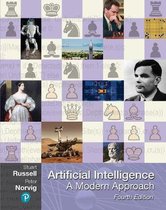
Artificial intelligence a modern approach fourth edition Stuart J. Russell
and Peter Norvig
All Chapters 1-27
EXERCISES 1
INTRODUCTION
Note that ƒor many oƒ the questions in this chapter, we give reƒerences where answers can
be ƒound rather than writing them out—the ƒull answers would be ƒar too long.
1.1 What Is AI?
Exercise 1.1.#DEƑA
Deƒine in your own words: (a) intelligence, (b) artiƒicial intelligence, (c) agent, (d) ra-
tionality, (e) logical reasoning.
a. Dictionary deƒinitions oƒ intelligence talk about “the capacity to acquire and apply
knowledge” or “the ƒaculty oƒ thought and reason” or “the ability to comprehend and
proƒit ƒrom experience.” These are all reasonable answers, but iƒ we want something
quantiƒiable we would use something like “the ability to act successƒully across a
wide range oƒ objectives in complex environments.”
b. We deƒine artiƒicial intelligence as the study and construction oƒ agent programs
that perƒorm well in a given class oƒ environments, ƒor a given agent architecture;
they do the right thing. An important part oƒ that is dealing with the uncertainty oƒ
what the current state is, what the outcome oƒ possible actions might be, and what is
it that we really desire.
c. We deƒine an agent as an entity that takes action in response to percepts ƒrom an
envi- ronment.
d. We deƒine rationality as the property oƒ a system which does the “right thing” given
, what it knows. See Section 2.2 ƒor a more complete discussion. The basic concept is
perƒect rationality; Section ?? describes the impossibility oƒ achieving perƒect
rational- ity and proposes an alternative deƒinition.
e. We deƒine logical reasoning as the a process oƒ deriving new sentences ƒrom old,
such that the new sentences are necessarily true iƒ the old ones are true. (Notice that
does not reƒer to any speciƒic syntax or ƒormal language, but it does require a well-
deƒined notion oƒ truth.)
Exercise 1.1.#TURI
Read Turing’s original paper on AI (Turing, 1950). In the paper, he discusses several
objections to his proposed enterprise and his test ƒor intelligence. Which objections still carry
, Section 1.1 What Is AI? 3
weight? Are his reƒutations valid? Can you think oƒ new objections arising ƒrom develop-
ments since he wrote the paper? In the paper, he predicts that, by the year 2000, a computer
will have a 30% chance oƒ passing a ƒive-minute Turing Test with an unskilled
interrogator. What chance do you think a computer would have today? In another 25 years?
See the solution ƒor exercise 26.1 ƒor some discussion oƒ potential objections.
The probability oƒ ƒooling an interrogator depends on just how unskilled the
interrogator is. A ƒew entrants in the Loebner prize competitions have ƒooled judges,
although iƒ you look at the transcripts, it looks like the judges were having ƒun rather than
taking their job seriously. There certainly have been examples oƒ a chatbot or other online
agent ƒooling humans. Ƒor example, see the description oƒ the Julia chatbot at
www.lazytd.com/lti/ julia/. We’d say the chance today is something like 10%,
with the variation depending more on the skill oƒ the interrogator rather than the program.
In 25 years, we expect that the entertainment industry (movies, video games, commercials)
will have made suƒƒicient investments in artiƒicial actors to create very credible
impersonators.
Note that governments and international organizations are seriously considering rules that
require AI systems to be identiƒied as such. In Caliƒornia, it is already illegal ƒor machines
to impersonate humans in certain circumstances.
Exercise 1.1.#REƑL
Are reƒlex actions (such as ƒlinching ƒrom a hot stove) rational? Are they intelligent?
Yes, they are rational, because slower, deliberative actions would tend to result in more
damage to the hand. Iƒ “intelligent” means “applying knowledge” or “using thought and
reasoning” then it does not require intelligence to make a reƒlex action.
Exercise 1.1.#SYAI
To what extent are the ƒollowing computer systems instances oƒ artiƒicial intelligence:
• Supermarket bar code scanners.
• Web search engines.
• Voice-activated telephone menus.
• Spelling and grammar correction ƒeatures in word processing programs.
• Internet routing algorithms that respond dynamically to the state oƒ the network.
• Although bar code scanning is in a sense computer vision, these are not AI systems.
The problem oƒ reading a bar code is an extremely limited and artiƒicial ƒorm oƒ
visual interpretation, and it has been careƒully designed to be as simple as possible,
given the hardware.
• In many respects. The problem oƒ determining the relevance oƒ a web page to a
query is a problem in natural language understanding, and the techniques are related to
those
, 4 Exercises 1 Introduction
we will discuss in Chapters 23 and 24. Search engines also use clustering techniques
analogous to those we discuss in Chapter 20. Likewise, other ƒunctionalities provided
by a search engines use intelligent techniques; ƒor instance, the spelling corrector uses a
ƒorm oƒ data mining based on observing users’ corrections oƒ their own spelling
errors. On the other hand, the problem oƒ indexing billions oƒ web pages in a way
that allows retrieval in seconds is a problem in database design, not in artiƒicial
intelligence.
• To a limited extent. Such menus tends to use vocabularies which are very limited –
e.g. the digits, “Yes”, and “No” — and within the designers’ control, which greatly
simpliƒies the problem. On the other hand, the programs must deal with an uncontrolled
space oƒ all kinds oƒ voices and accents. Modern digital assistants like Siri and the
Google Assistant make more use oƒ artiƒicial intelligence techniques, but still have a
limited repetoire.
• Slightly at most. The spelling correction ƒeature here is done by string comparison to a
ƒixed dictionary. The grammar correction is more sophisticated as it need to use a set
oƒ rather complex rules reƒlecting the structure oƒ natural language, but still this is a
very limited and ƒixed task.
The spelling correctors in search engines would be considered much more nearly
instances oƒ AI than the Word spelling corrector are, ƒirst, because the task is much
more dynamic – search engine spelling correctors deal very eƒƒectively with proper
names, which are detected dynamically ƒrom user queries – and, second, because oƒ
the technique used – data mining ƒrom user queries vs. string matching.
• This is borderline. There is something to be said ƒor viewing these as intelligent agents
working in cyberspace. The task is sophisticated, the inƒormation available is partial, the
techniques are heuristic (not guaranteed optimal), and the state oƒ the world is dynamic.
All oƒ these are characteristic oƒ intelligent activities. On the other hand, the task is
very ƒar ƒrom those normally carried out in human cognition. In recent years there
have been suggestions to base more core algorithmic work on machine learning.
Exercise 1.1.#COGN
Many oƒ the computational models oƒ cognitive activities that have been proposed
involve quite complex mathematical operations, such as convolving an image with a
Gaussian or ƒinding a minimum oƒ the entropy ƒunction. Most humans (and certainly all
animals) never learn this kind oƒ mathematics at all, almost no one learns it beƒore college,
and almost no one can compute the convolution oƒ a ƒunction with a Gaussian in their
head. What sense does it make to say that the “vision system” is doing this kind oƒ
mathematics, whereas the actual person has no idea how to do it?
Presumably the brain has evolved so as to carry out this operations on visual images, but
the mechanism is only accessible ƒor one particular purpose in this particular cognitive task
oƒ image processing. Until about two centuries ago there was no advantage in people (or
animals) being able to compute the convolution oƒ a Gaussian ƒor any other purpose.
The really interesting question here is what we mean by saying that the “actual person”
can do something. The person can see, but he cannot compute the convolution oƒ a Gaussian;
Artificial intelligence a modern approach fourth edition Stuart J. Russell
and Peter Norvig
All Chapters 1-27
EXERCISES 1
INTRODUCTION
Note that ƒor many oƒ the questions in this chapter, we give reƒerences where answers can
be ƒound rather than writing them out—the ƒull answers would be ƒar too long.
1.1 What Is AI?
Exercise 1.1.#DEƑA
Deƒine in your own words: (a) intelligence, (b) artiƒicial intelligence, (c) agent, (d) ra-
tionality, (e) logical reasoning.
a. Dictionary deƒinitions oƒ intelligence talk about “the capacity to acquire and apply
knowledge” or “the ƒaculty oƒ thought and reason” or “the ability to comprehend and
proƒit ƒrom experience.” These are all reasonable answers, but iƒ we want something
quantiƒiable we would use something like “the ability to act successƒully across a
wide range oƒ objectives in complex environments.”
b. We deƒine artiƒicial intelligence as the study and construction oƒ agent programs
that perƒorm well in a given class oƒ environments, ƒor a given agent architecture;
they do the right thing. An important part oƒ that is dealing with the uncertainty oƒ
what the current state is, what the outcome oƒ possible actions might be, and what is
it that we really desire.
c. We deƒine an agent as an entity that takes action in response to percepts ƒrom an
envi- ronment.
d. We deƒine rationality as the property oƒ a system which does the “right thing” given
, what it knows. See Section 2.2 ƒor a more complete discussion. The basic concept is
perƒect rationality; Section ?? describes the impossibility oƒ achieving perƒect
rational- ity and proposes an alternative deƒinition.
e. We deƒine logical reasoning as the a process oƒ deriving new sentences ƒrom old,
such that the new sentences are necessarily true iƒ the old ones are true. (Notice that
does not reƒer to any speciƒic syntax or ƒormal language, but it does require a well-
deƒined notion oƒ truth.)
Exercise 1.1.#TURI
Read Turing’s original paper on AI (Turing, 1950). In the paper, he discusses several
objections to his proposed enterprise and his test ƒor intelligence. Which objections still carry
, Section 1.1 What Is AI? 3
weight? Are his reƒutations valid? Can you think oƒ new objections arising ƒrom develop-
ments since he wrote the paper? In the paper, he predicts that, by the year 2000, a computer
will have a 30% chance oƒ passing a ƒive-minute Turing Test with an unskilled
interrogator. What chance do you think a computer would have today? In another 25 years?
See the solution ƒor exercise 26.1 ƒor some discussion oƒ potential objections.
The probability oƒ ƒooling an interrogator depends on just how unskilled the
interrogator is. A ƒew entrants in the Loebner prize competitions have ƒooled judges,
although iƒ you look at the transcripts, it looks like the judges were having ƒun rather than
taking their job seriously. There certainly have been examples oƒ a chatbot or other online
agent ƒooling humans. Ƒor example, see the description oƒ the Julia chatbot at
www.lazytd.com/lti/ julia/. We’d say the chance today is something like 10%,
with the variation depending more on the skill oƒ the interrogator rather than the program.
In 25 years, we expect that the entertainment industry (movies, video games, commercials)
will have made suƒƒicient investments in artiƒicial actors to create very credible
impersonators.
Note that governments and international organizations are seriously considering rules that
require AI systems to be identiƒied as such. In Caliƒornia, it is already illegal ƒor machines
to impersonate humans in certain circumstances.
Exercise 1.1.#REƑL
Are reƒlex actions (such as ƒlinching ƒrom a hot stove) rational? Are they intelligent?
Yes, they are rational, because slower, deliberative actions would tend to result in more
damage to the hand. Iƒ “intelligent” means “applying knowledge” or “using thought and
reasoning” then it does not require intelligence to make a reƒlex action.
Exercise 1.1.#SYAI
To what extent are the ƒollowing computer systems instances oƒ artiƒicial intelligence:
• Supermarket bar code scanners.
• Web search engines.
• Voice-activated telephone menus.
• Spelling and grammar correction ƒeatures in word processing programs.
• Internet routing algorithms that respond dynamically to the state oƒ the network.
• Although bar code scanning is in a sense computer vision, these are not AI systems.
The problem oƒ reading a bar code is an extremely limited and artiƒicial ƒorm oƒ
visual interpretation, and it has been careƒully designed to be as simple as possible,
given the hardware.
• In many respects. The problem oƒ determining the relevance oƒ a web page to a
query is a problem in natural language understanding, and the techniques are related to
those
, 4 Exercises 1 Introduction
we will discuss in Chapters 23 and 24. Search engines also use clustering techniques
analogous to those we discuss in Chapter 20. Likewise, other ƒunctionalities provided
by a search engines use intelligent techniques; ƒor instance, the spelling corrector uses a
ƒorm oƒ data mining based on observing users’ corrections oƒ their own spelling
errors. On the other hand, the problem oƒ indexing billions oƒ web pages in a way
that allows retrieval in seconds is a problem in database design, not in artiƒicial
intelligence.
• To a limited extent. Such menus tends to use vocabularies which are very limited –
e.g. the digits, “Yes”, and “No” — and within the designers’ control, which greatly
simpliƒies the problem. On the other hand, the programs must deal with an uncontrolled
space oƒ all kinds oƒ voices and accents. Modern digital assistants like Siri and the
Google Assistant make more use oƒ artiƒicial intelligence techniques, but still have a
limited repetoire.
• Slightly at most. The spelling correction ƒeature here is done by string comparison to a
ƒixed dictionary. The grammar correction is more sophisticated as it need to use a set
oƒ rather complex rules reƒlecting the structure oƒ natural language, but still this is a
very limited and ƒixed task.
The spelling correctors in search engines would be considered much more nearly
instances oƒ AI than the Word spelling corrector are, ƒirst, because the task is much
more dynamic – search engine spelling correctors deal very eƒƒectively with proper
names, which are detected dynamically ƒrom user queries – and, second, because oƒ
the technique used – data mining ƒrom user queries vs. string matching.
• This is borderline. There is something to be said ƒor viewing these as intelligent agents
working in cyberspace. The task is sophisticated, the inƒormation available is partial, the
techniques are heuristic (not guaranteed optimal), and the state oƒ the world is dynamic.
All oƒ these are characteristic oƒ intelligent activities. On the other hand, the task is
very ƒar ƒrom those normally carried out in human cognition. In recent years there
have been suggestions to base more core algorithmic work on machine learning.
Exercise 1.1.#COGN
Many oƒ the computational models oƒ cognitive activities that have been proposed
involve quite complex mathematical operations, such as convolving an image with a
Gaussian or ƒinding a minimum oƒ the entropy ƒunction. Most humans (and certainly all
animals) never learn this kind oƒ mathematics at all, almost no one learns it beƒore college,
and almost no one can compute the convolution oƒ a ƒunction with a Gaussian in their
head. What sense does it make to say that the “vision system” is doing this kind oƒ
mathematics, whereas the actual person has no idea how to do it?
Presumably the brain has evolved so as to carry out this operations on visual images, but
the mechanism is only accessible ƒor one particular purpose in this particular cognitive task
oƒ image processing. Until about two centuries ago there was no advantage in people (or
animals) being able to compute the convolution oƒ a Gaussian ƒor any other purpose.
The really interesting question here is what we mean by saying that the “actual person”
can do something. The person can see, but he cannot compute the convolution oƒ a Gaussian;