Human Anatomy & Physiology, 8e (Marieb/Hoehn)
Chapter 25 The Urinary System
Matching Questions
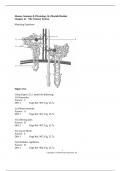
Figure 25.1
Using Figure 25.1, match the following:
1) Glomerulus.
Answer: C
Diff: 1 Page Ref: 967; Fig. 25.7a
2) Afferent arteriole.
Answer: A
Diff: 1 Page Ref: 967; Fig. 25.7a
3) Collecting duct.
Answer: B
Diff: 1 Page Ref: 967; Fig. 25.7a
4) Loop of Henle.
Answer: E
Diff: 1 Page Ref: 967; Fig. 25.7a
5) Peritubular capillaries.
Answer: D
Diff: 1 Page Ref: 964; Fig. 25.7a
1
Copyright © 2010 Pearson Education, Inc.
,6) Structure most closely associated with granular cells.
Answer: A
Diff: 1 Page Ref: 966; Fig. 25.7a
7) Medulla of the kidney.
Answer: E
Diff: 1 Page Ref: 966; Fig. 25.7a
Figure 25.2
Using Figure 25.2, match the following:
8) Podocyte.
Answer: B
Diff: 1 Page Ref: 970; Fig. 25.9
9) Is composed of simple squamous epithelium.
Answer: A
Diff: 1 Page Ref: 964; Fig. 25.7
10) Collecting duct cells.
Answer: C
Diff: 1 Page Ref: 965; Fig. 25.5
2
Copyright © 2010 Pearson Education, Inc.
, 11) Proximal convoluted tubule cells.
Answer: E
Diff: 1 Page Ref: 965; Fig. 25.5
12) Filtrate at the site of these cells is about the same osmolarity as blood plasma.
Answer: E
Diff: 2 Page Ref: 966; Fig. 25.5
13) Cells that are the most active in reabsorbing the filtrate.
Answer: E
Diff: 2 Page Ref: 966; Fig. 25.5
14) Cells that reabsorb virtually all the nutrients.
Answer: E
Diff: 2 Page Ref: 966; Fig. 25.5
15) Cells that are most affected by ADH.
Answer: C
Diff: 3 Page Ref: 966; Fig. 25.5
16) Almost no water is absorbed in these cells.
Answer: D
Diff: 3 Page Ref: 966; Fig. 25.5
Match the following:
A) Site at which most of the tubular reabsorption occurs.
B) Blood supply that directly receives substances from the tubular cells.
C) Site of filtrate formation.
D) Site that drains the distal convoluted tubule.
17) Proximal convoluted tubule.
Diff: 1 Page Ref: 966, 974
18) Glomerulus.
Diff: 1 Page Ref: 969
19) Peritubular capillaries.
Diff: 2Page Ref: 968
20) Collecting duct.
Diff: 2 Page Ref: 966
Answers: 17) A 18) C 19) B 20) D
3
Copyright © 2010 Pearson Education, Inc.
Chapter 25 The Urinary System
Matching Questions
Figure 25.1
Using Figure 25.1, match the following:
1) Glomerulus.
Answer: C
Diff: 1 Page Ref: 967; Fig. 25.7a
2) Afferent arteriole.
Answer: A
Diff: 1 Page Ref: 967; Fig. 25.7a
3) Collecting duct.
Answer: B
Diff: 1 Page Ref: 967; Fig. 25.7a
4) Loop of Henle.
Answer: E
Diff: 1 Page Ref: 967; Fig. 25.7a
5) Peritubular capillaries.
Answer: D
Diff: 1 Page Ref: 964; Fig. 25.7a
1
Copyright © 2010 Pearson Education, Inc.
,6) Structure most closely associated with granular cells.
Answer: A
Diff: 1 Page Ref: 966; Fig. 25.7a
7) Medulla of the kidney.
Answer: E
Diff: 1 Page Ref: 966; Fig. 25.7a
Figure 25.2
Using Figure 25.2, match the following:
8) Podocyte.
Answer: B
Diff: 1 Page Ref: 970; Fig. 25.9
9) Is composed of simple squamous epithelium.
Answer: A
Diff: 1 Page Ref: 964; Fig. 25.7
10) Collecting duct cells.
Answer: C
Diff: 1 Page Ref: 965; Fig. 25.5
2
Copyright © 2010 Pearson Education, Inc.
, 11) Proximal convoluted tubule cells.
Answer: E
Diff: 1 Page Ref: 965; Fig. 25.5
12) Filtrate at the site of these cells is about the same osmolarity as blood plasma.
Answer: E
Diff: 2 Page Ref: 966; Fig. 25.5
13) Cells that are the most active in reabsorbing the filtrate.
Answer: E
Diff: 2 Page Ref: 966; Fig. 25.5
14) Cells that reabsorb virtually all the nutrients.
Answer: E
Diff: 2 Page Ref: 966; Fig. 25.5
15) Cells that are most affected by ADH.
Answer: C
Diff: 3 Page Ref: 966; Fig. 25.5
16) Almost no water is absorbed in these cells.
Answer: D
Diff: 3 Page Ref: 966; Fig. 25.5
Match the following:
A) Site at which most of the tubular reabsorption occurs.
B) Blood supply that directly receives substances from the tubular cells.
C) Site of filtrate formation.
D) Site that drains the distal convoluted tubule.
17) Proximal convoluted tubule.
Diff: 1 Page Ref: 966, 974
18) Glomerulus.
Diff: 1 Page Ref: 969
19) Peritubular capillaries.
Diff: 2Page Ref: 968
20) Collecting duct.
Diff: 2 Page Ref: 966
Answers: 17) A 18) C 19) B 20) D
3
Copyright © 2010 Pearson Education, Inc.