Lecture Notes: Chapter 4 – Elasticity
Based on Microeconomics: Canada in the Global Environment, 11th Edition
Introduction
Elasticity is a fundamental concept in economics that measures responsiveness—how much
quantity demanded or supplied responds to changes in various economic variables like price,
income, or the price of related goods. Understanding elasticity helps us predict the impact of
policy decisions, market changes, and pricing strategies. This chapter focuses on three main
types: price elasticity of demand, income elasticity of demand, cross-price elasticity of
demand, and elasticity of supply. We’ll explore their definitions, calculations, and the key
factors that influence them—along with graph descriptions and real-world examples for clarity.
1. Price Elasticity of Demand
Definition
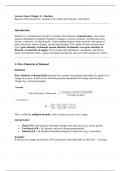
Price elasticity of demand (Ed) measures how sensitive the quantity demanded of a good is to a
change in its price. It tells us how much the quantity demanded will change when the price
changes by a certain percentage.
This is called the midpoint formula, used to ensure accuracy over a range.
Interpretation
Elastic (Ed > 1): Quantity demanded changes more than price (e.g., luxury goods).
Unit elastic (Ed = 1): Quantity and price change proportionally.
Inelastic (Ed < 1): Quantity demanded changes less than price (e.g., necessities).
Example:
If the price of oranges increases by 10% and quantity demanded falls by 20%, Ed = -2 (elastic).
, Graph Description
X-axis: Quantity demanded
Y-axis: Price
Elastic demand curve: Flatter slope – small price changes cause large changes in
quantity
Inelastic demand curve: Steeper slope – quantity barely changes as price moves
2. Factors That Influence Price Elasticity of Demand
Several factors determine how elastic a product’s demand is:
1. Availability of Substitutes
o More substitutes = more elastic demand
o Fewer substitutes = more inelastic demand
Example: Soft drinks (many substitutes) are more elastic than insulin (no
substitutes).
2. Necessity vs. Luxury
o Necessities (e.g., water, medicine) = inelastic
o Luxuries (e.g., designer shoes) = elastic
3. Definition of the Market
o Broader definitions (e.g., "food") = inelastic
o Narrower definitions (e.g., "organic bananas") = more elastic
4. Time Horizon
o Short run = less elastic
o Long run = more elastic, as consumers find alternatives
Example: Gasoline is inelastic short-term, but elastic over time as people switch
to public transit or electric cars.
5. Proportion of Income Spent on the Good
o More expensive goods relative to income = more elastic
o Cheaper goods = more inelastic
3. Total Revenue and Elasticity
Understanding elasticity helps firms make pricing decisions.
Total Revenue (TR) = Price × Quantity
If demand is elastic, lowering price increases TR.
If demand is inelastic, raising price increases TR.
Based on Microeconomics: Canada in the Global Environment, 11th Edition
Introduction
Elasticity is a fundamental concept in economics that measures responsiveness—how much
quantity demanded or supplied responds to changes in various economic variables like price,
income, or the price of related goods. Understanding elasticity helps us predict the impact of
policy decisions, market changes, and pricing strategies. This chapter focuses on three main
types: price elasticity of demand, income elasticity of demand, cross-price elasticity of
demand, and elasticity of supply. We’ll explore their definitions, calculations, and the key
factors that influence them—along with graph descriptions and real-world examples for clarity.
1. Price Elasticity of Demand
Definition
Price elasticity of demand (Ed) measures how sensitive the quantity demanded of a good is to a
change in its price. It tells us how much the quantity demanded will change when the price
changes by a certain percentage.
This is called the midpoint formula, used to ensure accuracy over a range.
Interpretation
Elastic (Ed > 1): Quantity demanded changes more than price (e.g., luxury goods).
Unit elastic (Ed = 1): Quantity and price change proportionally.
Inelastic (Ed < 1): Quantity demanded changes less than price (e.g., necessities).
Example:
If the price of oranges increases by 10% and quantity demanded falls by 20%, Ed = -2 (elastic).
, Graph Description
X-axis: Quantity demanded
Y-axis: Price
Elastic demand curve: Flatter slope – small price changes cause large changes in
quantity
Inelastic demand curve: Steeper slope – quantity barely changes as price moves
2. Factors That Influence Price Elasticity of Demand
Several factors determine how elastic a product’s demand is:
1. Availability of Substitutes
o More substitutes = more elastic demand
o Fewer substitutes = more inelastic demand
Example: Soft drinks (many substitutes) are more elastic than insulin (no
substitutes).
2. Necessity vs. Luxury
o Necessities (e.g., water, medicine) = inelastic
o Luxuries (e.g., designer shoes) = elastic
3. Definition of the Market
o Broader definitions (e.g., "food") = inelastic
o Narrower definitions (e.g., "organic bananas") = more elastic
4. Time Horizon
o Short run = less elastic
o Long run = more elastic, as consumers find alternatives
Example: Gasoline is inelastic short-term, but elastic over time as people switch
to public transit or electric cars.
5. Proportion of Income Spent on the Good
o More expensive goods relative to income = more elastic
o Cheaper goods = more inelastic
3. Total Revenue and Elasticity
Understanding elasticity helps firms make pricing decisions.
Total Revenue (TR) = Price × Quantity
If demand is elastic, lowering price increases TR.
If demand is inelastic, raising price increases TR.