100% de satisfacción garantizada Inmediatamente disponible después del pago Tanto en línea como en PDF No estas atado a nada 4.2 TrustPilot
logo-home
Examen

Albany State University | NURS 5410 Feedback Davis edge #2

Puntuación
-
Vendido
-
Páginas
12
Grado
A+
Subido en
03-04-2025
Escrito en
2024/2025

Albany State University | NURS 5410 Feedback Davis edge #2 Questions 1 to 25 of 31  1  Feedback Davis Edge #2 Score: 28 / 31 Feedback Report Question 1. Which of the following immunizations are given during early childhood? Rationales [Page Reference: 32] Course Topic: Health Promotion, Diagnosis, Treatment, and Evidence-Based Practice | Area of Practice: Psychosocial-Mental Health, Pediatrics, Adult-Gerontology Acute Care, Adult-Gerontology Primary Care, Family Practice | APN Knowledge Area: Health Promotion and Patient Education | Testing Domain: Assess | Cognitive Level: Knowledge [Remembering] Question 2. Which is a lab value that is commonly decreased in older adults? Rationales [Page Reference: 1452] Course Topic: Health Promotion, Diagnosis, Treatment, and Evidence-Based Practice | Area of Practice: Family Practice, AdultGerontology Primary Care | APN Knowledge Area: Diagnostic Tests and Therapeutic Procedures | Testing Domain: Assess |   1. Hepatitis A and B, tetanus, influenza B, rotavirus, measles, mumps, and rubella 2. Hepatitis A and B, tetanus, influenza B, and meningitis 3. Hepatitis A and B, tetanus, human papillomavirus, influenza B, measles, mumps, and rubella 4. Tetanus, human immunodeficiency virus (HIV), influenza B, measles, mumps, and rubella Option 1: All of these vaccines are given to children prior to age 6. Option 2: Meningitis is given to older children aged approximately 17 to 18. Option 3: Human papillomavirus is given to children ages 9 to 12 or up to age 26 if previously not vaccinated. Option 4: HIV has no vaccine.   1. Creatinine clearance 2. Serum cholesterol 3. Serum triglycerides 4. Blood urea nitrogen Option 1: The creatinine clearance value is commonly decreased in older adults because of impaired renal function. Option 2: Serum cholesterol values are usually increased in older adults. Option 3: Serum triglyceride values are usually increased in older adults. Option 4: Blood urea nitrogen values are usually increased in older adults. 1/30/25, 5:23 PM Feedback Question 3. Which of the following statements about health promotion is false? Rationales [Page Reference: 26] Course Topic: Health Promotion, Diagnosis, Treatment, and Evidence-Based Practice | Area of Practice: Adult-Gerontology Primary Care, Family Practice, Pediatrics, Adult-Gerontology Acute Care, Psychosocial-Mental Health | APN Knowledge Area: Health Promotion and Patient Education | Testing Domain: Assess | Cognitive Level: Knowledge [Remembering] Question 4. As a nurse practitioner, which of the following would not be an example of primary health promotion? Rationales [Page Reference: 26] Course Topic: Health Promotion, Diagnosis, Treatment, and Evidence-Based Practice | Area of Practice: Pediatrics, Adult-Gerontology Acute Care, Psychosocial-Mental Health, Adult-Gerontology Primary Care, Family Practice | APN Knowledge Area: Health Promotion and Patient Education | Testing Domain: Assess | Cognitive Level: Knowledge [Remembering] Question 5. Andrea, a 20-year-old nursing student, never had her second measles, mumps, rubella (MMR) immunization. What test must you do before giving Andrea her second MMR?   1. Health promotion is a benefit to add to your practice if you have time. 2. Health promotion helps to prevent diseases. 3. Health promotion includes early screening to detect diseases.  4. Health promotion includes helping to restore health after a patient has had an illness. Option 1: Health promotion is an important aspect of clinical practice and not used solely if it is convenient for the practitioner. Option 2: This is included in the scope of health promotion. Option 3: This is included in the scope of health promotion. Option 4: This is included in the scope of health promotion.   1. Posting health articles on your social media account 2. Speaking to patients at each visit about strategies for maintaining/attaining a healthy life 3. Lecturing at local community centers about diabetes 4. Organizing a 5K running event for the patients in your practice Option 1: Although this provides possibly helpful information, it is not the most appropriate way to reach your patients. Option 2: This is an example of health promotion. Option 3: This is an example of health promotion. Option 4: This is an example of health promotion.  1. Complete blood count 2. Complete metabolic panel 1/30/25, 5:23 PM Feedback [Page Reference: 1163] Course Topic: Health Promotion, Diagnosis, Treatment, and Evidence-Based Practice | Area of Practice: Adult-Gerontology Primary Care, Family Practice | APN Knowledge Area: Population Health and Epidemiology | Testing Domain: Assess | Cognitive Level: Analysis Question 6. Gerald, a 67-year-old retired maintenance worker, comes to your office for a physical. On reviewing Gerald's history, you discover that he has had pneumonia twice in the past 5 years. When you question Gerald about his immunization history, he reveals that his last tetanus and diphtheria (Td) immunization was 6 years ago, and his last flu shot was 8 months ago, during the last flu season. He denies ever having had a pneumonia vaccination. Which immunizations should you offer Gerald today? Rationales [Page Reference: 439] Course Topic: Health Promotion, Diagnosis, Treatment, and Evidence-Based Practice | Area of Practice: Family Practice, AdultGerontology Primary Care | APN Knowledge Area: Population Health and Epidemiology | Testing Domain: Plan | Cognitive Level: Analysis 3. Lipid profile  4. Urine pregnancy test Option 1: A complete blood count is not needed before MMR immunization. Option 2: A complete metabolic panel is not needed before MMR immunization. Option 3: A lipid profile is not needed before MMR immunization. Option 4: The MMR is a live attenuated vaccine, and therefore a female patient must not be pregnant when she receives the vaccination. Female patients must also be informed that they need to refrain from becoming pregnant for 3 months following MMR vaccination or risk fetal birth defects.  1. Td  2. Pneumococcal vaccine 3. Influenza  4. Td and pneumococcal vaccine Option 1: Gerald does not need a Td booster because his last injection was only 6 years ago, and the Centers for Disease Control and Prevention recommends a Td booster every 10 years. Option 2: Prevention of pneumococcal disease in older people is one of the health initiatives of the U.S. government report Healthy People 2020: National Health Promotion and Disease Prevention Objectives. The goal for health care providers is to have 90% of all patients older than 65 years immunized against pneumococcal disease by the year 2020. The pneumococcal vaccine is a onetime injection that may need to be repeated in 8 years. Option 3: The influenza injection would not be appropriate at this time. Influenza vaccine is adjusted yearly to address the type of influenza that is thought to be prevalent in that year. His last flu shot was 8 months ago. Also, the influenza vaccine is given just before flu season. Option 4: Gerald does not need a Td booster because his last injection was only 6 years ago, and the Centers for Disease Control and Prevention recommends a Td booster every 10 years. 1/30/25, 5:23 PM Feedback as a nurse practitioner? Rationales [Page Reference: 27] Course Topic: Health Promotion, Diagnosis, Treatment, and Evidence-Based Practice | Area of Practice: Pediatrics, Adult-Gerontology Acute Care, Psychosocial-Mental Health, Adult-Gerontology Primary Care, Family Practice | APN Knowledge Area: Health Promotion and Patient Education | Testing Domain: Assess | Cognitive Level: Knowledge [Remembering] Question 8. Margaret, age 29, is of medium build and 5 ft 4 in tall. How much do you estimate she should weigh? Rationales [Page Reference: 1399] Course Topic: Health Promotion, Diagnosis, Treatment, and Evidence-Based Practice | Area of Practice: Adult-Gerontology Primary Care, Family Practice | APN Knowledge Area: Population Health and Epidemiology | Testing Domain: Assess | Cognitive Level: Application Question 9. Between ages 7 and 18, both boys and girls are immunized against which of the following diseases?   1. Information about online dating 2. Exercise programs 3. Immunizations 4. Nutrition support Option 1: This does not promote the health of your patient, although he or she may consider it extremely important. Option 2: This activity promotes the health of your patient. Option 3: This activity promotes the health of your patient. Option 4: This activity promotes the health of your patient.  1. 105 lb 2. 110 lb  3. 120 lb 4. 130 lb Option 1: According to the formula, Margaret's ideal weight is about 120 lb. Option 2: According to the formula, Margaret's ideal weight is about 120 lb. Option 3: To estimate a patient's ideal weight, use the following formula: For women older than age 25, allow 100 lb for the first 5 ft, then add 5 lb for each inch thereafter. For men, allow 106 lb for the first 5 ft, then add 6 lb for each inch thereafter. Multiply the number by 110% for a patient with a large frame and 90% for a patient with a small frame. Option 4: According to the formula, Margaret's ideal weight is about 120 lb.   1. Tetanus, diphtheria, pertussis, meningitis, and human papillomavirus 2. Tetanus, diphtheria, pertussis, and rotavirus 1/30/25, 5:23 PM Feedback [Page Reference: 32] Course Topic: Health Promotion, Diagnosis, Treatment, and Evidence-Based Practice | Area of Practice: Pediatrics, Adult-Gerontology Acute Care, Psychosocial-Mental Health, Family Practice, Adult-Gerontology Primary Care | APN Knowledge Area: Health Promotion and Patient Education | Testing Domain: Assess | Cognitive Level: Knowledge [Remembering] Question 10. Which of the following refers to an aspect of a patient's health that cannot be changed or affected by a health intervention? Rationales [Page Reference: 29] Course Topic: Health Promotion, Diagnosis, Treatment, and Evidence-Based Practice | Area of Practice: Adult-Gerontology Acute Care, Psychosocial-Mental Health, Family Practice, Pediatrics, Adult-Gerontology Primary Care | APN Knowledge Area: Health Promotion and Patient Education | Testing Domain: Assess | Cognitive Level: Knowledge [Remembering] Question 11. Mimi, age 52, asks why she should perform a monthly breast selfexamination (BSE) when she has her mammograms on schedule. How do you respond? Rationales 3. Tetanus, diphtheria, pertussis, meningitis, human papillomavirus, and hepatitis A 4. Tetanus, diphtheria, pertussis, meningitis, human papillomavirus, and hepatitis C Option 1: This is true. Option 2: The rotavirus vaccine is given before age 7. Option 3: The hepatitis A vaccine is given before age 7. Option 4: There is no known vaccine for hepatitis C as of yet.  1. Modifiable risk factor  2. Nonmodifiable risk factor 3. Adjustable risk factor 4. Changeable risk factor Option 1: A modifiable risk factor is something that can be changed by a health intervention. Option 2: A nonmodifiable risk factor is an aspect of a patient's health that cannot be changed or affected by a health intervention. Option 3: This phrase does not exist in medicine. Option 4: This phrase does not exist in medicine.  1. "If you are faithful about your annual exams and mammograms, that is enough." 2. "More breast abnormalities are picked up by mammograms than by clinical exams or BSE."  3. "More than 90% of all breast abnormalities are first detected by self-examination." 4. "Self-examinations need to be performed only every other month." Option 1: All women older than age 20 should examine their breasts monthly. Option 2: More than 90% of all breast abnormalities are first detected by self-examination. 1/30/25, 5:23 PM Feedback Course Topic: Health Promotion, Diagnosis, Treatment, and Evidence-Based Practice | Area of Practice: Family Practice, AdultGerontology Primary Care | APN Knowledge Area: Health Promotion and Patient Education | Testing Domain: Plan | Cognitive Level: Analysis Question 12. When performing a sports physical exam on Kevin, a healthy 16-year-old boy, which question in the history is important to ask Kevin or his guardian? Rationales [Page Reference: 1409] Course Topic: Health Promotion, Diagnosis, Treatment, and Evidence-Based Practice | Area of Practice: Pediatrics, Family Practice | APN Knowledge Area: Health Promotion and Patient Education | Testing Domain: Assess | Cognitive Level: Application Question 13. What intervention would not be included in the definition of secondary prevention? Rationales Option 3: More than 90% of all breast abnormalities are first detected by self-examination. All women older than age 20 should examine their breasts monthly, a week after their period. After menopause, women should examine their breasts at the same time each month. There is some controversy. Most women perform BSE incorrectly, thus making the significance of a positive finding questionable. B recommends a BSE be performed because a mammogram may miss a tumor. Option 4: All women older than age 20 should examine their breasts monthly.   1. Did anyone in your family ever have sudden cardiac death? 2. Does anyone in your family have elevated cholesterol levels? 3. Did you ever have any injury requiring stitches? 4. Does anyone in your family have a history of asthma? Option 1: The risk of sudden death during sports activities from hypertrophic cardiomyopathy may be greatly reduced with a thorough cardiac history and examination. If a child has a relative who died of sudden cardiac disease before age 55, that child could possibly have hypertrophic cardiomyopathy. Option 2: Family history of elevated cholesterol levels is not relevant to determining the risk for sudden death during sports. Option 3: Prior injuries requiring stitches are not relevant to determining the risk for sudden death during sports. Option 4: Family history of asthma is not relevant to determining the risk for sudden death during sports.  1. Sexually transmitted infection (STI) testing 2. Preventive mammography 3. Testicular self-examination  4. Routine immunizations Option 1: This helps screen for diseases. Option 2: This helps screen for diseases. Option 3: This helps screen for diseases. Option 4: Routine immunizations are an example of primary health. 1/30/25, 5:23 PM Feedback Course Topic: Health Promotion, Diagnosis, Treatment, and Evidence-Based Practice | Area of Practice: Pediatrics, Adult-Gerontology Acute Care, Psychosocial-Mental Health, Adult-Gerontology Primary Care, Family Practice | APN Knowledge Area: Health Promotion and Patient Education | Testing Domain: Assess | Cognitive Level: Knowledge [Remembering] Question 14. All of the following statements about the U.S. Preventive Services Task Force (USPSTF) are true except which? Rationales [Page Reference: 31-32] Course Topic: Health Promotion, Diagnosis, Treatment, and Evidence-Based Practice | Area of Practice: Pediatrics, Adult-Gerontology Acute Care, Psychosocial-Mental Health, Adult-Gerontology Primary Care, Family Practice | APN Knowledge Area: Health Promotion and Patient Education | Testing Domain: Assess | Cognitive Level: Knowledge [Remembering] | IsInstructorOnly: Yes Question 15. How often should you receive a Tdap booster when no injury history is present? Rationales [Page Reference: 32] Course Topic: Health Promotion, Diagnosis, Treatment, and Evidence-Based Practice | Area of Practice: Pediatrics, Adult-Gerontology Acute Care, Psychosocial-Mental Health, Adult-Gerontology Primary Care, Family Practice | APN Knowledge Area: Health Promotion   1. All of the recommendations made by the USPSTF are strong recommendations. 2. This is a private sector group without government ties. 3. This group makes recommendations about preventive medicine. 4. All of the USPSTF recommendations are considered optional in primary care. Option 1: The recommendations made by this organization are based on a grading scale. Some of the guidelines state that they do not have enough scientific data to support an informed recommendation. Option 2: This is true. Option 3: This is true. Option 4: This is true.   1. Every 10 years 2. After 18, you do not need a booster unless you have a laceration 3. Every 20 years 4. Every 5 years Option 1: This is correct. Option 2: You need this vaccine every 10 years. If you suffer an injury between 5 and 10 years after receiving your last vaccine, some providers will go ahead and give you a booster. Option 3: You need this vaccine every 10 years. Option 4: You need this vaccine every 10 years. 1/30/25, 5:23 PM Feedback Question 16. Which of the following initiatives does not fall under the National Prevention Strategy? Rationales [Page Reference: 29] Course Topic: Health Promotion, Diagnosis, Treatment, and Evidence-Based Practice | Area of Practice: Pediatrics, Adult-Gerontology Acute Care, Psychosocial-Mental Health, Family Practice, Adult-Gerontology Primary Care | APN Knowledge Area: Health Promotion and Patient Education | Testing Domain: Assess | Cognitive Level: Knowledge [Remembering] Question 17. How do you respond when Jill, age 42, asks you how long she should work out each week? Rationales [Page Reference: 26] Course Topic: Health Promotion, Diagnosis, Treatment, and Evidence-Based Practice | Area of Practice: Adult-Gerontology Primary Care, Family Practice | APN Knowledge Area: Health Promotion and Patient Education | Testing Domain: Plan | Cognitive Level: Application Question 18. Which situation best illustrates the term endemic?   1. Diabetes management 2. Tobacco-free living 3. Healthy eating 4. Mental and emotional well-being Option 1: This was not included in the National Prevention Strategy initiatives. Option 2: This was included in the National Prevention Strategy initiatives. Option 3: This was included in the National Prevention Strategy initiatives. Option 4: This was included in the National Prevention Strategy initiatives.  1. Exercise for at least 30 minutes every day. 2. Exercise a total of 2 hours per week. 3. Exercise for at least 20 minutes 3 or more days per week.  4. Exercise for at least 30 minutes 5 days per week. Option 1: The American College of Sports Medicine (ACSM) recommends exercising 3 to 5 days per week. Option 2: The American College of Sports Medicine (ACSM) recommends exercising at least 150 minutes each week. Option 3: The American College of Sports Medicine (ACSM) recommends exercising at least 150 minutes each week. Option 4: The American College of Sports Medicine (ACSM) recommends 3 to 5 days per week for most cardiovascular exercise programs. For cardiovascular benefits, aim for 20 to 60 minutes in your target heart rate zone, apart from the warm-up and cool-down periods. ACSM's overall recommendation is for most adults to engage in at least 150 minutes of moderate-intensity exercise each week. If you encourage patients to exercise most days of the week, they might make this goal.  1/30/25, 5:23 PM Feedback [Page Reference: 35] Course Topic: Health Promotion, Diagnosis, Treatment, and Evidence-Based Practice | Area of Practice: Psychosocial-Mental Health, Family Practice, Pediatrics, Adult-Gerontology Acute Care, Adult-Gerontology Primary Care | APN Knowledge Area: Health Promotion and Patient Education | Testing Domain: Assess | Cognitive Level: Knowledge [Remembering] Question 19. As a primary care provider, which of the following topics is not typically important for adults aged 20 to 40? Rationales [Page Reference: 26] Course Topic: Health Promotion, Diagnosis, Treatment, and Evidence-Based Practice | Area of Practice: Pediatrics, Adult-Gerontology Acute Care, Psychosocial-Mental Health, Family Practice, Adult-Gerontology Primary Care | APN Knowledge Area: Health Promotion and Patient Education | Testing Domain: Assess | Cognitive Level: Knowledge [Remembering] Question 20. What disease process is responsible for the most common cause of death in the United States? Rationales  1. A winter influenza outbreak that meets expectations for what is considered normal in terms of cases and deaths 2. An influenza outbreak that affects middle-aged adults in the summer 3. An influenza outbreak that is seen in much larger numbers than expected 4. An influenza outbreak that spreads from the United States to Europe and Asia in a matter of a week Option 1: This defines an endemic because the rates of flu cases and deaths are expected based on historical data. Option 2: This is a sporadic event because flu normally does not affect middle-aged people, and it normally does not present in the summer. Option 3: This is the definition of an epidemic. Option 4: This is the definition of a pandemic.   1. Focusing on increasing lifespan 2. Career development 3. Self-image 4. Family relationships Option 1: This is typically important to patients greater than 65 years old. Option 2: This is typically important to 20- to 40-year-old patients. Option 3: This is typically important to 20- to 40-year-old patients. Option 4: This is typically important to 20- to 40-year-old patients.   1. Heart disease 2. Cancer 3. Car accidents 4. Opioid overdose Option 1: Heart disease is the most common cause of death in the United States. 1/30/25, 5:23 PM Feedback Course Topic: Health Promotion, Diagnosis, Treatment, and Evidence-Based Practice | Area of Practice: Adult-Gerontology Primary Care, Family Practice, Pediatrics, Adult-Gerontology Acute Care, Psychosocial-Mental Health | APN Knowledge Area: Population Health and Epidemiology | Testing Domain: Assess | Cognitive Level: Knowledge [Remembering] Question 21. Which of the following refers to an aspect of a patient's health that can be changed or affected by a health intervention? Rationales [Page Reference: 28] Course Topic: Health Promotion, Diagnosis, Treatment, and Evidence-Based Practice | Area of Practice: Pediatrics, Adult-Gerontology Acute Care, Psychosocial-Mental Health, Family Practice, Adult-Gerontology Primary Care | APN Knowledge Area: Health Promotion and Patient Education | Testing Domain: Assess | Cognitive Level: Knowledge [Remembering] Question 22. The study of the way diseases are spread through groups and what causes and helps spread these diseases is called which? Rationales [Page Reference: 35] Option 2: Cancer is the second most common cause of death in the United States. Option 3: Accidental death is the fourth most common cause of death in the United States. Option 4: Opioid overdose accounts for over 90,000 deaths per year in the United States   1. Modifiable risk factor 2. Nonmodifiable risk factor 3. Adjustable risk factor 4. Changeable risk factor Option 1: A modifiable risk factor is an aspect of a patient's health that can be changed or affected by a health intervention. Option 2: A nonmodifiable risk factor is something in a patient's health profile that cannot be changed. Option 3: This phrase does not exist in medicine. Option 4: This phrase does not exist in medicine.   1. Epidemiology 2. Pathology 3. Physiology 4. Kinesiology Option 1: Epidemiology is the study of the way diseases are spread through groups and what causes and helps spread these diseases. Option 2: Pathology is the study of diseased tissues and cells. Option 3: Physiology is the study of the physiological processes of the body. Option 4: Kinesiology is the study of body movement. 1/30/25, 5:23 PM Feedback Care, Family Practice, Pediatrics, Adult-Gerontology Acute Care, Psychosocial-Mental Health | APN Knowledge Area: Health Promotion and Patient Education | Testing Domain: Assess | Cognitive Level: Knowledge [Remembering] Question 23. Sandra, a 27-year-old nurse, states that she does not want to get the hepatitis B virus vaccine because of its adverse effects. Which do you tell her is the most common adverse effect? Rationales [Page Reference: 629] Course Topic: Health Promotion, Diagnosis, Treatment, and Evidence-Based Practice | Area of Practice: Adult-Gerontology Primary Care, Family Practice | APN Knowledge Area: Population Health and Epidemiology, Health Promotion and Patient Education | Testing Domain: Plan | Cognitive Level: Application Question 24. Mildred, an independent 92-year-old woman, is moving into her daughter's home. Her daughter comes to see you seeking information to help keep her mother from falling. Which of the following interventions would you suggest she do to help prevent Mildred from falling? Rationales [Page Reference: 1458]  1. Fatigue 2. Headache  3. Pain at the injection site 4. Elevated temperature Option 1: This mild, transient systemic adverse effect occurs in 11% to 17% of adults and 8% to 18% of children. Option 2: This mild, transient systemic adverse effect occurs in 11% to 17% of adults and 8% to 18% of children. Option 3: The most common adverse reaction to the hepatitis B virus vaccine is pain at the injection site (13%–20% in adults, 3%–9% in children). Option 4: This mild, transient systemic adverse effect occurs in 1% to 6% of all injections.  1. Install an intercom system in Mildred's bedroom. 2. Limit the time Mildred is home alone. 3. Hire an aide to assist Mildred 24 hours a day.  4. Remove all loose rugs from floors and install hand grasps in bathtubs and near toilets. Option 1: Installing an intercom system will not change Mildred's chance of falling. Option 2: Leaving Mildred home, alone or not, will not change her chance of falling. Option 3: Hiring an aide 24 hours a day would decrease Mildred's independence. Option 4: The correct answer is to allow Mildred her independence but provide a safe environment by removing loose rugs that she could easily trip over and installing handrails by the toilet and in the bathtub. The rails will provide support for her as she goes from a sitting to a standing position. 1/30/25, 5:23 PM Feedback Course Topic: Health Promotion, Diagnosis, Treatment, and Evidence-Based Practice | Area of Practice: Family Practice, AdultGerontology Primary Care | APN Knowledge Area: Health Promotion and Patient Education | Testing Domain: Plan | Cognitive Level: Application Question 25. For which patient would you administer the human papillomavirus (HPV) vaccination? Rationales [Page Reference: 1395] Course Topic: Health Promotion, Diagnosis, Treatment, and Evidence-Based Practice | Area of Practice: Adult-Gerontology Primary Care, Family Practice | APN Knowledge Area: Population Health and Epidemiology | Testing Domain: Plan | Cognitive Level: Application  1. Susie, age 7  2. Janice, age 17, who had a baby 6 months ago and is breastfeeding 3. Alice, age 18, who is allergic to yeast 4. Jill, age 25, who is pregnant Option 1: The HPV vaccination is not recommended for females under the age of 9. Option 2: Women who are lactating or immunocompromised are eligible to receive the vaccine. It is also recommended for females aged 9 to 25 years, regardless of whether they have had sex yet and even if the women already have a history of genital warts, a positive HPV test, or an abnormal Pap test. Option 3: A contraindication to the HPV vaccine is a history of immediate hypersensitivity to yeast. Option 4: HPV vaccination is not recommended for use in women who are pregnant.
Mostrar más Leer menos
Institución
Grado


Ups! No podemos cargar tu documento ahora. Inténtalo de nuevo o contacta con soporte.

Escuela, estudio y materia

Institución
Grado

Información del documento

Subido en
3 de abril de 2025
Número de páginas
12
Escrito en
2024/2025
Tipo
Examen
Contiene
Preguntas y respuestas

Temas

Vista previa del contenido

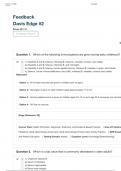
1/30/25, 5:23 PM Feedback


Feedback
Davis Edge #2
Score:

Feedback Report


Q


Question 1. Which of the following immunizations are given during early childhood?

 1. Hepatitis A and B, tetanus, influenza B, rotavirus, measles, mumps, and rubella
2. Hepatitis A and B, tetanus, influenza B, and meningitis
3. Hepatitis A and B, tetanus, human papillomavirus, influenza B, measles, mumps, and rubella
4. Tetanus, human immunodeficiency virus (HIV), influenza B, measles, mumps, and rubella
Rationales


Option 1: All of these vaccines are given to children prior to age 6.


Option 2: Meningitis is given to older children aged approximately 17 to 18.


Option 3: Human papillomavirus is given to children ages 9 to 12 or up to age 26 if previously not vaccinat


Option 4: HIV has no vaccine.


[Page Reference: 32]


Course Topic: Health Promotion, Diagnosis, Treatment, and Evidence-Based Practice | Area of Practice

Pediatrics, Adult-Gerontology Acute Care, Adult-Gerontology Primary Care, Family Practice | APN Knowl

and Patient Education | Testing Domain: Assess | Cognitive Level: Knowledge [Remembering]


Question 2. Which is a lab value that is commonly decreased in older adults?

 1. Creatinine clearance
2. Serum cholesterol
3. Serum triglycerides
4. Blood urea nitrogen

, 1/30/25, 5:23 PM Feedback

Cognitive Level: Comprehension


Question 3. Which of the following statements about health promotion is false?

 1. Health promotion is a benefit to add to your practice if you have time.
2. Health promotion helps to prevent diseases.
3. Health promotion includes early screening to detect diseases.
 4. Health promotion includes helping to restore health after a patient has had an illness.
Rationales


Option 1: Health promotion is an important aspect of clinical practice and not used solely if it is convenien


Option 2: This is included in the scope of health promotion.


Option 3: This is included in the scope of health promotion.


Option 4: This is included in the scope of health promotion.


[Page Reference: 26]


Course Topic: Health Promotion, Diagnosis, Treatment, and Evidence-Based Practice | Area of Practice

Care, Family Practice, Pediatrics, Adult-Gerontology Acute Care, Psychosocial-Mental Health | APN Know

and Patient Education | Testing Domain: Assess | Cognitive Level: Knowledge [Remembering]


Question 4. As a nurse practitioner, which of the following would not be an example
primary health promotion?

 1. Posting health articles on your social media account
2. Speaking to patients at each visit about strategies for maintaining/attaining a healthy life
3. Lecturing at local community centers about diabetes
4. Organizing a 5K running event for the patients in your practice
Rationales


Option 1: Although this provides possibly helpful information, it is not the most appropriate way to reach y


Option 2: This is an example of health promotion.


Option 3: This is an example of health promotion.


Option 4: This is an example of health promotion.
$15.99
Accede al documento completo:

100% de satisfacción garantizada
Inmediatamente disponible después del pago
Tanto en línea como en PDF
No estas atado a nada


Documento también disponible en un lote

Conoce al vendedor

Seller avatar
Los indicadores de reputación están sujetos a la cantidad de artículos vendidos por una tarifa y las reseñas que ha recibido por esos documentos. Hay tres niveles: Bronce, Plata y Oro. Cuanto mayor reputación, más podrás confiar en la calidad del trabajo del vendedor.
grade_bender Rasmussen College
Seguir Necesitas iniciar sesión para seguir a otros usuarios o asignaturas
Vendido
1035
Miembro desde
5 año
Número de seguidores
958
Documentos
1871
Última venta
1 mes hace
Grade_bender all documents, bundles, and flashcards

Access the most current and rigorously authenticated examination materials, including actual tests with 100% verification. Our comprehensive repository encompasses ATI, Nursing, PMHNP, TNCC, USMLE, ACLS, WGU, and all associated certification and academic assessments—each designed to ensure guaranteed success. Should a specific resource be unavailable in our catalog, our dedicated support team will procure it promptly upon request. Purchase with absolute confidence. We strongly encourage all clients to submit a review post-acquisition to affirm complete satisfaction and uphold our commitment to academic excellence.

Lee mas Leer menos
3.8

146 reseñas

5
71
4
31
3
14
2
8
1
22

Recientemente visto por ti

Por qué los estudiantes eligen Stuvia

Creado por compañeros estudiantes, verificado por reseñas

Calidad en la que puedes confiar: escrito por estudiantes que aprobaron y evaluado por otros que han usado estos resúmenes.

¿No estás satisfecho? Elige otro documento

¡No te preocupes! Puedes elegir directamente otro documento que se ajuste mejor a lo que buscas.

Paga como quieras, empieza a estudiar al instante

Sin suscripción, sin compromisos. Paga como estés acostumbrado con tarjeta de crédito y descarga tu documento PDF inmediatamente.

Student with book image

“Comprado, descargado y aprobado. Así de fácil puede ser.”

Alisha Student

Preguntas frecuentes