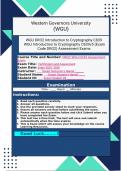
Western Governors University
(WGU)
WGU DRO2 Introduction to Cryptography C839
WGU Introduction to Cryptography C839v5 (Exam
Code DRO2) Assessment Exams
Course Title and Number: DRO2 WGU D334 Assessment
Exam
Exam Title: Certification and Assessment
Exam Date: Exam 2025- 2026
Instructor: ____ [Insert Instructor’s Name] _______
Student Name: ___ [Insert Student’s Name] _____
Student ID: ____ [Insert Student ID] _____________
Examination
Time: - ____ Hours: ___ Minutes
Instructions:
1. Read each question carefully.
2. Answer all questions.
3. Use the provided answer sheet to mark your responses.
4. Ensure all answers are final before submitting the exam.
5. Please answer each question below and click Submit when you
have completed the Exam.
6. This test has a time limit, The test will save and submit
automatically when the time expires
7. This is Exam which will assess your knowledge on the course
Learning Resources.
Good Luck……...!
, I can Help BYPASS PROCTORED EXAM 📑
📱Hit Me UP__ Inbox Open 24/7 – 365 …...!!!!
💬 Chat with us here: 📧
Click Here To <<ORDER NOW >> Follow Link
https://yourassignmenthandlers.kit.com/93b2309b47
!!!.ORDER NOW.!!! << TO GET INSTANT EXPERT HELP >> !!!.ORDER
NOW.!!!
WGU C839 Intro to Cryptography Exam Review Study Guide
Questions and Answers | 100% Pass Guaranteed | Graded A+ |
2025- 2026
C839 and D334 Intro to Cryptography
WGU Introduction to Cryptography C839v5 (Exam Code DRO2)
and D334 (Exam Code HNO1)
WGU Western Governors University
Read All Instructions Carefully and Answer All the
Questions Correctly Good Luck: -
RC4 has a variable key length that ranges from ___ to ___ -
=Answer>> 1-256 bits
MIC (Message Integrity Check) - =Answer>> guards against
the bit flipping attacks identified within WEP
Chaskey bit key size - =Answer>> 128
Rabbit (key size and IV size) - =Answer>> 128 bit key size
64 bit IV
Trivium (key size and IV size) - =Answer>> 80 bit key
80 IV
Need Writing 📝Help? We've Got You Covered! ✍️
100% NO A I or Plagiarism Guaranteed🎯
💬 Chat with us here: 📧
, I can Help BYPASS PROCTORED EXAM 📑
📱Hit Me UP__ Inbox Open 24/7 – 365 …...!!!!
💬 Chat with us here: 📧
PCBC (Propagating or Plaintext Cipher-Blocking Chaining) Mode
- =Answer>> - Like CBC mode.
- Mixes bits from previous ciphertext and plaintext blocks
before encrypting them.
- If one ciphertext bit is damaged, next plaintext block and all
subsequent blocks will be damaged and unable to decrypt.
CFP (Cipher Feedback) Mode - =Answer>> - CFP is like CBC.
- Ciphertext from the previous round is encrypted each round
and then add the output to the plaintext bits.
- If one bit of plaintext message is damaged, the corresponding
ciphertext block and all subsequent cyphertext blocks will be
damaged. - If one ciphertext bit is damaged, only two received
plaintext blocks will be damaged.
OFB (Output Feedback) Mode - =Answer>> ➢ Converts
block cipher to synchronous stream output.
➢ Current block takes output from the cipher stage vs from the
output of the XOR process of the previous block (difference
between CFB and OFB).
➢ The first stage takes the data blocks and X-ORs it with the
encrypted version of the IV value. The output of the first stage
encryption is then feed into the next stage, and encrypted, with
the output being X-OR'ed with the second block
- mitigates copy and paste attacks.
Cipher Feedback Mode (CFB) - =Answer>> ➢ Converts the
block cipher into a self-synchronizing stream cipher.
➢ Current block takes output of the XOR ⊕ process vs from the
cipher stage of the previous block (difference between CFB and
OFB)
ECB (Electronic Codeblock) - =Answer>> ➢ Most basic,
weak, and unsecure mode.
➢ Each block is processed separately. ➢ No Salt or IV is used
and the same key will be used to encrypt each block.
- if plaintext is encrypted and results ciphertext, the same
ciphertext will be the output EVERYTIME that same plaintext is
encrypted.
Need Writing 📝Help? We've Got You Covered! ✍️
100% NO A I or Plagiarism Guaranteed🎯
💬 Chat with us here: 📧
(WGU)
WGU DRO2 Introduction to Cryptography C839
WGU Introduction to Cryptography C839v5 (Exam
Code DRO2) Assessment Exams
Course Title and Number: DRO2 WGU D334 Assessment
Exam
Exam Title: Certification and Assessment
Exam Date: Exam 2025- 2026
Instructor: ____ [Insert Instructor’s Name] _______
Student Name: ___ [Insert Student’s Name] _____
Student ID: ____ [Insert Student ID] _____________
Examination
Time: - ____ Hours: ___ Minutes
Instructions:
1. Read each question carefully.
2. Answer all questions.
3. Use the provided answer sheet to mark your responses.
4. Ensure all answers are final before submitting the exam.
5. Please answer each question below and click Submit when you
have completed the Exam.
6. This test has a time limit, The test will save and submit
automatically when the time expires
7. This is Exam which will assess your knowledge on the course
Learning Resources.
Good Luck……...!
, I can Help BYPASS PROCTORED EXAM 📑
📱Hit Me UP__ Inbox Open 24/7 – 365 …...!!!!
💬 Chat with us here: 📧
Click Here To <<ORDER NOW >> Follow Link
https://yourassignmenthandlers.kit.com/93b2309b47
!!!.ORDER NOW.!!! << TO GET INSTANT EXPERT HELP >> !!!.ORDER
NOW.!!!
WGU C839 Intro to Cryptography Exam Review Study Guide
Questions and Answers | 100% Pass Guaranteed | Graded A+ |
2025- 2026
C839 and D334 Intro to Cryptography
WGU Introduction to Cryptography C839v5 (Exam Code DRO2)
and D334 (Exam Code HNO1)
WGU Western Governors University
Read All Instructions Carefully and Answer All the
Questions Correctly Good Luck: -
RC4 has a variable key length that ranges from ___ to ___ -
=Answer>> 1-256 bits
MIC (Message Integrity Check) - =Answer>> guards against
the bit flipping attacks identified within WEP
Chaskey bit key size - =Answer>> 128
Rabbit (key size and IV size) - =Answer>> 128 bit key size
64 bit IV
Trivium (key size and IV size) - =Answer>> 80 bit key
80 IV
Need Writing 📝Help? We've Got You Covered! ✍️
100% NO A I or Plagiarism Guaranteed🎯
💬 Chat with us here: 📧
, I can Help BYPASS PROCTORED EXAM 📑
📱Hit Me UP__ Inbox Open 24/7 – 365 …...!!!!
💬 Chat with us here: 📧
PCBC (Propagating or Plaintext Cipher-Blocking Chaining) Mode
- =Answer>> - Like CBC mode.
- Mixes bits from previous ciphertext and plaintext blocks
before encrypting them.
- If one ciphertext bit is damaged, next plaintext block and all
subsequent blocks will be damaged and unable to decrypt.
CFP (Cipher Feedback) Mode - =Answer>> - CFP is like CBC.
- Ciphertext from the previous round is encrypted each round
and then add the output to the plaintext bits.
- If one bit of plaintext message is damaged, the corresponding
ciphertext block and all subsequent cyphertext blocks will be
damaged. - If one ciphertext bit is damaged, only two received
plaintext blocks will be damaged.
OFB (Output Feedback) Mode - =Answer>> ➢ Converts
block cipher to synchronous stream output.
➢ Current block takes output from the cipher stage vs from the
output of the XOR process of the previous block (difference
between CFB and OFB).
➢ The first stage takes the data blocks and X-ORs it with the
encrypted version of the IV value. The output of the first stage
encryption is then feed into the next stage, and encrypted, with
the output being X-OR'ed with the second block
- mitigates copy and paste attacks.
Cipher Feedback Mode (CFB) - =Answer>> ➢ Converts the
block cipher into a self-synchronizing stream cipher.
➢ Current block takes output of the XOR ⊕ process vs from the
cipher stage of the previous block (difference between CFB and
OFB)
ECB (Electronic Codeblock) - =Answer>> ➢ Most basic,
weak, and unsecure mode.
➢ Each block is processed separately. ➢ No Salt or IV is used
and the same key will be used to encrypt each block.
- if plaintext is encrypted and results ciphertext, the same
ciphertext will be the output EVERYTIME that same plaintext is
encrypted.
Need Writing 📝Help? We've Got You Covered! ✍️
100% NO A I or Plagiarism Guaranteed🎯
💬 Chat with us here: 📧