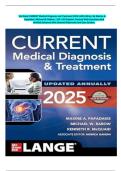
TEST BANK FOR CURRENT MEDICAL DIAGNOSIS
AND TREATMENT QUESTIONS WITH VERIFIED ANSWERS 2025
17.While donning sterile gloves, the nurse notices the edges of the glove package are
slightly yellow. The yellow area is more than 1 inch away from the gloves and only
appears to be on the outside of the glove package. What is the best action for the
nurse to take at this point?
a)Continue using the gloves inside the package because the package is intact.
b)Remove gloves from the sterile field and use a new pair of sterile gloves.
c)Throw all supplies away that were to be used and begin again.
d)Use the gloves and make sure the yellow edges of the package do not touch the
client.-ANSWER B
The gloves should be thrown away because the gloves are likely to be contaminated
from an outside source. The supplies do not have to be thrown away because they
have not been contaminated.
18.The nurse is removing personal protective equipment (PPE). Which item should
be removed first?
a)Gown b)Gloves
c)Face shield
d)Hair covering-ANSWER B
The gloves are removed first because they are usually the most contaminated PPE
and must be removed to avoid contamination of clean areas of the other PPE during
their removal. The gown is removed second, then the mask or face shield, and
finally, the hair covering.
,19.The patient in the intensive care unit has developed a urinary tract in- fection
related to the indwelling urinary catheter. Which of the following best describes this
type of infection?
a)Nosocomial
b)Healthcare associated
c)Multidrug-resistant organisms (MDRO)
d)Unavoidable occurrence-ANSWER A
Nosocomial infections refer specifically to hospital-acquired infections. Health- care-
associated infections (HAIs) refer to infections associated with healthcare given in
any setting (hospitals, long-term care facilities); however, nosocomial is more
specific. A multi-drug-resistant organism (MDRO) is a bacterium that is resistant to
many antibiotics. Examples of MDROs include methicillin-resistant Staphylococcus
aureus (MRSA) and vancomycin-resistant Enterococcus (VRE). Indwelling urinary
catheters are needed in many circumstances, and might be unavoidable in that
sense. However, the infection itself is not unavoidable because it can be prevented
in most instances with meticulous nursing care. Therefore "unavoidable
occurrence" is an incorrect option.
20.The mother of a 6-year-old child says to the pediatric nurse, "My son had such a
bad case of the measles. I hope he doesn't get them again." What is the most
appropriate response by the nurse?
a)"It sounds like he was very sick. Let's hope he doesn't get them again."
b)"Measles is a disease that once you've had it, you won't get it again. The body has
learned to make cells that will fight off any future exposures."
c)"Would you like me to prepare a plan for you with ways you can prevent future
, episodes of measles?"
d)"It will be important for you to keep your son away from other children with
measles, as he is now more susceptible."-ANSWER B
People who recover from some infectious diseases such as measles and chickenpox
never get the disease again, even if they are repeatedly exposed to the virus. The
reason is "specific immunity"-ANSWER the process by which the body's immune
cells learn to recognize and destroy pathogens they have encountered before.
Keeping a child who has had measles away from a child who currently has measles
will have no effect on the child acquiring measles.
21.The nurse has just administered a subcutaneous insulin injection to her diabetic
patient. What is the next immediate action by the nurse?
a)Dispose of the needle/syringe uncapped into a disposable sharps contain- er.
b)Recap the syringe with needle and dispose into a sharps container.
c)Dispose the needle/syringe into a biohazard bag inside the patient's room.
d)Separate the needle and syringe and place them into a sharps container.-ANSWER
A
Always place disposable needles, syringes, and other sharp items such as broken
glass in a special disposable, sharps container immediately after their use. Never
recap or handle any contaminated needle. Biohazard bags are used for contaminat-
ed items and equipment related to body fluids that are not to be placed in regular
trash containers.
22.Should a bioterrorism event occur, what factor is most important in mini- mizing
the effects of such an event?
a)Rapidly recognize unusual disease patterns and detect the presence of unusual
AND TREATMENT QUESTIONS WITH VERIFIED ANSWERS 2025
17.While donning sterile gloves, the nurse notices the edges of the glove package are
slightly yellow. The yellow area is more than 1 inch away from the gloves and only
appears to be on the outside of the glove package. What is the best action for the
nurse to take at this point?
a)Continue using the gloves inside the package because the package is intact.
b)Remove gloves from the sterile field and use a new pair of sterile gloves.
c)Throw all supplies away that were to be used and begin again.
d)Use the gloves and make sure the yellow edges of the package do not touch the
client.-ANSWER B
The gloves should be thrown away because the gloves are likely to be contaminated
from an outside source. The supplies do not have to be thrown away because they
have not been contaminated.
18.The nurse is removing personal protective equipment (PPE). Which item should
be removed first?
a)Gown b)Gloves
c)Face shield
d)Hair covering-ANSWER B
The gloves are removed first because they are usually the most contaminated PPE
and must be removed to avoid contamination of clean areas of the other PPE during
their removal. The gown is removed second, then the mask or face shield, and
finally, the hair covering.
,19.The patient in the intensive care unit has developed a urinary tract in- fection
related to the indwelling urinary catheter. Which of the following best describes this
type of infection?
a)Nosocomial
b)Healthcare associated
c)Multidrug-resistant organisms (MDRO)
d)Unavoidable occurrence-ANSWER A
Nosocomial infections refer specifically to hospital-acquired infections. Health- care-
associated infections (HAIs) refer to infections associated with healthcare given in
any setting (hospitals, long-term care facilities); however, nosocomial is more
specific. A multi-drug-resistant organism (MDRO) is a bacterium that is resistant to
many antibiotics. Examples of MDROs include methicillin-resistant Staphylococcus
aureus (MRSA) and vancomycin-resistant Enterococcus (VRE). Indwelling urinary
catheters are needed in many circumstances, and might be unavoidable in that
sense. However, the infection itself is not unavoidable because it can be prevented
in most instances with meticulous nursing care. Therefore "unavoidable
occurrence" is an incorrect option.
20.The mother of a 6-year-old child says to the pediatric nurse, "My son had such a
bad case of the measles. I hope he doesn't get them again." What is the most
appropriate response by the nurse?
a)"It sounds like he was very sick. Let's hope he doesn't get them again."
b)"Measles is a disease that once you've had it, you won't get it again. The body has
learned to make cells that will fight off any future exposures."
c)"Would you like me to prepare a plan for you with ways you can prevent future
, episodes of measles?"
d)"It will be important for you to keep your son away from other children with
measles, as he is now more susceptible."-ANSWER B
People who recover from some infectious diseases such as measles and chickenpox
never get the disease again, even if they are repeatedly exposed to the virus. The
reason is "specific immunity"-ANSWER the process by which the body's immune
cells learn to recognize and destroy pathogens they have encountered before.
Keeping a child who has had measles away from a child who currently has measles
will have no effect on the child acquiring measles.
21.The nurse has just administered a subcutaneous insulin injection to her diabetic
patient. What is the next immediate action by the nurse?
a)Dispose of the needle/syringe uncapped into a disposable sharps contain- er.
b)Recap the syringe with needle and dispose into a sharps container.
c)Dispose the needle/syringe into a biohazard bag inside the patient's room.
d)Separate the needle and syringe and place them into a sharps container.-ANSWER
A
Always place disposable needles, syringes, and other sharp items such as broken
glass in a special disposable, sharps container immediately after their use. Never
recap or handle any contaminated needle. Biohazard bags are used for contaminat-
ed items and equipment related to body fluids that are not to be placed in regular
trash containers.
22.Should a bioterrorism event occur, what factor is most important in mini- mizing
the effects of such an event?
a)Rapidly recognize unusual disease patterns and detect the presence of unusual