Sociology of organisations
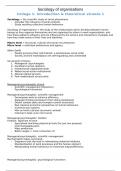
College 1: Introduction & theoretical strands 1
Sociology = the scientific study of social phenomena
- Consider the influence of social contests
- Study resulting collective human behaviour
Sociology of organisations = the study of the relationships which develop between human
beings as they organise themselves and are organised by others in work organisations, and
how these patterns influence and are influenced by the actions and interactions of people and
how they make sense of their lives and identities.
Macro level = structural, cultural and social circumstances
Micro level = individual preferences and agency
Adem Smith
- People pursuing their self-interest: a spontaneous social order
- Society and the marketplace are self-regulating and unintended
Six strands of theory
1. Managerial- psychologistic
2. Durkheim-human-relations
3. Interactionist-negotiated-order
4. Weber-social-action-institutional
5. Marxian-labour-process
6. Post-modern/post structuralist
Managerial-psychologistic strand
- Scientific management (Taylorism)
- Psychological humanism
Managerial-psychologistic: scientific management
- Decompose work to enhance efficiency
- Separate thinking (employer) from doing (employee)
- Deskill (simple tasks and complex control structures)
- Neo-classical economic perspective on human behaviour
- Incentive pay systems
- Man as homo calculus (economic animal)
- Coleman’s boat: pure micro-level
Managerial-psychologistic: Fordism
Fordism: Taylorism on tech
- Specialised machinery/electrical tools (for just one purpose)
- Interchangeable parts
- Mass production
- Better wages = more consumers (?)
Managerial-psychologistic: scientific management
Mechanisation takes command…
- Engineers took the lead in rationalizing industrial relations
- Standardization of work processes and the human element
- Manipulating human behaviour to maximize output/efficiency
Managerial-psychologistic: psychological humanism
,Abraham Maslow hierarchy of needs
Recent research:
- All needs matter
- They are not fully hierarchical
- Importance varies between people
Two-level theory of motivation
1. Hygiene factors = things that can lead to dissatisfaction if their not fulfilled, but cant
really lead to satisfaction (salary)
2. Motivation factors = need to be present for people to increase their work satisfaction
(achievement, recognition, growth, responsibility)
Managerial-psychologistic = scientific management and psychological humanism study
different incentives, but both:
- Focus strongly on the micro level
- Draw sharp distinctions between managements and employees
- Aim to manipulate employee behaviour
- Implicitly believe there is one best way of organizing
Durkheim-human-relations
- The works of Durkheim
- Human relations school
Durkheim-human-relations
- Emphasises the social system around individuals
, - An autonomous and externally existing society
- Social underpinnings of cognitions: norms, values and ways of doing
- (Over) emphasis on the macro level
Four phases of the industrial revolution post-industrial 1960 - …
Pre-capitalist phase many people are working as farmers. People were working for
themselves on the farm
Pre-industrial phase increasing specialisations (bakers, smith)
Industrial phase even further specialisations
Durkheim distinguishes between two types of solidarity:
1. Mechanical solidarity = Pre-capitalist society: people looked much the same. People
were engaged to similar activities in life. People understood each other because their
lives looked pretty much the same.
2. Organic solidarity = Pre-industrial phase: people became more depended on each
other. They also became more dis-similar.
Hawthorne effect = being observed effect?
- Few respondents
- Different jobs
- Only women
Durkheim-human-relations emphasis on:
- Informal relations
- Social cohesion
- Sentiments rather than reason
- System properties (interdependencies)
As determinants of output
Compared to managerial-psychologistic the Durkheim-human-relations are more macro-focus.
But they all:
- Draw sharp distinctions between management and employees
- Aim to manipulate worker/employee behaviour
- Believe (implicitly in one best way of organizing, the way to get there just differs
(economic, psychological or social incentives)
Interactionist-negotiated order
Bridging micro and macro. Organizations and their members are restricted by rules and bend
the rules. What happens results from ongoing interactions between actors, leading to an
‘order’
- Individuals and society are mutually interdependent
- Combining psychology and sociology
- Less emphasis on rationality or sentiments, more on negotiations
Organisations and employees strive to preserve their identity:
College 1: Introduction & theoretical strands 1
Sociology = the scientific study of social phenomena
- Consider the influence of social contests
- Study resulting collective human behaviour
Sociology of organisations = the study of the relationships which develop between human
beings as they organise themselves and are organised by others in work organisations, and
how these patterns influence and are influenced by the actions and interactions of people and
how they make sense of their lives and identities.
Macro level = structural, cultural and social circumstances
Micro level = individual preferences and agency
Adem Smith
- People pursuing their self-interest: a spontaneous social order
- Society and the marketplace are self-regulating and unintended
Six strands of theory
1. Managerial- psychologistic
2. Durkheim-human-relations
3. Interactionist-negotiated-order
4. Weber-social-action-institutional
5. Marxian-labour-process
6. Post-modern/post structuralist
Managerial-psychologistic strand
- Scientific management (Taylorism)
- Psychological humanism
Managerial-psychologistic: scientific management
- Decompose work to enhance efficiency
- Separate thinking (employer) from doing (employee)
- Deskill (simple tasks and complex control structures)
- Neo-classical economic perspective on human behaviour
- Incentive pay systems
- Man as homo calculus (economic animal)
- Coleman’s boat: pure micro-level
Managerial-psychologistic: Fordism
Fordism: Taylorism on tech
- Specialised machinery/electrical tools (for just one purpose)
- Interchangeable parts
- Mass production
- Better wages = more consumers (?)
Managerial-psychologistic: scientific management
Mechanisation takes command…
- Engineers took the lead in rationalizing industrial relations
- Standardization of work processes and the human element
- Manipulating human behaviour to maximize output/efficiency
Managerial-psychologistic: psychological humanism
,Abraham Maslow hierarchy of needs
Recent research:
- All needs matter
- They are not fully hierarchical
- Importance varies between people
Two-level theory of motivation
1. Hygiene factors = things that can lead to dissatisfaction if their not fulfilled, but cant
really lead to satisfaction (salary)
2. Motivation factors = need to be present for people to increase their work satisfaction
(achievement, recognition, growth, responsibility)
Managerial-psychologistic = scientific management and psychological humanism study
different incentives, but both:
- Focus strongly on the micro level
- Draw sharp distinctions between managements and employees
- Aim to manipulate employee behaviour
- Implicitly believe there is one best way of organizing
Durkheim-human-relations
- The works of Durkheim
- Human relations school
Durkheim-human-relations
- Emphasises the social system around individuals
, - An autonomous and externally existing society
- Social underpinnings of cognitions: norms, values and ways of doing
- (Over) emphasis on the macro level
Four phases of the industrial revolution post-industrial 1960 - …
Pre-capitalist phase many people are working as farmers. People were working for
themselves on the farm
Pre-industrial phase increasing specialisations (bakers, smith)
Industrial phase even further specialisations
Durkheim distinguishes between two types of solidarity:
1. Mechanical solidarity = Pre-capitalist society: people looked much the same. People
were engaged to similar activities in life. People understood each other because their
lives looked pretty much the same.
2. Organic solidarity = Pre-industrial phase: people became more depended on each
other. They also became more dis-similar.
Hawthorne effect = being observed effect?
- Few respondents
- Different jobs
- Only women
Durkheim-human-relations emphasis on:
- Informal relations
- Social cohesion
- Sentiments rather than reason
- System properties (interdependencies)
As determinants of output
Compared to managerial-psychologistic the Durkheim-human-relations are more macro-focus.
But they all:
- Draw sharp distinctions between management and employees
- Aim to manipulate worker/employee behaviour
- Believe (implicitly in one best way of organizing, the way to get there just differs
(economic, psychological or social incentives)
Interactionist-negotiated order
Bridging micro and macro. Organizations and their members are restricted by rules and bend
the rules. What happens results from ongoing interactions between actors, leading to an
‘order’
- Individuals and society are mutually interdependent
- Combining psychology and sociology
- Less emphasis on rationality or sentiments, more on negotiations
Organisations and employees strive to preserve their identity: