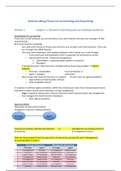
Samenvatting Financial Accounting and Reporting
lecture 1 chapter 1, financial reporting and accounting standards
Developments in accounting
If you start a small company, you are the owner, your own financier and your own manager → sole
proprietorship.
But if your business is growing:
- you need some money to finance your business, you can get a loan from someone. Then, you
are no longer the 100% financier.
- You need some employees. Start paying employees which makes you a real manager.
o If you have loans and employees, there is separation of ownership & control
o Ownership & control = finance & management
▪ Shareholders = capital providers (banks or investors)
▪ Managers
- If companies grow, it becomes more complex and we have a new problem → Agency
problem.
o Principal = shareholders huurt werknemer in
o Agent = manager werknemer
- More factors that make the business so complex: → more room for agency problems.
o legal entities (private & public entities)
o local and global markets
in response to all these agency problems, within the company you have more corporate governance
mechanisms which should control behaviour of top management.
- Bigger companies always have a board of directors which should monitor top management
- Top management should monitor employees
o More agency problems
Agency problem
Separation of ownership & control
Delegation of decision making authority
Principal Agent
Financial accounting (internal and external) vs. Management accounting (internal)
& reporting & management control
Who are the principal (P) and the agent (A) in Financial Accounting (FA) and in Management
Accounting (MA): number 7
, Assumptions of the agency theory
- Agent has bounded rationality → agent (manager) has limited information processing
capacity
- Opportunistic, self-interested behaviour → agent must have this behaviour
- Risk attitude / references
- Goal conflicts among participants → principals have different goals than the agent
- Information asymmetry → principals and agent does not have the same info
▪ How to reduce information asymmetry?
▪ Manager (agent) must give some information to the capital provides
(principals) so that they can make useful decisions.
• Information: relevant and reliable!!
- Behavioural risk
o Adverse selection
o Moral hazard
Corporate governance mechanisms:
Two mechanisms that ensure that information is relevant and reliable
- Accounting standards → if information meets the accounting standards it is more likely that
this information is useful for decision making.
- External auditor → increase the likelihood that information is reliable.
Regulation
Accounting standards Principal-based Rules-based
Global standards IFRS (international financial US GAAP (general accepted
reporting standards) accounting principles)
Local standards Dutch GAAP
If you are a European company, when do you have to follow the IFRS?
- All the stock exchange listed companies, the public companies. So if you do international
business, you have to follow the IFRS. And they have to follow it for the consolidated
financial statements.
Accounting standards in the EU: IFRS endorsed
If you are a private company, it is allowed to use the IFRS standards. But you can also use the local
standards (Dutch GAAP).
,Objective of financial reporting
These IFRS have one very clear goal. Which is formulated here:
The objective of general purpose financial reporting is to provide financial information about the
reporting entity that is useful to existing and potential investors, lenders and other creditors in
making decisions about providing resources to the entity.
Examples of economic decisions
‒ buy, sell or hold shares (and other equity instruments)
‒ provide or settle loans and other forms of credit
So the objective of financial reporting is providing financial information basically to capital
providers/investors and the information should be useful for economic decision makings.
Objectives of financial reporting (goals of financial reporting)
1. communicate information that is useful in making decisions
• in making resources allocation decisions
2. assessing management stewardship = providing information in which you describe and
explain how you use the resources provided by the principals and whether you could
generate returns on them.
• monitor managers’ activities
• accountability → describe how you use the money of capital providers and explain
whether you have made profit or not.
▪ discharge management from responsibility
Relationship between economic decision making & stewardship:
If you provide better information on how you used the resources in last year, it might positively
affect the economic decision making.
3. Capital protection → guarantees that statements are relevant and reliable.
Return on equity = net income / stockholders equity
Every year he has paid out dividends, he gets more and more profits and stockholders equity doubles
every year. But, last year he has made very high net income and he disappears.
He used to money the new investors payed to buy new shares, he used the money to pay the
dividends. So, the income statements and the balance sheet were wrong.
So capital protection means that you have some
mechanisms that guarantees that the financial
statements are not fake. But relevant and reliable.
, Corporate financial statements:
1. Income statement (USA) = profit and loss account (UK)
Statement of comprehensive income
2. Balance sheet = statement of financial position (IASB)
3. Statement of cash flows
o Direct statement of cash flows
o Indirect statement of cash flows
4. Statement of changes in (shareholders / stockholders) equity
Later:
Consolidated financial statements
Company financial statements
Property , plant and equipment = buildings, machinery etc.. → right on the balance sheet
Intellectual capital → impossible on the balance sheet
Goodwill → could be correct, but only on the single balance sheet and not on the consolidated
Financial assets = investments/shares in other companies → correct item.
Non-controlling interest = → correct
Long-term debt → Provisions → Current liabilities must be Provisions → Long-term debt →
Current liabilities.
Company financial statements can not have a consolidated balance sheet.
Income assessment & dividend distribution
Can you pay dividends to shareholders if you have a loss of 1 million? → yes, you can.
lecture 1 chapter 1, financial reporting and accounting standards
Developments in accounting
If you start a small company, you are the owner, your own financier and your own manager → sole
proprietorship.
But if your business is growing:
- you need some money to finance your business, you can get a loan from someone. Then, you
are no longer the 100% financier.
- You need some employees. Start paying employees which makes you a real manager.
o If you have loans and employees, there is separation of ownership & control
o Ownership & control = finance & management
▪ Shareholders = capital providers (banks or investors)
▪ Managers
- If companies grow, it becomes more complex and we have a new problem → Agency
problem.
o Principal = shareholders huurt werknemer in
o Agent = manager werknemer
- More factors that make the business so complex: → more room for agency problems.
o legal entities (private & public entities)
o local and global markets
in response to all these agency problems, within the company you have more corporate governance
mechanisms which should control behaviour of top management.
- Bigger companies always have a board of directors which should monitor top management
- Top management should monitor employees
o More agency problems
Agency problem
Separation of ownership & control
Delegation of decision making authority
Principal Agent
Financial accounting (internal and external) vs. Management accounting (internal)
& reporting & management control
Who are the principal (P) and the agent (A) in Financial Accounting (FA) and in Management
Accounting (MA): number 7
, Assumptions of the agency theory
- Agent has bounded rationality → agent (manager) has limited information processing
capacity
- Opportunistic, self-interested behaviour → agent must have this behaviour
- Risk attitude / references
- Goal conflicts among participants → principals have different goals than the agent
- Information asymmetry → principals and agent does not have the same info
▪ How to reduce information asymmetry?
▪ Manager (agent) must give some information to the capital provides
(principals) so that they can make useful decisions.
• Information: relevant and reliable!!
- Behavioural risk
o Adverse selection
o Moral hazard
Corporate governance mechanisms:
Two mechanisms that ensure that information is relevant and reliable
- Accounting standards → if information meets the accounting standards it is more likely that
this information is useful for decision making.
- External auditor → increase the likelihood that information is reliable.
Regulation
Accounting standards Principal-based Rules-based
Global standards IFRS (international financial US GAAP (general accepted
reporting standards) accounting principles)
Local standards Dutch GAAP
If you are a European company, when do you have to follow the IFRS?
- All the stock exchange listed companies, the public companies. So if you do international
business, you have to follow the IFRS. And they have to follow it for the consolidated
financial statements.
Accounting standards in the EU: IFRS endorsed
If you are a private company, it is allowed to use the IFRS standards. But you can also use the local
standards (Dutch GAAP).
,Objective of financial reporting
These IFRS have one very clear goal. Which is formulated here:
The objective of general purpose financial reporting is to provide financial information about the
reporting entity that is useful to existing and potential investors, lenders and other creditors in
making decisions about providing resources to the entity.
Examples of economic decisions
‒ buy, sell or hold shares (and other equity instruments)
‒ provide or settle loans and other forms of credit
So the objective of financial reporting is providing financial information basically to capital
providers/investors and the information should be useful for economic decision makings.
Objectives of financial reporting (goals of financial reporting)
1. communicate information that is useful in making decisions
• in making resources allocation decisions
2. assessing management stewardship = providing information in which you describe and
explain how you use the resources provided by the principals and whether you could
generate returns on them.
• monitor managers’ activities
• accountability → describe how you use the money of capital providers and explain
whether you have made profit or not.
▪ discharge management from responsibility
Relationship between economic decision making & stewardship:
If you provide better information on how you used the resources in last year, it might positively
affect the economic decision making.
3. Capital protection → guarantees that statements are relevant and reliable.
Return on equity = net income / stockholders equity
Every year he has paid out dividends, he gets more and more profits and stockholders equity doubles
every year. But, last year he has made very high net income and he disappears.
He used to money the new investors payed to buy new shares, he used the money to pay the
dividends. So, the income statements and the balance sheet were wrong.
So capital protection means that you have some
mechanisms that guarantees that the financial
statements are not fake. But relevant and reliable.
, Corporate financial statements:
1. Income statement (USA) = profit and loss account (UK)
Statement of comprehensive income
2. Balance sheet = statement of financial position (IASB)
3. Statement of cash flows
o Direct statement of cash flows
o Indirect statement of cash flows
4. Statement of changes in (shareholders / stockholders) equity
Later:
Consolidated financial statements
Company financial statements
Property , plant and equipment = buildings, machinery etc.. → right on the balance sheet
Intellectual capital → impossible on the balance sheet
Goodwill → could be correct, but only on the single balance sheet and not on the consolidated
Financial assets = investments/shares in other companies → correct item.
Non-controlling interest = → correct
Long-term debt → Provisions → Current liabilities must be Provisions → Long-term debt →
Current liabilities.
Company financial statements can not have a consolidated balance sheet.
Income assessment & dividend distribution
Can you pay dividends to shareholders if you have a loss of 1 million? → yes, you can.