Vivian Leung
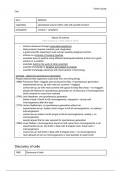
Cell
term definition
organelles specialised subunit within cells with specific function
protoplasm nucleus + cytoplasm
Nature of science
what science is + how science works
- science advances through reasonable skepticism
- doing science requires creativity and imagination
- a good scientific experiment must include carefully designed controls
- science is a process of ongoing inquiries
- scientists have to explore using different techniques/methods to find out a good
solution to a problem
- scientists build on the work of other scientists
- scientific knowledge is tentative and subject to change
- scientific knowledge advances with improvement in technology
example - disproving spontaneous generation
People believed that organisms could arise from non-living things
(1668) Francesco Redi: maggots were produced by flies, X spontaneous generation
- experimental set-up: jar with meat not covered > maggots
- control set-up: jar with meat covered with gauze to keep flies away > no maggots
- people still believed in spontaneous generation bc of discovery of microorganisms
which seemed to come from nowhere
(1745) John Needham: yes spontaneous generation
- boiled a flask of broth to kill microorganisms, stoppered > cloudy with
microorganisms after few days
(1775) Lazaro Spallanzani: no spontaneous generation without air
- experimental set-up: boiled a broth longer to kill all microorganisms, no sealing >
microorganisms
- control set-up: boiled a broth longer to kill all microorganisms, sealing > no
microorganisms
- people argued that air was required for spontaneous generation
(1859) Louis Pasteur: microorganisms found in broth came from microorganisms in air
- experimental set-up: boil broth in flask with S-shaped neck, break neck >
microorganisms
- control set-up: boil broth in flask with S-shaped neck > no microorganisms
- neck allowed air but not microorganisms or dust particles to reach broth
Discovery of cells
1665 Discovery of cells
, Vivian Leung
Cell
Robert Hooke: used a compound microscope (x50) designed by himself
observed many small irregular boxes in a thin slice of cork/tissue of bark
called boxes ‘cells’ (chambers)
the boxes were actually cell walls of dead cork cells
1674 1st observation of living cells under microscope
Antoni van Leeuwenhoek: used simple single-lens microscope (x200)
observed microorganisms in pond water
1839 Formulation of Cell Theory
Theodor Schwann: proposed the Cell Theory1
Matthias Schleidan: discovered plant parts made up of cells
Theodor Schwann: discovered animals parts made up of cells
1. All organisms are made up of one or more cells
unicellular: amoeba, bacteria
multicellular: animals, plants
2. The cell is the basic unit of life
the smallest unit that shows all the characteristics of life
3. All cells come from pre-existing cells
cell division
Microscopes
Light microscopes Electron microscopes
Transmission electron Scanning electron
microscope (TEM) microscope (SEM)
light passes through a (thin electron beams pass electron beams scan over
slide of) specimen through a very thin slide of the surface of a specimen
specimen
max (x1600) low max (x1 500 000) very high max (x200 000) high
photomicrograph: coloured electron micrograph: b&w electron micrograph: b&w
2D, show internal structures 3D, show external structures
advantages advantages
Living specimen higher magnification
Specimens prepared higher resolution (≠ magnification)
easily under same magnification:
1) clearer
2) more details can be seen
1
general system of ideas used to explain or interpret observations > can be modified or replaced
Cell
term definition
organelles specialised subunit within cells with specific function
protoplasm nucleus + cytoplasm
Nature of science
what science is + how science works
- science advances through reasonable skepticism
- doing science requires creativity and imagination
- a good scientific experiment must include carefully designed controls
- science is a process of ongoing inquiries
- scientists have to explore using different techniques/methods to find out a good
solution to a problem
- scientists build on the work of other scientists
- scientific knowledge is tentative and subject to change
- scientific knowledge advances with improvement in technology
example - disproving spontaneous generation
People believed that organisms could arise from non-living things
(1668) Francesco Redi: maggots were produced by flies, X spontaneous generation
- experimental set-up: jar with meat not covered > maggots
- control set-up: jar with meat covered with gauze to keep flies away > no maggots
- people still believed in spontaneous generation bc of discovery of microorganisms
which seemed to come from nowhere
(1745) John Needham: yes spontaneous generation
- boiled a flask of broth to kill microorganisms, stoppered > cloudy with
microorganisms after few days
(1775) Lazaro Spallanzani: no spontaneous generation without air
- experimental set-up: boiled a broth longer to kill all microorganisms, no sealing >
microorganisms
- control set-up: boiled a broth longer to kill all microorganisms, sealing > no
microorganisms
- people argued that air was required for spontaneous generation
(1859) Louis Pasteur: microorganisms found in broth came from microorganisms in air
- experimental set-up: boil broth in flask with S-shaped neck, break neck >
microorganisms
- control set-up: boil broth in flask with S-shaped neck > no microorganisms
- neck allowed air but not microorganisms or dust particles to reach broth
Discovery of cells
1665 Discovery of cells
, Vivian Leung
Cell
Robert Hooke: used a compound microscope (x50) designed by himself
observed many small irregular boxes in a thin slice of cork/tissue of bark
called boxes ‘cells’ (chambers)
the boxes were actually cell walls of dead cork cells
1674 1st observation of living cells under microscope
Antoni van Leeuwenhoek: used simple single-lens microscope (x200)
observed microorganisms in pond water
1839 Formulation of Cell Theory
Theodor Schwann: proposed the Cell Theory1
Matthias Schleidan: discovered plant parts made up of cells
Theodor Schwann: discovered animals parts made up of cells
1. All organisms are made up of one or more cells
unicellular: amoeba, bacteria
multicellular: animals, plants
2. The cell is the basic unit of life
the smallest unit that shows all the characteristics of life
3. All cells come from pre-existing cells
cell division
Microscopes
Light microscopes Electron microscopes
Transmission electron Scanning electron
microscope (TEM) microscope (SEM)
light passes through a (thin electron beams pass electron beams scan over
slide of) specimen through a very thin slide of the surface of a specimen
specimen
max (x1600) low max (x1 500 000) very high max (x200 000) high
photomicrograph: coloured electron micrograph: b&w electron micrograph: b&w
2D, show internal structures 3D, show external structures
advantages advantages
Living specimen higher magnification
Specimens prepared higher resolution (≠ magnification)
easily under same magnification:
1) clearer
2) more details can be seen
1
general system of ideas used to explain or interpret observations > can be modified or replaced