1
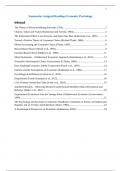
Summaries Assigned Readings Economic Psychology
Inhoud
The Theory of Decision Making (Edwards, 1954).....................................................................2
Choices, Values and Frames (Kahneman and Tversky, 1984)....................................................3
The Endowment Effect, Loss Aversion, and Status Quo Bias (Kahneman et al., 1991)............5
Toward a Positive Theory of Consumer Choice (Richard Thaler, 1980)....................................6
Mental Accounting and Consumer Choice (Thaler, 1985).........................................................8
Reason-Based Choice (Shafir et al., 1993).................................................................................9
Emotion-Based Choice (Mellers et al., 1999)...........................................................................11
Moral Sentiments – A Behavioral Economics Approach (Zeelenberg et al., 2012).................12
Anomalies Intertemporal Choice (Loewenstein & Thaler, 1989).............................................13
Does Studying Economics Inhibit Cooperation (Frank et al., 1993)........................................14
Fairness and the Assumptions of Economics (Kahneman et al., 1986)....................................15
Psychological Selfishness (Carlson et al., 2022)......................................................................16
Dispositional Greed (Seuntjens et al., 2015).............................................................................18
Civic Honesty Around the Globe (Cohn et al., 2019)...............................................................19
Justified Ethicality – Observing Desired Counterfactuals Modifies Ethical Perceptions and
Behavior (Shalvi et al., 2011)....................................................................................................20
Experimental Economics from the Vantage Point of Behavioural Economics (Loewenstein,
1999).........................................................................................................................................21
The Psychology and Economics Conference Handbook: Comments on Simon, on Einhorn and
Hogarth, and on Tversky and Kahneman (Thaler, 1986)..........................................................23
A Psychological Perspective on Economics (Kahneman, 2003)..............................................24
, 2
The Theory of Decision Making (Edwards, 1954)
Economic Man: An idealized version of a perfectly rational decision maker, who has
complete information, who weighs every detail with perfect precision, and who always makes
choices that maximizes his utility.
Utility: We're all driven by this desire to maximize pleasure and minimize pain. “I like this
apple twice as much as this banana.”
Ordinal Utility: which is about ranking your preferences. “I prefer this apple to this banana,
but I don't know exactly how much more.”
Indifference Curves: Visualizes utility.
Risk: You know which probabilities are involved, even if the outcome itself is uncertain.
Uncertainty: When you're dealing with the truly unknown. You can’t assign probabilities to
the outcomes because you have no idea what might happen.
Doubly Inflected Utility Curve: A curve that first rises steeply, representing how our
satisfaction increases rapidly when we gain money, but then as we accumulate more wealth,
the curve levels off, suggesting that those extra dollars bring less additional happiness.
We tend to overestimate low probabilities and underestimate high probabilities. So we might
worry too much about rare events, while downplaying the risks of more common occurrences.
The transitivity trap: Logic suggests that if I prefer option A to option B and option B to
option C, then I must prefer option A to option C. But it turns out this principle can break
down when our choices involve multiple dimensions.
Example Transitivity Trap – New Apartment
You're trying to choose a new apartment, and you care about the price and the location. What
if those factors conflict? Maybe the cheapest apartment is the furthest one from work? Or the
most spacious one is in a less desirable neighbourhood. Suddenly that neat logic of transitivity
starts to unravel. We might find ourselves making choices that seem to contradict our stated
preferences.
Game Theory: It tries to model these strategic interactions and assumes that the players are
rational and self-interested and have complete information. Every decision we make is a move
in a complex game. Instead of just thinking about what we want, we have to think about what
other players (e.g. people, the weather, availability of parking spots) might do.
Minimize-Maximized Loss (Minimax) Strategy: When you're faced with uncertainty, you
should choose the strategy that minimizes your potential losses.
Mixed Strategy: You randomly choose between different options to keep your opponent
guessing.
, 3
Choices, Values and Frames (Kahneman and Tversky, 1984)
Confirmation Bias: This is the tendency to seek out or interpret information in a way that
confirms our existing beliefs.
Loss Aversion: The idea that the pain of a loss feels much stronger to us than the pleasure of
an equal gain.
Example Loss Aversion – Taking a Bet
Imagine I offer you a bet. You have a 50/50, chance of winning $100 or losing $50 would you
take that bet? Hmm. Well, let me think about it. On the one hand, I could win $100 which
would be great, but on the other hand, I could lose $50 which would be kind of a bummer,
right? And that's where loss aversion comes in. Even though the potential gain is larger than
the potential loss, the pain of that potential loss weighs more heavily on our minds. So a lot of
people would actually choose not to take that bet, even though, from a purely rational
perspective, it has a positive expected value that's so interesting.
Status Quo Bias: This is the idea that because change often feels like a potential loss, we're
naturally biased towards sticking with what we already know.
Example Status Quo Bias – Car Insurance
There was a study on car insurance plans in New Jersey and Pennsylvania that perfectly
demonstrates this. Both states offered a choice between two types of car insurance. One was
cheaper, but restricted the right to sue. The other was more expensive, but it maintained that
right. In New Jersey, the default option was the cheaper plan. In Pennsylvania, the default
option (the option that is pre-selected) was the more expensive plan. The majority of people in
both states opted to stick with the default plan.
Framing Effects: The idea that the way a choice is presented or framed can have a huge
impact on our decisions, even if the underlying options are exactly the same.
Example Framing Effects – The Asian Disease Problem
Imagine there's an outbreak of a deadly disease, and you're in charge of choosing a course of
action. You're given two options, option A and option B. Option A might say “200 people will
be saved for sure”. Option B might say “there's a 1/3 probability that 600 people will be saved
and a two thirds probability that no one will be saved”. Okay, so with Option A, you have a
certain outcome, a guaranteed number of lives saved, while with Option B, it's more of a
gamble, exactly. Now, in another framing of the problem, the exact same options are
presented in terms of lives lost. So option C might say “400 people will die for sure”. Option
D might say “there's a 1/3 probability that no one will die and a two thirds probability that 600
people will die”. When the problem is framed in terms of lives saved, people tend to be more
risk averse. They prefer the certain option where 200 people will be saved for sure. But when
the problem is framed in terms of lives lost, people tend to become more risk seeking. They're
more willing to take the gamble, even though it means potentially losing more lives.
Mental Accounting: How we mentally categorize our spending, and how we value things.
Example Mental Accounting – Calculator
, 4
Imagine you're shopping and you see a calculator for $15. Would you drive 10 minutes to
save $5? Probably. Now imagine the item is $125. Would you still drive 10 minutes to save
$5? No.
Prospect Theory: A descriptive model of how people actually make decisions under
conditions of risk. People evaluate outcomes relative to a reference point.
Example Reference Point – Winning or Losing Money
A reference point, yeah, so instead of just looking at the absolute value of an outcome, we
tend to compare it to some kind of baseline or status quo. So for example, if you win $50 but
you were expecting to win $100 you might actually feel disappointed even though you gain
money.
, 5
The Endowment Effect, Loss Aversion, and Status Quo Bias (Kahneman et al.,
1991)
The Endowment Effect: We tend to value things that we own more highly than things that
we don't own, even if objectively they're the same.
Example Endowment Effect – The Mug Experiment
Experimenters gave a bunch of students either a coffee mug or the equivalent amount of
money, and then they set up this little market where the students could trade. Way fewer
students decided to trade than they expected. The students who were given the mugs thought
that those mugs were super valuable. Way more valuable than the students who didn't have a
mug.
Loss Aversion: When we lose something, it feels way worse to us than the good feeling we
get when we gain something of the same value.
Example Loss Aversion – The Pen Experiment
They gave some students pens and some of them cash. Then they had to trade. The people
with the pens, all of a sudden thought their pens were worth a lot more money then the cash
holders were willing to pay. It's like our brains just don't want to let go of what we have.
Status Quo Bias: Sometimes it's just easier to stick with what you know, even if you know
logically a change might be a good thing.
Example Status Quo Bias – Car Insurance
Jersey and Pennsylvania offered the same two car insurance plans but with different default
options. So in New Jersey the default was a cheaper plan with a limited rate to sue, and in
Pennsylvania the default was more expensive, but you had full right to sue. Most people just
stuck with whatever the default was. They're just sticking with what was presented as the
norm.
Summaries Assigned Readings Economic Psychology
Inhoud
The Theory of Decision Making (Edwards, 1954).....................................................................2
Choices, Values and Frames (Kahneman and Tversky, 1984)....................................................3
The Endowment Effect, Loss Aversion, and Status Quo Bias (Kahneman et al., 1991)............5
Toward a Positive Theory of Consumer Choice (Richard Thaler, 1980)....................................6
Mental Accounting and Consumer Choice (Thaler, 1985).........................................................8
Reason-Based Choice (Shafir et al., 1993).................................................................................9
Emotion-Based Choice (Mellers et al., 1999)...........................................................................11
Moral Sentiments – A Behavioral Economics Approach (Zeelenberg et al., 2012).................12
Anomalies Intertemporal Choice (Loewenstein & Thaler, 1989).............................................13
Does Studying Economics Inhibit Cooperation (Frank et al., 1993)........................................14
Fairness and the Assumptions of Economics (Kahneman et al., 1986)....................................15
Psychological Selfishness (Carlson et al., 2022)......................................................................16
Dispositional Greed (Seuntjens et al., 2015).............................................................................18
Civic Honesty Around the Globe (Cohn et al., 2019)...............................................................19
Justified Ethicality – Observing Desired Counterfactuals Modifies Ethical Perceptions and
Behavior (Shalvi et al., 2011)....................................................................................................20
Experimental Economics from the Vantage Point of Behavioural Economics (Loewenstein,
1999).........................................................................................................................................21
The Psychology and Economics Conference Handbook: Comments on Simon, on Einhorn and
Hogarth, and on Tversky and Kahneman (Thaler, 1986)..........................................................23
A Psychological Perspective on Economics (Kahneman, 2003)..............................................24
, 2
The Theory of Decision Making (Edwards, 1954)
Economic Man: An idealized version of a perfectly rational decision maker, who has
complete information, who weighs every detail with perfect precision, and who always makes
choices that maximizes his utility.
Utility: We're all driven by this desire to maximize pleasure and minimize pain. “I like this
apple twice as much as this banana.”
Ordinal Utility: which is about ranking your preferences. “I prefer this apple to this banana,
but I don't know exactly how much more.”
Indifference Curves: Visualizes utility.
Risk: You know which probabilities are involved, even if the outcome itself is uncertain.
Uncertainty: When you're dealing with the truly unknown. You can’t assign probabilities to
the outcomes because you have no idea what might happen.
Doubly Inflected Utility Curve: A curve that first rises steeply, representing how our
satisfaction increases rapidly when we gain money, but then as we accumulate more wealth,
the curve levels off, suggesting that those extra dollars bring less additional happiness.
We tend to overestimate low probabilities and underestimate high probabilities. So we might
worry too much about rare events, while downplaying the risks of more common occurrences.
The transitivity trap: Logic suggests that if I prefer option A to option B and option B to
option C, then I must prefer option A to option C. But it turns out this principle can break
down when our choices involve multiple dimensions.
Example Transitivity Trap – New Apartment
You're trying to choose a new apartment, and you care about the price and the location. What
if those factors conflict? Maybe the cheapest apartment is the furthest one from work? Or the
most spacious one is in a less desirable neighbourhood. Suddenly that neat logic of transitivity
starts to unravel. We might find ourselves making choices that seem to contradict our stated
preferences.
Game Theory: It tries to model these strategic interactions and assumes that the players are
rational and self-interested and have complete information. Every decision we make is a move
in a complex game. Instead of just thinking about what we want, we have to think about what
other players (e.g. people, the weather, availability of parking spots) might do.
Minimize-Maximized Loss (Minimax) Strategy: When you're faced with uncertainty, you
should choose the strategy that minimizes your potential losses.
Mixed Strategy: You randomly choose between different options to keep your opponent
guessing.
, 3
Choices, Values and Frames (Kahneman and Tversky, 1984)
Confirmation Bias: This is the tendency to seek out or interpret information in a way that
confirms our existing beliefs.
Loss Aversion: The idea that the pain of a loss feels much stronger to us than the pleasure of
an equal gain.
Example Loss Aversion – Taking a Bet
Imagine I offer you a bet. You have a 50/50, chance of winning $100 or losing $50 would you
take that bet? Hmm. Well, let me think about it. On the one hand, I could win $100 which
would be great, but on the other hand, I could lose $50 which would be kind of a bummer,
right? And that's where loss aversion comes in. Even though the potential gain is larger than
the potential loss, the pain of that potential loss weighs more heavily on our minds. So a lot of
people would actually choose not to take that bet, even though, from a purely rational
perspective, it has a positive expected value that's so interesting.
Status Quo Bias: This is the idea that because change often feels like a potential loss, we're
naturally biased towards sticking with what we already know.
Example Status Quo Bias – Car Insurance
There was a study on car insurance plans in New Jersey and Pennsylvania that perfectly
demonstrates this. Both states offered a choice between two types of car insurance. One was
cheaper, but restricted the right to sue. The other was more expensive, but it maintained that
right. In New Jersey, the default option was the cheaper plan. In Pennsylvania, the default
option (the option that is pre-selected) was the more expensive plan. The majority of people in
both states opted to stick with the default plan.
Framing Effects: The idea that the way a choice is presented or framed can have a huge
impact on our decisions, even if the underlying options are exactly the same.
Example Framing Effects – The Asian Disease Problem
Imagine there's an outbreak of a deadly disease, and you're in charge of choosing a course of
action. You're given two options, option A and option B. Option A might say “200 people will
be saved for sure”. Option B might say “there's a 1/3 probability that 600 people will be saved
and a two thirds probability that no one will be saved”. Okay, so with Option A, you have a
certain outcome, a guaranteed number of lives saved, while with Option B, it's more of a
gamble, exactly. Now, in another framing of the problem, the exact same options are
presented in terms of lives lost. So option C might say “400 people will die for sure”. Option
D might say “there's a 1/3 probability that no one will die and a two thirds probability that 600
people will die”. When the problem is framed in terms of lives saved, people tend to be more
risk averse. They prefer the certain option where 200 people will be saved for sure. But when
the problem is framed in terms of lives lost, people tend to become more risk seeking. They're
more willing to take the gamble, even though it means potentially losing more lives.
Mental Accounting: How we mentally categorize our spending, and how we value things.
Example Mental Accounting – Calculator
, 4
Imagine you're shopping and you see a calculator for $15. Would you drive 10 minutes to
save $5? Probably. Now imagine the item is $125. Would you still drive 10 minutes to save
$5? No.
Prospect Theory: A descriptive model of how people actually make decisions under
conditions of risk. People evaluate outcomes relative to a reference point.
Example Reference Point – Winning or Losing Money
A reference point, yeah, so instead of just looking at the absolute value of an outcome, we
tend to compare it to some kind of baseline or status quo. So for example, if you win $50 but
you were expecting to win $100 you might actually feel disappointed even though you gain
money.
, 5
The Endowment Effect, Loss Aversion, and Status Quo Bias (Kahneman et al.,
1991)
The Endowment Effect: We tend to value things that we own more highly than things that
we don't own, even if objectively they're the same.
Example Endowment Effect – The Mug Experiment
Experimenters gave a bunch of students either a coffee mug or the equivalent amount of
money, and then they set up this little market where the students could trade. Way fewer
students decided to trade than they expected. The students who were given the mugs thought
that those mugs were super valuable. Way more valuable than the students who didn't have a
mug.
Loss Aversion: When we lose something, it feels way worse to us than the good feeling we
get when we gain something of the same value.
Example Loss Aversion – The Pen Experiment
They gave some students pens and some of them cash. Then they had to trade. The people
with the pens, all of a sudden thought their pens were worth a lot more money then the cash
holders were willing to pay. It's like our brains just don't want to let go of what we have.
Status Quo Bias: Sometimes it's just easier to stick with what you know, even if you know
logically a change might be a good thing.
Example Status Quo Bias – Car Insurance
Jersey and Pennsylvania offered the same two car insurance plans but with different default
options. So in New Jersey the default was a cheaper plan with a limited rate to sue, and in
Pennsylvania the default was more expensive, but you had full right to sue. Most people just
stuck with whatever the default was. They're just sticking with what was presented as the
norm.