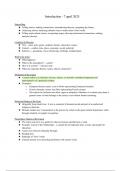
Lecture 1 - 10 february 2025
Coming Together, Coming Apart - Week 1: Economic integration
Why is economic integration beneficial?
Why do economists favour international trade?
Create more welfare → greater and more efficient production through:
1. Specialisation (differences between countries);
2. Economies of scale
3 Trade theories
1. (Neo)classical trade theory of David Ricardo (1817);
a. Key Concept:
i. comparative cost advantage → produce at the lowest cost;
ii. specialize in the most efficient product;
b. Argues that a country should specialise in a product that they can produce at the lowest
cost (efficient) → maximum welfare that can be achieved when specialisation and trade;
c. Solution of efficient production → specialize in products with comparative cost
advantage;
d. Conclusion:
i. Specialization makes the most efficient use of production factors;
ii. International trade → greater prosperity for both countries;
iii. Autarky (self-sufficient) is undesirable;
2. Heckscher-Ohlin theory (1933);
a. Ricardo didn't explain why countries have a comparative advantage → Hechscher-Ohlin:
factor endowment;
i. I.e. availability of production factors, labour and capital;
b. Specialize in most available production factor;
i. Much labour → low wages → specialize in labour-intensive products;
ii. Much capital → specialize in capital intensive production;
3. New trade theory (Krugman, 1980);
a. How to explain intra-industry trade?
i. Differences in taste;
ii. Exploitation of economies of scale.
Bottom line trade theories → welfare is optimized if we use production factors (labour and capital) most
efficiently and trade with other countries → against trade barriers.
,Protectionism
Despite theories, protectionism is still common;
★ Import duties;
★ Quotas;
★ Export subsidies;
★ Voluntary export restrictions;
★ Non-trade barriers: licensing, quality requirements.
→ protect domestic industries and employment.
Economic crisis of the 1930s
★ Mass unemployment;
★ Deflation;
★ Strong increase in protectionism.
After war
★ Calls for trade liberalization
★ 1947; General Agreement on Tariffs and Trade (GATT);
○ Substantial reduction of tariffs and other trade barriers.
Preferential trade liberalizations
★ Free trade area (FTA);
○ No trade barriers internally;
○ National policy towards foreign countries;
★ Customs union (CU);
○ No trade barriers internally;
○ CET (common external tariff) for foreign countries;
○ Requires a certain political integration;
★ Single market (SM);
○ Removal of non-trade barriers;
★ Internal market (IM);
○ 4 freedoms → freedom of mobility; persons, goods, capital and services.
Preferential trading arrangements
Today: large number of preferential trading arrangements.
★ Preferential trading arrangements → refer to trade agreements between countries that grant
preferential access to each other’s markets by reducing or eliminating tariffs, quotas, and other
trade barriers on certain goods and services. These agreements are designed to promote trade and
economic cooperation between member countries.
Most of them are Free trade zones.
,FTA
★ In FTA countries have the right to set their own import tariff (increases the price for a product).
Lowest tariff will be chosen by other countries → different prices and tariffs between FTA
countries;
★ What will happen? Trade deflection → make a profit by buying products in FTA countries,
instead of other countries outside of the FTA → indirect way of importing;
★ Trade deflection refers to the practice where goods are imported into a country with lower tariffs
and then re-exported to another country with higher tariffs to take advantage of preferential trade
agreements or tariff differences. This often happens in free trade areas (FTAs) where member
countries eliminate tariffs among themselves but maintain different external tariffs for
non-member countries;
★ Conclusions:
○ Customs are needed;
○ Certificate of origin.
FTA vs. CU
Conclusions;
★ Arbitrage (smuggle) is profitable;
★ Custom controls are needed;
★ Certificate of origin is needed.
Disadvantages of a FTA
1. Discrimination against certain countries;
2. Facilitates parallel import (trade deflection) → certificate or origin required.
Much deeper level of integration → Customs Union
★ FTA;
★ Common tariff for the outside world;
★ Lose some sovereignty → no sovereignty over import tariff;
★ Customs union requires some degree of political integration;
★ Deeper level of economic integration.
Does the removal of trade barriers lead to more international trade?
Yes and no → Two effects; trade creation and trade diversion.
★ Trade creation:
○ Trade creation occurs when a preferential trade agreement leads to a shift in trade from a
higher-cost domestic producer to a lower-cost producer within the trade bloc.
○ This results in greater efficiency, lower prices for consumers, and increased economic
welfare;
★ Trade diversion (also called supply switching):
○ Trade diversion happens when a trade agreement causes imports to shift from a more
efficient, low-cost global producer to a higher-cost producer within the trade bloc, due to
tariff preferences.
○ This reduces overall economic efficiency and may lead to higher prices for consumers.
, Conclusion Custom Unions
★ Economic effects of CU are indeterminate because of opposite effects of trade creation and trade
diversion;
★ Economic effects are distributed unequally over various groups of actors domestically, partner
and foreign;
★ Customs Union has started a process of market integration that is assumed to generate further
positive economic effects.
To summarize
★ Trade creation: increase in international trade due to joining PTA - FTA or CU;
★ Trade diversion: loss of international trade due to joining a FTA or CU;
★ Trade deflection Taking advantage of arbitrage possibilities.
After WW2
Disagreement about depth of European integration: Federalism vs. intergovernmentalism.
Federalism is the system of giving power or a central authority or a central government = United States of
Europe.
★ Federalism;
○ Supranational institutions;
○ ECSC, EEC;
★ Intergovernmentalism;
○ Nations retain sovereignty;
○ OEEC, Council of Europe, EFTA;
Divided European Integration
★ EEC;
○ Customs union;
○ Common external tariff;
★ EFTA;
○ FTA;
○ Import duty is national policy;
○ Bureaucracy (certificate of origin).
1960-1973: Two-non-overlapping circles
EEC and EFTA.
Evolution to two centric circles
★ CU EEC and EFTA completed in 1968;
★ Change in trade flows (trade diversion) → pressure on EFTA countries to join EEC;
★ 1973: UK, Ireland and Denmark join EEC; others follow → the battle of the blocs was won by
the EEC;
★ Agriculture remained highly protected by CAP.
Coming Together, Coming Apart - Week 1: Economic integration
Why is economic integration beneficial?
Why do economists favour international trade?
Create more welfare → greater and more efficient production through:
1. Specialisation (differences between countries);
2. Economies of scale
3 Trade theories
1. (Neo)classical trade theory of David Ricardo (1817);
a. Key Concept:
i. comparative cost advantage → produce at the lowest cost;
ii. specialize in the most efficient product;
b. Argues that a country should specialise in a product that they can produce at the lowest
cost (efficient) → maximum welfare that can be achieved when specialisation and trade;
c. Solution of efficient production → specialize in products with comparative cost
advantage;
d. Conclusion:
i. Specialization makes the most efficient use of production factors;
ii. International trade → greater prosperity for both countries;
iii. Autarky (self-sufficient) is undesirable;
2. Heckscher-Ohlin theory (1933);
a. Ricardo didn't explain why countries have a comparative advantage → Hechscher-Ohlin:
factor endowment;
i. I.e. availability of production factors, labour and capital;
b. Specialize in most available production factor;
i. Much labour → low wages → specialize in labour-intensive products;
ii. Much capital → specialize in capital intensive production;
3. New trade theory (Krugman, 1980);
a. How to explain intra-industry trade?
i. Differences in taste;
ii. Exploitation of economies of scale.
Bottom line trade theories → welfare is optimized if we use production factors (labour and capital) most
efficiently and trade with other countries → against trade barriers.
,Protectionism
Despite theories, protectionism is still common;
★ Import duties;
★ Quotas;
★ Export subsidies;
★ Voluntary export restrictions;
★ Non-trade barriers: licensing, quality requirements.
→ protect domestic industries and employment.
Economic crisis of the 1930s
★ Mass unemployment;
★ Deflation;
★ Strong increase in protectionism.
After war
★ Calls for trade liberalization
★ 1947; General Agreement on Tariffs and Trade (GATT);
○ Substantial reduction of tariffs and other trade barriers.
Preferential trade liberalizations
★ Free trade area (FTA);
○ No trade barriers internally;
○ National policy towards foreign countries;
★ Customs union (CU);
○ No trade barriers internally;
○ CET (common external tariff) for foreign countries;
○ Requires a certain political integration;
★ Single market (SM);
○ Removal of non-trade barriers;
★ Internal market (IM);
○ 4 freedoms → freedom of mobility; persons, goods, capital and services.
Preferential trading arrangements
Today: large number of preferential trading arrangements.
★ Preferential trading arrangements → refer to trade agreements between countries that grant
preferential access to each other’s markets by reducing or eliminating tariffs, quotas, and other
trade barriers on certain goods and services. These agreements are designed to promote trade and
economic cooperation between member countries.
Most of them are Free trade zones.
,FTA
★ In FTA countries have the right to set their own import tariff (increases the price for a product).
Lowest tariff will be chosen by other countries → different prices and tariffs between FTA
countries;
★ What will happen? Trade deflection → make a profit by buying products in FTA countries,
instead of other countries outside of the FTA → indirect way of importing;
★ Trade deflection refers to the practice where goods are imported into a country with lower tariffs
and then re-exported to another country with higher tariffs to take advantage of preferential trade
agreements or tariff differences. This often happens in free trade areas (FTAs) where member
countries eliminate tariffs among themselves but maintain different external tariffs for
non-member countries;
★ Conclusions:
○ Customs are needed;
○ Certificate of origin.
FTA vs. CU
Conclusions;
★ Arbitrage (smuggle) is profitable;
★ Custom controls are needed;
★ Certificate of origin is needed.
Disadvantages of a FTA
1. Discrimination against certain countries;
2. Facilitates parallel import (trade deflection) → certificate or origin required.
Much deeper level of integration → Customs Union
★ FTA;
★ Common tariff for the outside world;
★ Lose some sovereignty → no sovereignty over import tariff;
★ Customs union requires some degree of political integration;
★ Deeper level of economic integration.
Does the removal of trade barriers lead to more international trade?
Yes and no → Two effects; trade creation and trade diversion.
★ Trade creation:
○ Trade creation occurs when a preferential trade agreement leads to a shift in trade from a
higher-cost domestic producer to a lower-cost producer within the trade bloc.
○ This results in greater efficiency, lower prices for consumers, and increased economic
welfare;
★ Trade diversion (also called supply switching):
○ Trade diversion happens when a trade agreement causes imports to shift from a more
efficient, low-cost global producer to a higher-cost producer within the trade bloc, due to
tariff preferences.
○ This reduces overall economic efficiency and may lead to higher prices for consumers.
, Conclusion Custom Unions
★ Economic effects of CU are indeterminate because of opposite effects of trade creation and trade
diversion;
★ Economic effects are distributed unequally over various groups of actors domestically, partner
and foreign;
★ Customs Union has started a process of market integration that is assumed to generate further
positive economic effects.
To summarize
★ Trade creation: increase in international trade due to joining PTA - FTA or CU;
★ Trade diversion: loss of international trade due to joining a FTA or CU;
★ Trade deflection Taking advantage of arbitrage possibilities.
After WW2
Disagreement about depth of European integration: Federalism vs. intergovernmentalism.
Federalism is the system of giving power or a central authority or a central government = United States of
Europe.
★ Federalism;
○ Supranational institutions;
○ ECSC, EEC;
★ Intergovernmentalism;
○ Nations retain sovereignty;
○ OEEC, Council of Europe, EFTA;
Divided European Integration
★ EEC;
○ Customs union;
○ Common external tariff;
★ EFTA;
○ FTA;
○ Import duty is national policy;
○ Bureaucracy (certificate of origin).
1960-1973: Two-non-overlapping circles
EEC and EFTA.
Evolution to two centric circles
★ CU EEC and EFTA completed in 1968;
★ Change in trade flows (trade diversion) → pressure on EFTA countries to join EEC;
★ 1973: UK, Ireland and Denmark join EEC; others follow → the battle of the blocs was won by
the EEC;
★ Agriculture remained highly protected by CAP.