100% de satisfacción garantizada Inmediatamente disponible después del pago Tanto en línea como en PDF No estas atado a nada 4,6 TrustPilot
logo-home
Examen

CPA ethics course Exam (Latest Update) Questions and Verified Answers (100% Guaranteed Pass).

Puntuación
-
Vendido
-
Páginas
26
Grado
A+
Subido en
24-03-2025
Escrito en
2024/2025

CPA ethics course Exam (Latest Update) Questions and Verified Answers (100% Guaranteed Pass). Question: To address an ethical matter and make good judgments, you must first be able to recognize issues when they arise. This means being familiar with the profession's body of rules and regulations from the American Institute of Certified Public Accountants, your local state accountancy board, which issues your license to practice, and other sources of regulation. This also means staying attuned to potential ethical "warning signs." Question: Ethical decision making model 1. recognize the ethical issue 2. gather the critical facts 3. identify the stakeholders 4. consider your alternatives 5. consider the effect on stakeholders 6. consider your comfort level 7 consider rules, regulations and laws 8. make a decision 9. document your effort 10. evaluate the outcome Question: Which step in the decision-making model is characterized by asking the question, "Are these options consistent with applicable professional ethics rules, regulations, and laws?" consider rules, regulations and laws. Step 7 asks this question. You may determine that the greatest benefit and least amount of harm would likely result if you take a particular course of action, but if that course of action is inconsistent with the profession's rules of conduct, you may not ignore those rules Question: Which step in the decision-making model is characterized by asking the question, "If you had to discuss your decision in public, would you be concerned about how it reflects on your ethics?" consider your comfort level Step 6 asks you to consider your comfort level. Before you make a decision about the correct action when facing an ethical issue, you should ask yourself some questions. Click the forward arrow to continue. Question: GAO The GAO issues ethics and independence rules that apply to engagements performed under generally accepted government auditing standards (GAGAS). These governmental standards are commonly referred to as the "Yellow Book." We will discuss these rules later in this course. Question: Internal Revenue Service (IRS) The IRS is a government agency under the U.S. Department of the Treasury. The Internal Revenue Code (IRC) authorizes the Secretary of the Treasury to set rules and regulations necessary to enforce the U.S. tax laws. Treasury Department Circular 230 governs federal tax practice before the IRS by CPAs, enrolled agents, attorneys, and actuaries, and the IRS Office of Professional Responsibility (OPR) enforces these regulations. Preparer penalty and confidentiality provisions appear in the IRC. We will discuss the ethics requirements for CPAs in tax practice later in this course. Question: U.S. Department of Labor (DOL) Auditors of employee benefit plans that file reports with the DOL should be aware of the DOL interpretive bulletin on independence. These rules will be addressed later in this course. Question: American Institute of Certified Public Accountants The American Institute of Certified Public Accountants is the national professional organization for all certified public accountants. Its mission is to provide members with the resources and information that enable them to offer valuable services in the highest professional manner to benefit the public, employers, and clients. Question: Securities and Exchange Commission (SEC) The SEC is a federal agency that establishes and enforces accounting and auditing policy, including auditor independence. Its mission is to improve the professional performance of public company auditors to ensure that financial statements are presented fairly and have credibility. We will discuss the SEC independence rules later in this course. Question: Public Company Accounting Oversght Board (PCAOB) The Sarbanes-Oxley Act of 2002 created and authorized the PCAOB to establish auditing and related attestation, quality control, ethics, and independence standards for public company auditors. The SEC oversees the PCAOB's activities. Later, we will address the independence rules that apply to these auditors, which include the PCAOB rules. Question: International Federation of Accountants (IFAC) The IFAC develops standards for auditing, education, ethics, and public sector financial reporting in the accounting profession globally. It also promotes good ethical practices by encouraging professional accounting organizations throughout the world to adopt high ethical standards and helps foster meaningful debate on ethical issues that accountants face. Question: CPAs must follow the rules and standards promulgated by which bodies? State CPA licensing boards are charged with issuing CPA licenses and overseeing the ethical conduct of CPAs in 55 jurisdictions in the United States. It is critically important for CPAs to know their state board's requirements. If you are licensed by more than one state board, you should familiarize yourself with each state's requirements. Question: The American Institute of Certified Public Accountants Professional Ethics Executive Committee (PEEC) promulgates and enforces ethics and independence rules that apply to all of its members. is responsible for maintaining the American Institute of Certified Public Accountants Code of Professional Conduct (the code). Question: Ethics The rules or standards governing the conduct of members of a profession The study of the general nature of morals and of specific moral choices In accordance with the accepted principles that govern the conduct of a group, especially of a profession Question: American Institute of Certified Public Accountants Code Principles concerned with basically the public interests Question: Structure of the Code Part 1: Rules and interpretations applicable to members in public practice, including a new conceptual framework applicable to rules other than independence, an independence conceptual framework, and guidance on ethical conflict resolution. Part 2: Rules and interpretations applicable to members in business, including a new conceptual framework applicable to all rules and guidance on ethical conflict resolution. Part 3: Rule and interpretation applicable to all other members (for example, retired or between jobs). Question: Principles of Professional Conduct Broad principles that articulate auditors' responsibilities and their requirements to act in the public interest, to act with integrity and objectivity, to be independent, to exercise due care, and to perform an appropriate scope of services. Question: As a professional CPA, I willingly accept my responsibility to serve. public interest Question: As a professional CPA, I willingly accept my responsibility to maintain and broaden public confidence by performing all my responsibilities with integrity Question: As a professional CPA, I willingly accept my responsibility to maintain my objectivity and to be free of conflicts of interest and to discharge all my responsibilities with... due care Due care implies a certain level of quality and competence in the performance of services Question: Members in public practice 1.100 — Integrity and Objectivity 1.200 — Independence 1.300 — General Standards 1.310 — Compliance With Standards 1.320 — Accounting Principles 1.400 — Acts Discreditable 1.500 — Fees and Other Types of Remuneration 1.600 — Advertising and Other Forms of Solicitation 1.700 — Confidential Information 1.800 — Form of Organization and Name Question: Members in Business 2.100 — Integrity and Objectivity 2.300 — General Standards 2.310 — Compliance With Standards 2.320 — Accounting Principles 2.400 — Acts Discreditable Part 3 — Other Members 3.400 — Acts Discreditable Question: Interpretations and other guidance Interpretations of the rules of conduct are adopted after exposure to the membership, state societies, state boards, and other interested parties. The interpretations of the rules of conduct, "Definitions," "Application of the Code," and "Citations" provide guidelines about the scope and application of the rules but are not intended to limit such scope or application. Question: Integrity and Objectivity Rule "In the performance of any professional service, a member shall maintain objectivity and integrity, shall be free of conflicts of interest, and shall not knowingly misrepresent facts or subordinate his or her judgment to others." Question: Principles of Professional Conduct Integrity is an element of character fundamental to professional recognition, requires a member to be, among other things, honest and candid, and is measured in terms of what is right and just. making financials look good-even temporary would be considered unethical, To adjust the books simply to make them appear healthy to donors would be dishonest and show a lack of integrity. In some cases, an act may even be legal, but this does not mean the action is ethical. Question: Whistle blowing you should exhaust all other channels first Likely, you will want to obtain legal and other counsel in making your decision. Question: Conceptual frameworks key terms Threats: Relationships or circumstances that could compromise a member's compliance with the rules. These include adverse interest; advocacy, familiarity, management participation, self-interest, selfreview, and undue influence. Acceptable level: A level at which a reasonable and informed third party who is aware of the relevant information would be expected to conclude that a member's compliance with the rules is not compromised. Safeguard: May partially or completely eliminate a threat or diminish the influence of a threat. To be effective, safeguards should eliminate the threat or reduce it to an acceptable level. Question: Conflict of interest A member or his or her firm may be faced with a conflict of interest when performing a professional service. In determining whether a professional service, relationship or matter would result in a conflict of interest, a member should use professional judgment, taking into account whether a reasonable and informed third party who is aware of the relevant information would conclude that a conflict of interest exists. A conflict of interest creates adverse interest and self-interest threats to the member's Question: Undue Influence occurs when one party to a contract is in a position of trust and wrongfully dominates the other party, expensive watch, yes infrequent lunch to discuss business no Bob, CPA Bob works for the parent company (a bank) in a division that makes business loans. His mother has been offered a seat on the board of directors of a subsidiary company that is an investment advisor. Question: Does this scenario cause a significant threat to Bob's integrity and objectivity? We need more information to determine whether this situation creates a significant threat to Bob's ability to be objective. Question: What factors must be in place for you to perform services in light of a potential conflict of interest? you must conclude that you can provide the services objectively (that is, threats to your objectivity are insignificant or have been reduced to an acceptable level) Question: Competence in this context, means that the member or member's staff possesses the appropriate technical qualifications to perform professional services and that the member, as required, supervises and evaluates the quality of work performed. Competence encompasses knowledge of the profession's standards, the techniques and technical subject matter involved, and the ability to exercise sound judgement in applying such knowledge in the performance of professional services. due care the quest for excellence, perform to the best of one's responsibilities Question: If you dont have the experience for a job that you really want you should be honest and declined the offer and work toward gaining the skills you need down the road to make a good CFO Question: Principle CPAs should not indicate that a company's financial data, for example, financial statements, are presented in conformity with generally accepted accounting principles (GAAP) if such data contain any departure from an accounting principle. Question: The American Institute of Certified Public Accountants Code Members may prepare or report on financial statements under frameworks besides U.S. GAAP, such as GAAP of another country or other frameworks, for example, a framework prescribed by law or contract. Question: Confidential client information A CPA in public practice is privy to a great deal of confidential information about his or her clients. For that reason, the code requires that you do not disclose any confidential information unless the client specifically allows you to do so. As a general rule, it is best to treat all the information about your client as confidential. Question: Information is not considered confidential if professional standards require it to be disclosed in the financial statements. Your obligation to follow the audit and accounting rules always takes precedence over retaining client confidentiality. Question: Acts Discreditable to the Profession Discrimination and harassment Noncompliance with government regulations Improper preparation of financial statements Removing client files Failure to timely filing of tax returns Indemnification or limitation of liability Disclosure of employer's confidential information (including volunteer positions) Suppose that a statute exists in your state that allows you to place a lien on client records in the event of unpaid fees. Question: Given these facts, are you obligated to return the client's records? yes, The American Institute of Certified Public Accountants code requires you to return client-provided records under all circumstances. As part of your work, you prepared several schedules relating to the client's investment trading activity. He now says he needs these schedules so that he can complete his tax return himself. Question: Are you required to provide him with the schedules you prepared? Your work papers, including analyses and schedules prepared by you at the client's request, are your property, not client-provided records. As part of another engagement, you have agreed to complete tax returns for a limited partnership for which the client representative (the individual you dealt with on client matters) was the general partner. After the engagement was completed, you returned all the client records to the general partner, including those related to the partnership. You now are receiving requests from all the limited partners asking that they receive copies of the partnership records. They claim that the general partner refused to furnish these records and referred all inquiries to you. Assume that you retained copies of the records in question. Are you required to furnish these to all limited partners who ask? no, because they are not the client representatives. Question: CPAs in public service outsourcing: you are required to inform the client, preferably in writing, that you may be using a service provider when providing professional services to that client. Advertising and Solicitations: Members in public practice may not advertise their services in a manner that is false, misleading, or deceptive. Solicitation by the use of coercion, over-reaching, or harassing conduct is prohibited. Question: Form of Organization and Firm Name: You may practice public accounting only in a form of organization permitted by law or regulation that also conforms to the resolutions of the American Institute of Certified Public Accountants Council. Question: What does Alf & Company need to do to outsource tax work to the service provider? I. Ensure that the service provider is current in its income tax obligations. II. Ensure that the service provider has appropriate controls in place to protect the confidentiality of client data. III. Disclose to the client that services may be performed by a third-party service provider. IV. Have a contractual agreement with the service provider to protect the confidentiality of client information. II, III and IV The firm needs to take certain steps to protect client confidentiality and to inform the client that a thirdparty service provider may be used. Question: Consequences of Ethical Infractions A single significant error in judgment could lead to investigation by the American Institute of Certified Public Accountants, your state accountancy board, or the SEC. The results can be significant. For example, you could: lose your license to practice as a CPA, be expelled from membership in the American Institute of Certified Public Accountants or a state CPA society, and incur significant fines and legal liabilities. Question: To discredit the profession the reputation of, as to make someone or something appear untrustworthy or wrong, or 2. the loss of someone's or something's good name or reputation, or a person or thing that causes its loss, for example conduct that is considered to taint the profession as a whole. Question: Attest engagement Attest services often culminate in the accountant's expression of an opinion or some other form of assurance that the information being reported on, for example, a financial statement, is free of material misstatements. A firm and its people are required to be independent during the period of the professional engagement, and period covered by the financial statements or other information to which the attest services relate. Independence rules focus on the relationships between certain individuals in a firm (which we will simply refer to as the covered member) and the attest client, or in some cases, an "affiliate" of the client. Question: Covered members include firm nonattest partners and managers partners in the attest office persons who influence the engagement attest engagement team controlled entity Question: Constance James, the managing partner of the Petaluma office, will have no client responsibilities of any kind relating to the RLR engagement. Is Constance James a covered member who must be independent of RLR? Constance James needs to be independent. As a partner in the Petaluma office, and even more so, the managing partner, she is able to influence the outcome of the RLR engagement. Question: Robert H. Olson, an audit manager located in the firm's San Diego office, will have no client responsibilities of any kind relating to the RLR engagement. Is Robert H. Olson a covered member who must be independent of RLR? Only those managers who participate in the attest engagement, provide 10 or more hours of nonattest services, or are otherwise able to influence the engagement need to be independent. Click the forward arrow to continue. Question: Felipe Arturo, an e-business consulting manager located in the Petaluma office, will provide approximately 25 hours of consulting services to the client on a quarterly basis. Is Felipe Arturo a covered member who must be independent of RLR? Felipe Arturo must be independent. He will provide over 10 hours of nonattest services to RLR Design, so he has to be independent of that client. Kuniko Uchida, a tax accountant in the Petaluma office, will help prepare the tax return and assist the client in computing the tax provision for RLR Design. Is Kuniko Uchida a covered member who must be independent of RLR? Kuniko Uchida must be independent. Anyone who participates in the RLR Design attest engagement, that is, calculates the client's tax provision, must be independent. Question: Spousal Equivalent In determining whether an individual is a spousal equivalent, one must look to the closeness of the bond between the covered member and the individual. For example, persons in domestic partnerships or common law marriages, cohabitants, and others in close committed relationships that are in substance the equivalent of marriage would generally meet this criterion. Question: Dependent In general, a dependent is any individual for whom the covered member provides more than half of his or her financial support. Jack Garry receives a call from a recruiting agency offering him a new position with Vertex, a mid-sized company in Toledo, Ohio and audit client of James & Jon, PC. His spouse, Kathy, is a manager in the consulting practice of James & Jon. The position is an entry-level position in the company's internal audit group and would report to the internal audit manager and help formulate, test, and monitor internal control over financial reporting. Kathy provides occasional consulting services to Vertex. Question: Question: Does Jack's position create significant threats to Kathy's independence? Which of the following should Kathy consider in evaluating this situation? Kathy should consider both the scope of her services and the scope of the duties of her spouse in the new position. Question: Linda has two young children and is a covered member with respect to ABC Company. When are her children no longer considered to be immediate family who are subject to the same rules as Linda? Children who are no longer your dependents cease to be immediate family under the rules. close relatives include non-dependent children, your brothers and sisters, and your parents. In some cases, financial and employment relationships of a covered member's close relatives create significant threats to independence. Question: Falling into this category are: persons on a client's attest team. person able to influence a client's attest engagement. A partner was on a client's board of directors during 2017 but resigned from the board before her firm accepted an engagement to audit the 2018 financial statements. Even though she resigned before the professional engagement period began, the partner's service as a board member during the period covered by the financial statements would be considered to impair the firm's independence. This is because the firm would be auditing a period during which a partner was serving in a decisionmaking capacity for the client (that is, management participation threat). Resignation in these circumstances would not sufficiently mitigate the threat to the firm's independence. Question: What is NOT considered to be an attest engagement under the American Institute of Certified Public Accountants independence rules? financial planning On October 11, 2017, ROC Accountants signed an engagement letter to begin auditing XYZ Corp. for the 12-month period ended December 31, 2017. Audit planning is scheduled to commence on November 4, 2017. What is the earliest date on which ROC would be required to be independent of XYZ? ROC should be independent for the period of professional engagement and the period covered by the financial statements. If ROC had certain business relationships during the period it will audit, its independence may be considered impaired. January 1, 2017 Covered members are prohibited from having a direct financial interest in a client, regardless of how small the investment might be. The first thing you should recognize is that the manager meets the definition of covered member because she will provide over 10 hours of nonattest services to the client. She has a direct financial interest in the client. It does not matter when or how this investment came about or how much she has invested. Any direct financial interest by a covered member in a client creates an insurmountable threat to independence. In general, as a covered member, you may not obtain a loan from a client nor may you loan money to an attest client. Loans to or from an attest client or any officer, director, or stockholder with a 10 percent or greater interest in the client impair independence. A new staff accountant obtains an automobile loan under normal terms and conditions from an audit client to purchase a BMW sports car. The car is material to his net worth; it is his net worth as is the amount he borrowed. He is a covered member of the lender. Question: Does this loan impair independence? An auto loan does not impair independence if it is obtained under the lender's normal terms and conditions and is fully secured by the vehicle. A manager obtained her MBA prior to joining a CPA firm. While going to school, she obtained student loans under the lender's normal terms and conditions that are not material to her net worth. She is a covered member of the lender that made the loan. Question: Does this loan impair independence? no. A grandfathered loan for a covered member does not impair independence if the loan is immaterial to his or her net worth and he or she meets the other requirements for grandfathering. A tax partner obtained a personal loan from a business associate in 2015. In 2018, the business associate became a director of the partner's client, which is also an audit client of the firm. Question: Does this loan impair independence? possibly, When aware, a covered member should evaluate possible threats to independence caused by lending relationships with an officer, director, or 10 percent or greater shareholder of an audit client's affiliate. A staff member has a credit card from an attest client. The staff member is also a covered member of the attest client. The balance on his current credit card statement is $ 10,100 and is material to his net worth. Question: Does this loan impair independence? yes, If the staff member maintains a balance of $ 10,000 or less on a current basis, taking into consideration the payment due date and any available grace period, the loan does not impair independence. nonattest services may raise self-review, management participation, or advocacy threats to independence. The code lays out general requirements and interpretations (by type of service) designed to ensure that threats are at an acceptable level and do not impair independence. When performing nonattest services for a client, you must not assume management responsibilities or make management decisions. Here are some examples of activities that would create unacceptable threats to your independence: Authorizing transactions Preparing source documents Taking custody of assets Supervising client employees Other Independence Question: An unacceptable management participation threat would exist and impair independence if any partner or professional employee of a firm is simultaneously associated with a client as a: director, officer, or employee; promoter, underwriter, or voting trustee; or trustee of any pension or profit-sharing trust of the client. Question: Does a client's failure to pay fees threaten your independence? The code says "yes"—undue influence, self-interest, or advocacy threats are possible if fees are outstanding for a long time. If fees remain unpaid for over one year, independence is considered impaired because the debt creates a self-interest threat due to the member's stake in the client's continued viability. Deen CPAs accepts a commission from Lara Corporation, a financial statement review client, for referring Lara to an insurer. What is correct in this situation? Because Lara is a review client, Deen is prohibited from receiving a commission for either (a) recommending to Lara services or products that a third party will provide, or (b) recommending Lara's services or products to others. May Leider Electric (an SEC registrant) engage AB Accounting, its auditor, to perform information technology-related services under the SEC's independence rules? The SEC rules do not prohibit a firm from working on IT systems that are unrelated to the financial reporting process, as long as they are approved by the issuer's audit committee before they are performed and do not run afoul of any other SEC independence rules or principles (for example, perform management functions). Which people, in addition to the lead audit engagement partner, are required to rotate from the engagement after five years of service? Once these individuals rotate off the engagement, they must remain off the engagement for five years. concurring review partners Status Photo wants to engage Daily, CPAs, as its auditors for the year ended December 31, 2017. What must happen under PCAOB Rule 3526? Auditors are required to communicate in writing with Status Photo's audit committee a description of all relationships that Daily believes may reasonably be thought to effect their independence. This provides the audit committee an opportunity to provide their input on whether or not they believe the matter would effect the firm's independence. The PCAOB rule requires communication at least annually and prior to being engaged annually Pressure exerted by the client to perform the audit in an unreasonable period may impair the firm's independence.

Mostrar más Leer menos
Institución
CPA
Grado
CPA


Ups! No podemos cargar tu documento ahora. Inténtalo de nuevo o contacta con soporte.

Escuela, estudio y materia

Institución
CPA
Grado
CPA

Información del documento

Subido en
24 de marzo de 2025
Número de páginas
26
Escrito en
2024/2025
Tipo
Examen
Contiene
Preguntas y respuestas

Temas

Vista previa del contenido

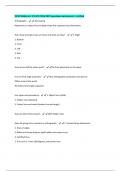
CPA ethics course Exam (Latest Update)
Questions and Verified Answers (100%
Guaranteed Pass).


Question:
To address an ethical matter and make good judgments, you must first be able to recognize issues
when they arise.
This means being familiar with the profession's body of rules and regulations from the American
Institute of Certified Public Accountants, your local state accountancy board, which issues your
license to practice, and other sources of regulation. This also means staying attuned to potential
ethical "warning signs."


Question:
Ethical decision making model
1. recognize the ethical issue


2. gather the critical facts


3. identify the stakeholders


4. consider your alternatives


5. consider the effect on stakeholders


6. consider your comfort level

,7 consider rules, regulations and laws


8. make a decision


9. document your effort


10. evaluate the outcome


Question:
Which step in the decision-making model is characterized by asking the question, "Are these
options consistent with applicable professional ethics rules, regulations, and laws?" consider
rules, regulations and laws.


Step 7 asks this question. You may determine that the greatest benefit and least amount of harm
would likely result if you take a particular course of action, but if that course of action is
inconsistent with the profession's rules of conduct, you may not ignore those rules


Question:
Which step in the decision-making model is characterized by asking the question, "If you had
to discuss your decision in public, would you be concerned about how it reflects on your
ethics?" consider your comfort level


Step 6 asks you to consider your comfort level. Before you make a decision about the correct
action when facing an ethical issue, you should ask yourself some questions. Click the forward
arrow to continue.

, Question:
GAO
The GAO issues ethics and independence rules that apply to engagements performed under
generally accepted government auditing standards (GAGAS). These governmental standards are
commonly referred to as the "Yellow Book." We will discuss these rules later in this course.


Question:
Internal Revenue Service (IRS)
The IRS is a government agency under the U.S. Department of the Treasury. The Internal
Revenue Code (IRC) authorizes the Secretary of the Treasury to set rules and regulations
necessary to enforce the U.S. tax laws. Treasury Department Circular 230 governs federal tax
practice before the IRS by CPAs, enrolled agents, attorneys, and actuaries, and the IRS Office of
Professional Responsibility (OPR) enforces these regulations. Preparer penalty and
confidentiality provisions appear in the IRC. We will discuss the ethics requirements for CPAs in
tax practice later in this course.


Question:
U.S. Department of Labor (DOL)
Auditors of employee benefit plans that file reports with the DOL should be aware of the DOL
interpretive bulletin on independence. These rules will be addressed later in this course.


Question:
American Institute of Certified Public Accountants
The American Institute of Certified Public Accountants is the national professional organization
for all certified public accountants. Its mission is to provide members with the resources and
information that enable them to offer valuable services in the highest professional manner to
benefit the public, employers, and clients.

$11.49
Accede al documento completo:

100% de satisfacción garantizada
Inmediatamente disponible después del pago
Tanto en línea como en PDF
No estas atado a nada


Documento también disponible en un lote

Conoce al vendedor

Seller avatar
Los indicadores de reputación están sujetos a la cantidad de artículos vendidos por una tarifa y las reseñas que ha recibido por esos documentos. Hay tres niveles: Bronce, Plata y Oro. Cuanto mayor reputación, más podrás confiar en la calidad del trabajo del vendedor.
ProfGoodlucK Rasmussen College
Seguir Necesitas iniciar sesión para seguir a otros usuarios o asignaturas
Vendido
3480
Miembro desde
5 año
Número de seguidores
2868
Documentos
8730
Última venta
1 día hace
High Quality Exams, Study guides, Reviews, Notes, Case Studies

All study solutions.

4.0

706 reseñas

5
381
4
131
3
83
2
39
1
72

Recientemente visto por ti

Por qué los estudiantes eligen Stuvia

Creado por compañeros estudiantes, verificado por reseñas

Calidad en la que puedes confiar: escrito por estudiantes que aprobaron y evaluado por otros que han usado estos resúmenes.

¿No estás satisfecho? Elige otro documento

¡No te preocupes! Puedes elegir directamente otro documento que se ajuste mejor a lo que buscas.

Paga como quieras, empieza a estudiar al instante

Sin suscripción, sin compromisos. Paga como estés acostumbrado con tarjeta de crédito y descarga tu documento PDF inmediatamente.

Student with book image

“Comprado, descargado y aprobado. Así de fácil puede ser.”

Alisha Student

Preguntas frecuentes