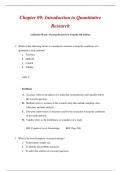
Chapter 09: Introduction to Quantitative
Research
LoBiondo-Wood: Nursing Research in Canada, 4th Edition
1. Which of the following factors is considered a measure to keep the conditions of a
quantitative study uniform?
a. Accuracy
b. Methods
c. Control
d. Validity
ANS: C
Feedback
A. Accuracy refers to all aspects of a study that systematically and logically follow
the research question.
B. Methods refers to sections of the research study that include sampling, data
collection, and data analysis.
C. The term control refers to measures used by the researcher to keep the conditions
of the study uniform.
D. Validity refers to the truthfulness or soundness of a study.
DIF: Cognitive Level: Knowledge REF: Page 200
2. What is the overall purpose of research design?
a. To determine sample size
b. To identify the problem statement
c. To aid in the solution of a research question
, d. To assist the researcher in identifying gaps in knowledge
ANS: C
Feedback
A. Sample size is determined by the chosen design and power analysis.
B. The problem statement describes the general focus of the research study.
C. The purpose of the research design is to provide the plan for finding answers to
the research question(s).
D. Gaps in knowledge should be identified and synthesized in the literature review.
DIF: Cognitive Level: Comprehension REF: Pages 199–200
3. Which of the following actions in a quantitative research study represents a measure to
eliminate bias on the dependent variable?
a. Establishing strict eligibility criteria for the study participants
b. Ensuring that all data are collected by a single researcher
c. Formulating at least two hypotheses for each research question
d. Testing a theoretical framework
ANS: A
Feedback
A. Strict eligibility criteria help reduce extraneous or mediating variables that
compete with study variables for influence on the dependent variable.
B. Collection of data by a single researcher would not control bias if poor sampling
techniques are used.
C. Formulating two hypotheses would not eliminate potential bias and could
possibly confuse the study.
Research
LoBiondo-Wood: Nursing Research in Canada, 4th Edition
1. Which of the following factors is considered a measure to keep the conditions of a
quantitative study uniform?
a. Accuracy
b. Methods
c. Control
d. Validity
ANS: C
Feedback
A. Accuracy refers to all aspects of a study that systematically and logically follow
the research question.
B. Methods refers to sections of the research study that include sampling, data
collection, and data analysis.
C. The term control refers to measures used by the researcher to keep the conditions
of the study uniform.
D. Validity refers to the truthfulness or soundness of a study.
DIF: Cognitive Level: Knowledge REF: Page 200
2. What is the overall purpose of research design?
a. To determine sample size
b. To identify the problem statement
c. To aid in the solution of a research question
, d. To assist the researcher in identifying gaps in knowledge
ANS: C
Feedback
A. Sample size is determined by the chosen design and power analysis.
B. The problem statement describes the general focus of the research study.
C. The purpose of the research design is to provide the plan for finding answers to
the research question(s).
D. Gaps in knowledge should be identified and synthesized in the literature review.
DIF: Cognitive Level: Comprehension REF: Pages 199–200
3. Which of the following actions in a quantitative research study represents a measure to
eliminate bias on the dependent variable?
a. Establishing strict eligibility criteria for the study participants
b. Ensuring that all data are collected by a single researcher
c. Formulating at least two hypotheses for each research question
d. Testing a theoretical framework
ANS: A
Feedback
A. Strict eligibility criteria help reduce extraneous or mediating variables that
compete with study variables for influence on the dependent variable.
B. Collection of data by a single researcher would not control bias if poor sampling
techniques are used.
C. Formulating two hypotheses would not eliminate potential bias and could
possibly confuse the study.