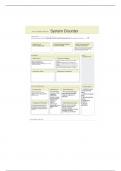
ACTIVE LEARNING TEMPLATE: System Disorder
STUDENT NAME _____________________________________
96
Postoperative Care for a Child Following a Skin Graft REVIEW MODULE CHAPTER ___________
DISORDER/DISEASE PROCESS __________________________________________________________
Alterations in Pathophysiology Related Health Promotion and
Health (Diagnosis) to Client Problem Disease Prevention
Biologic skin coverings may be used to promote healing
of large buns. Requires repeated surgical application.
Permanent skin coverings may be treatment of choice
for burns covering large areas of the body
ASSESSMENT SAFETY
CONSIDERATIONS
Risk Factors Expected Findings
Infections - discoloration of unburned skin surrounding burn wound - Observe drainage tubes for patency and proper
- green color to subcutaneous fat
- degeneration of granulation tissue function
- development of subeschar hemorrhage - Check dressings for excessive drainage and
- hyperventilation indicating systemic involvement of infection reinforce as needed. Report excess drainage to the
- unstable body temperature
surgeon
- Outline drainage spots with a pen, noting date and
time. Report increasing drainage to the surgeon.
Laboratory Tests Diagnostic Procedures
PATIENT-CENTERED CARE Complications
Nursing Care Medications Client Education 1. Inhalation injury
- Direct thermal
- Administer humidified oxygen
- Maintain immobilization of the graft gate
Pain medications - The child should keep injury
- Premedicate as prescribed prior to wound care - Morphine sulfate the extremity elevated
(administer hydroxyzine or diphenhydramine for
(analgesia), - carbon monoxide
pruritus)
- Elevate the extremity
- Midazolam,
- Report evidence of injury
fentanyl, propofol, infection 2. Shock/systemic
and nitrous oxide sepsis
(sedation and
analgesia) 3. Pulmonary
- Nitrous problems
Therapeutic Procedures Interprofessional Care
oxide/oxygen 4. Wound
- Provide heated blankets when the client arrives
after a temperature is obtained and reapply if the mixture (short term Refer to services (nutrition, infections
client is hypothermic. Causes of hypothermia analgesic gas. child life, social support,
include decreased body fat, age-related changes in
the hypothalamus that regulate body temperature, 50%) respiration therapy,
and decreased environmental temperature in the
surgical suite.
occupational/physical therapy,
individual and family
counseling) as prescribed
ACTIVE LEARNING TEMPLATES
STUDENT NAME _____________________________________
96
Postoperative Care for a Child Following a Skin Graft REVIEW MODULE CHAPTER ___________
DISORDER/DISEASE PROCESS __________________________________________________________
Alterations in Pathophysiology Related Health Promotion and
Health (Diagnosis) to Client Problem Disease Prevention
Biologic skin coverings may be used to promote healing
of large buns. Requires repeated surgical application.
Permanent skin coverings may be treatment of choice
for burns covering large areas of the body
ASSESSMENT SAFETY
CONSIDERATIONS
Risk Factors Expected Findings
Infections - discoloration of unburned skin surrounding burn wound - Observe drainage tubes for patency and proper
- green color to subcutaneous fat
- degeneration of granulation tissue function
- development of subeschar hemorrhage - Check dressings for excessive drainage and
- hyperventilation indicating systemic involvement of infection reinforce as needed. Report excess drainage to the
- unstable body temperature
surgeon
- Outline drainage spots with a pen, noting date and
time. Report increasing drainage to the surgeon.
Laboratory Tests Diagnostic Procedures
PATIENT-CENTERED CARE Complications
Nursing Care Medications Client Education 1. Inhalation injury
- Direct thermal
- Administer humidified oxygen
- Maintain immobilization of the graft gate
Pain medications - The child should keep injury
- Premedicate as prescribed prior to wound care - Morphine sulfate the extremity elevated
(administer hydroxyzine or diphenhydramine for
(analgesia), - carbon monoxide
pruritus)
- Elevate the extremity
- Midazolam,
- Report evidence of injury
fentanyl, propofol, infection 2. Shock/systemic
and nitrous oxide sepsis
(sedation and
analgesia) 3. Pulmonary
- Nitrous problems
Therapeutic Procedures Interprofessional Care
oxide/oxygen 4. Wound
- Provide heated blankets when the client arrives
after a temperature is obtained and reapply if the mixture (short term Refer to services (nutrition, infections
client is hypothermic. Causes of hypothermia analgesic gas. child life, social support,
include decreased body fat, age-related changes in
the hypothalamus that regulate body temperature, 50%) respiration therapy,
and decreased environmental temperature in the
surgical suite.
occupational/physical therapy,
individual and family
counseling) as prescribed
ACTIVE LEARNING TEMPLATES