Page: 1 of 6
Student name:
Addition in Binary and Hexadecimal
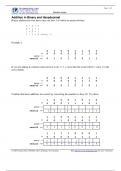
Binary addition has four basic rules, the first 3 of which are pretty obvious:
0 + 0 = 0
0 + 1 = 1
1 + 0 = 1
1 + 1 = 0 carry 1.
Example 1:
0 1 0 0 1 1 0 1
+ 0 0 0 0 0 1 1 0
carry -> 1 1
result -> 0 1 0 1 0 0 1 1
If you are adding in columns and you have to do 1 + 1 + carry then the result will be 1 carry 1 to the
next column:
0 0 0 0 1 1 1 1
+ 0 0 0 0 0 1 1 0
carry -> 1 1 1
result -> 0 0 0 1 0 1 0 1
Confirm that these additions are correct by converting the numbers to base 10. Try these:
1 0 0 0 1 0 1 0
+ 0 0 0 1 1 1 0 1
carry -> 1
result -> 1 0 1 0 0 1 1 1
1 1 0 0 1 1 1 1
+ 0 0 1 0 0 0 1 1
carry -> 1 1 1 1
result -> 1 1 1 1 0 0 1 0
1 1 1 1 0 0 0 1
+ 0 0 0 0 1 1 1 1
carry -> 1 1 1 1 1 1 1
result -> 0 0 0 0 0 0 0 0
© 2007 Richard Jones, PO BOX 246, Cambridge, New Zealand. See: http://www.ib-computing.com/ for more worksheets
, Page: 2 of 6
Student name:
What happened in the last example?
We ran out of bits to show the result of the sum.
-----------------------------------------------------------------------------------------------------------------
-----------------------------------------------------------------------------------------------------------------
This is known as “overflow”.
Imagine now that the three examples given above are in two’s complement form (the last value is the
same magnitude but negative – ie -128).
Convert to decimal and see what the examples tell you. Comment on the last example again:
-----------------------------------------------------------------------------------------------------------------
Adding those two numbers result in zero/overflow.
-----------------------------------------------------------------------------------------------------------------
We conclude that when subtracting two numbers by adding a two’s complement form positive number
to a two’s complement form negative number, that any overflow beyond the MSB can be ignored. This
is not true, of course, for addition.
Consider two hexadecimal numbers:
0 0 1 A
0 2 0 9
carry -> 1
result -> 0 2 2 3
When we add the first column 9 + A we clearly go beyond F – the largest hex symbol we can have. I
got three by starting my left-hand thumb at A and then counting round 9 fingers (not forgetting 0) to
get the 3. Then of course we need to carry to the next column.
This is a bit tricky if you have to add, say C and D – you need more than 10 fingers (unless you can
“wrap around” of course.
The easiest way (I find) is to write down the numbers on a peice of paper (which you can do in the
exam – remembering you won’t have a calculator with you), and count around:
For example to add C to D:
0 1 2 3 4 5 6 7 8 9 A B C D E F
start
here
Now, count around 1 on D, 2 on E, 3 on F, 4 on 0 and so on, until you count to D; you should end up
on 9.
© 2007 Richard Jones, PO BOX 246, Cambridge, New Zealand. See: http://www.ib-computing.com/ for more worksheets
Student name:
Addition in Binary and Hexadecimal
Binary addition has four basic rules, the first 3 of which are pretty obvious:
0 + 0 = 0
0 + 1 = 1
1 + 0 = 1
1 + 1 = 0 carry 1.
Example 1:
0 1 0 0 1 1 0 1
+ 0 0 0 0 0 1 1 0
carry -> 1 1
result -> 0 1 0 1 0 0 1 1
If you are adding in columns and you have to do 1 + 1 + carry then the result will be 1 carry 1 to the
next column:
0 0 0 0 1 1 1 1
+ 0 0 0 0 0 1 1 0
carry -> 1 1 1
result -> 0 0 0 1 0 1 0 1
Confirm that these additions are correct by converting the numbers to base 10. Try these:
1 0 0 0 1 0 1 0
+ 0 0 0 1 1 1 0 1
carry -> 1
result -> 1 0 1 0 0 1 1 1
1 1 0 0 1 1 1 1
+ 0 0 1 0 0 0 1 1
carry -> 1 1 1 1
result -> 1 1 1 1 0 0 1 0
1 1 1 1 0 0 0 1
+ 0 0 0 0 1 1 1 1
carry -> 1 1 1 1 1 1 1
result -> 0 0 0 0 0 0 0 0
© 2007 Richard Jones, PO BOX 246, Cambridge, New Zealand. See: http://www.ib-computing.com/ for more worksheets
, Page: 2 of 6
Student name:
What happened in the last example?
We ran out of bits to show the result of the sum.
-----------------------------------------------------------------------------------------------------------------
-----------------------------------------------------------------------------------------------------------------
This is known as “overflow”.
Imagine now that the three examples given above are in two’s complement form (the last value is the
same magnitude but negative – ie -128).
Convert to decimal and see what the examples tell you. Comment on the last example again:
-----------------------------------------------------------------------------------------------------------------
Adding those two numbers result in zero/overflow.
-----------------------------------------------------------------------------------------------------------------
We conclude that when subtracting two numbers by adding a two’s complement form positive number
to a two’s complement form negative number, that any overflow beyond the MSB can be ignored. This
is not true, of course, for addition.
Consider two hexadecimal numbers:
0 0 1 A
0 2 0 9
carry -> 1
result -> 0 2 2 3
When we add the first column 9 + A we clearly go beyond F – the largest hex symbol we can have. I
got three by starting my left-hand thumb at A and then counting round 9 fingers (not forgetting 0) to
get the 3. Then of course we need to carry to the next column.
This is a bit tricky if you have to add, say C and D – you need more than 10 fingers (unless you can
“wrap around” of course.
The easiest way (I find) is to write down the numbers on a peice of paper (which you can do in the
exam – remembering you won’t have a calculator with you), and count around:
For example to add C to D:
0 1 2 3 4 5 6 7 8 9 A B C D E F
start
here
Now, count around 1 on D, 2 on E, 3 on F, 4 on 0 and so on, until you count to D; you should end up
on 9.
© 2007 Richard Jones, PO BOX 246, Cambridge, New Zealand. See: http://www.ib-computing.com/ for more worksheets