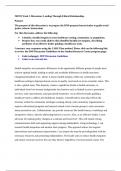
NR703 Week 5 Discussion: Leading Through Ethical Relationships
Purpose
The purpose of this discussion is to prepare the DNP-prepared nurse leader to guide social
justice reform. Instructions
For this discussion, address the following:
I dentify a health inequity in your healthcare setting, community, or population.
Propose how you could address this identified healthcare inequity, describing
attributes of an effective leader guiding a healthcare team.
Construct your responses using the CARE Plan method. Please click on the following link
to review the DNP Discussion Guidelines on the Student Resource Center program page:
Link (webpage): DNP Discussion Guidelines
Links to an external site.
Health inequities are systematic differences in the opportunity different groups of people must
achieve optimal health, leading to unfair and avoidable differences in health outcomes
(Tangcharoensathien et al., 2023). A known health inequity within my community in the
healthcare setting is disproportionate access to quality care based on socio-economic status. This
is also a global issue. This disparity creates a significant divide in health outcomes, as
individuals from low-income backgrounds face barriers such as limited access to preventive
services, early interventions, and specialized treatments. As an effective leader guiding a
healthcare team to address this healthcare inequity, I should build a team that reflects the
diversity within the community and begin working closely with community organizations to
improve educational programs and outreach aimed at low-income groups to raise awareness
about preventive care. Collaborations can provide resources like health literacy workshops and
inexpensive clinics, directly addressing barriers to access. Also, as an effective leader, I must
advocate for making policy changes at a national and local level. This will require strong
communication skills and organizing support among stakeholders. Using technology, I can
research health disparities and monitor their progress. This approach allows for targeted
interventions and continuous improvement. I can inspire the team by providing them with the
necessary resources and promoting independence. The leader aims to reduce health inequities
and ensure everyone receives the care they deserve regardless of socioeconomic status. The
Purpose
The purpose of this discussion is to prepare the DNP-prepared nurse leader to guide social
justice reform. Instructions
For this discussion, address the following:
I dentify a health inequity in your healthcare setting, community, or population.
Propose how you could address this identified healthcare inequity, describing
attributes of an effective leader guiding a healthcare team.
Construct your responses using the CARE Plan method. Please click on the following link
to review the DNP Discussion Guidelines on the Student Resource Center program page:
Link (webpage): DNP Discussion Guidelines
Links to an external site.
Health inequities are systematic differences in the opportunity different groups of people must
achieve optimal health, leading to unfair and avoidable differences in health outcomes
(Tangcharoensathien et al., 2023). A known health inequity within my community in the
healthcare setting is disproportionate access to quality care based on socio-economic status. This
is also a global issue. This disparity creates a significant divide in health outcomes, as
individuals from low-income backgrounds face barriers such as limited access to preventive
services, early interventions, and specialized treatments. As an effective leader guiding a
healthcare team to address this healthcare inequity, I should build a team that reflects the
diversity within the community and begin working closely with community organizations to
improve educational programs and outreach aimed at low-income groups to raise awareness
about preventive care. Collaborations can provide resources like health literacy workshops and
inexpensive clinics, directly addressing barriers to access. Also, as an effective leader, I must
advocate for making policy changes at a national and local level. This will require strong
communication skills and organizing support among stakeholders. Using technology, I can
research health disparities and monitor their progress. This approach allows for targeted
interventions and continuous improvement. I can inspire the team by providing them with the
necessary resources and promoting independence. The leader aims to reduce health inequities
and ensure everyone receives the care they deserve regardless of socioeconomic status. The