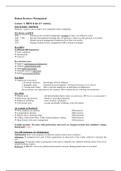
Human Resource Management
Lecture 1: HRM in the 21st century.
Case of today – Starbucks
Starbucks’ turnover rate is relative low compared to their competitors.
The history of HRM
1930 : Taylorism and scientific management (workers are lazy, not willing to work)
1930 – 1960 : Personnel management (keeping files of employees, make sure they get paid, cost center)
1960 : Human resource management (employees have their own needs)
1970 : Strategic human resource management (HR is related to strategy)
M in HRM
Traditional HRM aimed for:
Task completion
Absenteeism
Turnover
Key outcomes now:
Improve performance & productivity
Achieve organizational goals
Help employees prosper
Stimulate positive behaviours
Fulfill social responsibilities
R in HRM
Employees as resources
1. Economic resources (knowledge, skills & abilities)
2. Intangible assets (creativity & social capitals (=background brings in new ideas))
3. Varying asset values (star vs non-star employees; up and downs of employees)
Star performers are important for the company; HR is responsible for retaining star performers.
H in HRM
Human needs : self-determination theory (make own decisions, HR; how to accommodate?)
Motivation and emotions : Maslow’s motivation hierarchy
Employee wellbeing : stress, burnout, satisfaction
Life beyond work : security and health, wellbeing, work-life balance
An example of Starbucks
Treat employees as partners (HR policies)
Compensation structure (HR systems)
Salaries above minimum wage (HR practices)
College Achievement Plan, Coffee master program; training (HR practices)
Open forums with senior management (HR practices)
Example question: The most valid performance interviews are designed around each candidate’s unique
background. False!
New HR challenges (1) Globalization
Globalization deals with companies in different countries and diverse workforce.
Offshoring companies have part of their organization in other parts of the world; could be to decrease the
cost.
Outsourcing outsource tasks is giving part of the tasks to someone else, different location; doesn’t have to be
outside the home country.
Reshoring BREXIT; driven by political and economic concerns. Bringing back tasks to own hand.
,How does it challenge HRM in the 21st century?
Obtain HR at home, host and third-party
Racial and cultural diversity in labor forces
Performance management: global assignment, expatriation and reparation
Global assignment and compensation
Training and development
Legislation compliance and labor relations
New HR challenges (2) Changing demographic trends
Racial diversity
Increasing female labor
Aging workforce (increase retirement rate, create retirement plans, etc.)
How does it challenge HRM in the 21st century?
Succession plans
Performance management (technology challenges)
Benefit & compensation (pension, health, safety schemes)
Legislation and labor relations (age discrimination)
New HR challenges (3) Diversified employment forms
part-time jobs, freelancers, start-ups, entrepreneurship, flex-workers
employees may have multiple contracts and bosses (HR: how to manage this?)
How does it challenge HRM in the 21st century?
Psychological contract: The mutual beliefs, perceptions, and informal obligations between an employer and
an employee that are distinct from the formal employment contract
Psychological success
Protean career: A career that is driven by the individual and not by the organization. Try to retain employees
(training, motivation, satisfaction) to deal with this problem.
New HR challenges (4) Sustainability and social responsibility
Customers are more social responsible, companies react on this; customers do not want to buy coffee beans
that are not sustainable and therefore companies should make the coffee beans companies sustainable.
New HR challenges (5) Technology development
Aging employees have to deal with changing technology; have to adapt to tablets, laptops etc.
Companies more and more communicate with employees online (schedule, payment etc.).
Strategic Human Resource Management
Strategy is made up from internal and external environment and should match the organizations’ structure and
culture. Strategic HRM is a pattern of planned HR activities intended to enable an organization to reach its
desired outcomes and results
Common strategies:
> Cost leadership
> Differentiation
> Niche market
Strategic configuration of HR practices
1. Match HR practices with corporate strategies
2. Develop a strategic configuration of HR practices
> Focus on core/strategic HR functions
> Downplay peripheral/less important HR functions
,Downplay less strategic HRM activities
1. HR Outsourcing (HRO): sub-contracting HR functions to external (payroll, taxes, training, benefits…)
2. Digitalize HR services: online hiring, online training & learning, performance reporting & appraisals.
Three forms of Strategic HR integrations
1. Vertical integration: HR is outward looking and connected to corporate values and beliefs, its corporate
strategy and contextual challenges
2. Horizontal integration: HR activities and contributions need to be mutually supportive and designed in a
holistic way rather than exist as unconnected and isolated interventions
3. Functional integration: HR needs to work in conjunction with other organizational functions (e.g.
manufacturing, sales) rather than in isolation.
Other information:
Self-service is giving employees online access to information about HR issues such as training, benefits, and
compensation
Complexity, formalization and centralization are the three fundamental components of organizational structure.
Complexity is the degree of differentiation & enables to minimize costs. Formalization is the degree of
standardization & influences efficiency. Centralization is the degree to which decision making is centralized and
results in greater control.
, Chapter 1: The New Human Resource Management Process
1.1. Why study Human Resource Management?
Human resources are the people within an organization and are the primary means of creating competitive
advantage.
Employee engagement is the combination of job satisfaction, ability, and a willingness to perform for the
organization at a high level and over an extended period of time. Companies with high levels of satisfaction and
engagement outperformed those companies with less engaged employees in ROI, operating income, growth rate
and long-term company valuation.
1.2. HRM Past and Present
1.2.1. HRM in the Past
Human resource managers in the past were those keeping all personnel files straight, little to do with
organization’s business processes. They provided little services to the organization and therefore they were
considered as cost center (= bringing no revenue or profit for the organization). However, there is a need for
revenue centers (= divisions or departments that generate monetary returns for the organization).
1.2.2. Present View of HRM
Productivity center is a revenue center that enhances profitability of the organization through enhancing the
productivity of the people within the organization.
Today’s HR managers improve organizational revenues and profits by enhancing the productivity of people
within the organization. Productivity is the amount of output that an organization gets per unit of input; human
input is expressed in terms of units of time.
Productivity is the end result of two components:
1. Effectiveness: function of getting the job done whenever and however it must be done. ‘Do we do the right
things?’
2. Efficiency: a function of how many organizational resources we used in getting the job done. ‘Did we do
thing right?’
Most of the time we are focused on efficiency. Chief Human Resource Officers (CHRO) are concerned about
employee engagement and productivity. Having a CHRO increased profitability by 105% compared to
companies that did not have a CHRO.
1.2.3. Technology’s Effect on Efficiency
Technology is used to improve efficiency of workers. Technology allows to gather, analyse and manage large
amounts of data more quickly, this allows managers to find commonalities in the data to create new and more
efficient processes.
1.3. The Changing World of HRM
1.3.2. Labor Demographics
Demographic changes are faced in the labor force more diversity in terms of gender, ethnicity & religion,
aging of workers, skills shortages, etc. This affects HR’s ability to provide the organization with the right
numbers and types of employees. Managers of a 21 st century organization should be more culturally aware and
able to deal with individuals with different work ethics, cultural norms and languages.
1.3.3. Knowledge Workers and the Pace of Change
Knowledge Workers use their head more than hands & manage knowledge for the firm. Technology is
outpacing our ability to use it as computers are getting faster. We must find ways to use the technology more
successfully through hiring and training better and more capable employees to create competitive advantage.
There is a continuous shortage of knowledge workers.
1.4. Understanding HR’s Critical Factors
1.4.1. Critical Dependent Variables (issue 1)
Managers must control things that they can’t directly manipulate because people have free will. These items are
called dependent variables because they can be affected only through indirect means. We can control the
independent variable.
Lecture 1: HRM in the 21st century.
Case of today – Starbucks
Starbucks’ turnover rate is relative low compared to their competitors.
The history of HRM
1930 : Taylorism and scientific management (workers are lazy, not willing to work)
1930 – 1960 : Personnel management (keeping files of employees, make sure they get paid, cost center)
1960 : Human resource management (employees have their own needs)
1970 : Strategic human resource management (HR is related to strategy)
M in HRM
Traditional HRM aimed for:
Task completion
Absenteeism
Turnover
Key outcomes now:
Improve performance & productivity
Achieve organizational goals
Help employees prosper
Stimulate positive behaviours
Fulfill social responsibilities
R in HRM
Employees as resources
1. Economic resources (knowledge, skills & abilities)
2. Intangible assets (creativity & social capitals (=background brings in new ideas))
3. Varying asset values (star vs non-star employees; up and downs of employees)
Star performers are important for the company; HR is responsible for retaining star performers.
H in HRM
Human needs : self-determination theory (make own decisions, HR; how to accommodate?)
Motivation and emotions : Maslow’s motivation hierarchy
Employee wellbeing : stress, burnout, satisfaction
Life beyond work : security and health, wellbeing, work-life balance
An example of Starbucks
Treat employees as partners (HR policies)
Compensation structure (HR systems)
Salaries above minimum wage (HR practices)
College Achievement Plan, Coffee master program; training (HR practices)
Open forums with senior management (HR practices)
Example question: The most valid performance interviews are designed around each candidate’s unique
background. False!
New HR challenges (1) Globalization
Globalization deals with companies in different countries and diverse workforce.
Offshoring companies have part of their organization in other parts of the world; could be to decrease the
cost.
Outsourcing outsource tasks is giving part of the tasks to someone else, different location; doesn’t have to be
outside the home country.
Reshoring BREXIT; driven by political and economic concerns. Bringing back tasks to own hand.
,How does it challenge HRM in the 21st century?
Obtain HR at home, host and third-party
Racial and cultural diversity in labor forces
Performance management: global assignment, expatriation and reparation
Global assignment and compensation
Training and development
Legislation compliance and labor relations
New HR challenges (2) Changing demographic trends
Racial diversity
Increasing female labor
Aging workforce (increase retirement rate, create retirement plans, etc.)
How does it challenge HRM in the 21st century?
Succession plans
Performance management (technology challenges)
Benefit & compensation (pension, health, safety schemes)
Legislation and labor relations (age discrimination)
New HR challenges (3) Diversified employment forms
part-time jobs, freelancers, start-ups, entrepreneurship, flex-workers
employees may have multiple contracts and bosses (HR: how to manage this?)
How does it challenge HRM in the 21st century?
Psychological contract: The mutual beliefs, perceptions, and informal obligations between an employer and
an employee that are distinct from the formal employment contract
Psychological success
Protean career: A career that is driven by the individual and not by the organization. Try to retain employees
(training, motivation, satisfaction) to deal with this problem.
New HR challenges (4) Sustainability and social responsibility
Customers are more social responsible, companies react on this; customers do not want to buy coffee beans
that are not sustainable and therefore companies should make the coffee beans companies sustainable.
New HR challenges (5) Technology development
Aging employees have to deal with changing technology; have to adapt to tablets, laptops etc.
Companies more and more communicate with employees online (schedule, payment etc.).
Strategic Human Resource Management
Strategy is made up from internal and external environment and should match the organizations’ structure and
culture. Strategic HRM is a pattern of planned HR activities intended to enable an organization to reach its
desired outcomes and results
Common strategies:
> Cost leadership
> Differentiation
> Niche market
Strategic configuration of HR practices
1. Match HR practices with corporate strategies
2. Develop a strategic configuration of HR practices
> Focus on core/strategic HR functions
> Downplay peripheral/less important HR functions
,Downplay less strategic HRM activities
1. HR Outsourcing (HRO): sub-contracting HR functions to external (payroll, taxes, training, benefits…)
2. Digitalize HR services: online hiring, online training & learning, performance reporting & appraisals.
Three forms of Strategic HR integrations
1. Vertical integration: HR is outward looking and connected to corporate values and beliefs, its corporate
strategy and contextual challenges
2. Horizontal integration: HR activities and contributions need to be mutually supportive and designed in a
holistic way rather than exist as unconnected and isolated interventions
3. Functional integration: HR needs to work in conjunction with other organizational functions (e.g.
manufacturing, sales) rather than in isolation.
Other information:
Self-service is giving employees online access to information about HR issues such as training, benefits, and
compensation
Complexity, formalization and centralization are the three fundamental components of organizational structure.
Complexity is the degree of differentiation & enables to minimize costs. Formalization is the degree of
standardization & influences efficiency. Centralization is the degree to which decision making is centralized and
results in greater control.
, Chapter 1: The New Human Resource Management Process
1.1. Why study Human Resource Management?
Human resources are the people within an organization and are the primary means of creating competitive
advantage.
Employee engagement is the combination of job satisfaction, ability, and a willingness to perform for the
organization at a high level and over an extended period of time. Companies with high levels of satisfaction and
engagement outperformed those companies with less engaged employees in ROI, operating income, growth rate
and long-term company valuation.
1.2. HRM Past and Present
1.2.1. HRM in the Past
Human resource managers in the past were those keeping all personnel files straight, little to do with
organization’s business processes. They provided little services to the organization and therefore they were
considered as cost center (= bringing no revenue or profit for the organization). However, there is a need for
revenue centers (= divisions or departments that generate monetary returns for the organization).
1.2.2. Present View of HRM
Productivity center is a revenue center that enhances profitability of the organization through enhancing the
productivity of the people within the organization.
Today’s HR managers improve organizational revenues and profits by enhancing the productivity of people
within the organization. Productivity is the amount of output that an organization gets per unit of input; human
input is expressed in terms of units of time.
Productivity is the end result of two components:
1. Effectiveness: function of getting the job done whenever and however it must be done. ‘Do we do the right
things?’
2. Efficiency: a function of how many organizational resources we used in getting the job done. ‘Did we do
thing right?’
Most of the time we are focused on efficiency. Chief Human Resource Officers (CHRO) are concerned about
employee engagement and productivity. Having a CHRO increased profitability by 105% compared to
companies that did not have a CHRO.
1.2.3. Technology’s Effect on Efficiency
Technology is used to improve efficiency of workers. Technology allows to gather, analyse and manage large
amounts of data more quickly, this allows managers to find commonalities in the data to create new and more
efficient processes.
1.3. The Changing World of HRM
1.3.2. Labor Demographics
Demographic changes are faced in the labor force more diversity in terms of gender, ethnicity & religion,
aging of workers, skills shortages, etc. This affects HR’s ability to provide the organization with the right
numbers and types of employees. Managers of a 21 st century organization should be more culturally aware and
able to deal with individuals with different work ethics, cultural norms and languages.
1.3.3. Knowledge Workers and the Pace of Change
Knowledge Workers use their head more than hands & manage knowledge for the firm. Technology is
outpacing our ability to use it as computers are getting faster. We must find ways to use the technology more
successfully through hiring and training better and more capable employees to create competitive advantage.
There is a continuous shortage of knowledge workers.
1.4. Understanding HR’s Critical Factors
1.4.1. Critical Dependent Variables (issue 1)
Managers must control things that they can’t directly manipulate because people have free will. These items are
called dependent variables because they can be affected only through indirect means. We can control the
independent variable.