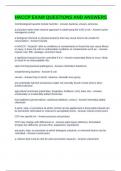
HACCP EXAM QUESTIONS AND ANSWERS
microbiological hazards include harmful: - Answer-bacteria, viruses, protozoa
a proactive rather than reactive approach to addressing the CDC's risk - Answer-active
managerial control.
a biological chemical or physical property that may cause food to be unsafe for
consumption - Answer-hazard.
in HACCP, "hazards" refer to conditions or contaminants in foods that can cause illness
or injury. It does not refer to undesirable conditions or contaminants such as: - Answer-
insects, hair, filth, spoilage, economic fraud.
a significant hazard must be controlled if it is - Answer-reasonably likely to occur, likely
to result in an unacceptable risk.
spore forming bacteria (pathogens) - Answer-clostridium botulinum.
nonperforming bacteria - Answer-E coli
viruses - Answer-hep A and E, rotavirus, Norwalk virus group
any potentially harmful extraneous matter not normally found in food (cherry pits) -
Answer-physical
agricultural chemicals (pesticides, fungicides, fertilizers, GH), lead, zinc - Answer-
unintentially or incidentally added chemicals.
food additives (perservatives, nutritional additives, colour) - Answer-intentially added
chemicals
A point, step, or procedure at which control can be applied and a food safety hazard can
be prevented, eliminated or reduced to acceptable levels - Answer-critical control point.
CCP are specific for - Answer-process and product.
CCP may change with differences in - Answer-plant layout (kitchen), formulation
(recipes are different), process flow, equipment, ingredients.
any point, step, or procedure at which biological, physical, or chemical factors can be
controlled - Answer-control point.
a criterion that must be met for each preventive measure - Answer-critical limit
microbiological hazards include harmful: - Answer-bacteria, viruses, protozoa
a proactive rather than reactive approach to addressing the CDC's risk - Answer-active
managerial control.
a biological chemical or physical property that may cause food to be unsafe for
consumption - Answer-hazard.
in HACCP, "hazards" refer to conditions or contaminants in foods that can cause illness
or injury. It does not refer to undesirable conditions or contaminants such as: - Answer-
insects, hair, filth, spoilage, economic fraud.
a significant hazard must be controlled if it is - Answer-reasonably likely to occur, likely
to result in an unacceptable risk.
spore forming bacteria (pathogens) - Answer-clostridium botulinum.
nonperforming bacteria - Answer-E coli
viruses - Answer-hep A and E, rotavirus, Norwalk virus group
any potentially harmful extraneous matter not normally found in food (cherry pits) -
Answer-physical
agricultural chemicals (pesticides, fungicides, fertilizers, GH), lead, zinc - Answer-
unintentially or incidentally added chemicals.
food additives (perservatives, nutritional additives, colour) - Answer-intentially added
chemicals
A point, step, or procedure at which control can be applied and a food safety hazard can
be prevented, eliminated or reduced to acceptable levels - Answer-critical control point.
CCP are specific for - Answer-process and product.
CCP may change with differences in - Answer-plant layout (kitchen), formulation
(recipes are different), process flow, equipment, ingredients.
any point, step, or procedure at which biological, physical, or chemical factors can be
controlled - Answer-control point.
a criterion that must be met for each preventive measure - Answer-critical limit