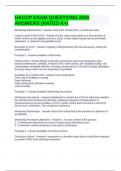
HACCP EXAM QUESTIONS AND
ANSWERS (RATED A+)
Monitoring Measurement - Answer-Used if the critical limit is a numerical value
Critical Control Point (CCP) - Answer-A point, step or procedure in a food process at
which control can be applied, and as a result, a food safety hazard can be prevented,
eliminated, or reduced to acceptable levels.
Examples of CCPs - Answer-Cooking, chilling/cooking, thermal processing, testing for
contamination
Principle 3 - Answer-Establish critical limits
Critical Limits - Answer-Based on process parameters such as temperature, time,
physical dimensions, humidity, moisture level, water activity, pH, titratable acidity, salt
concentration, available chlorine, viscosity, preservatives or survival of target pathogens
at actual values which can be measured or quantified.
Examples of a Critical Limit - Answer-Oven temperature
Time: rate of heating or cooling
Patty thickness
Patty composition (all beef or turkey)
Oven humidity
Principle 4 - Answer-Establish Monitoring Procedures
Monitoring Procedures - Answer-Established to monitor the CCPs to determine whether
the critical limits are being met through a planned sequence of observations or
measurements to access whether a CCP is under control and to produce a record for
future use in verification. This should be continuous.
Monitoring Observation - Answer-Used if the critical limit is the presence or absence of
an attribute
Monitoring Procedure Objectives - Answer-1. To track control of the process
2. To determine when there is a loss of control and a deviation occurs
3. To provide a written document to be used in verification
Principle 5 - Answer-Establish Corrective Actions
Corrective Actions - Answer-A response to a deviation away from a critical limit required
to prevent PHFs from reaching consumers.
, Correction Action Steps - Answer-1. Identify and eliminate the cause of the deviation
2. Ensure that the CCP is under control after the corrective action is taken
3. Ensure that measures are established to prevent recurrence
4. Ensure that no product affected by the deviation is shipped
Principle 6 - Answer-Establish Verification Procedures
Verification Procedures - Answer-Establish the accuracy of, or confirm the monitoring
of, the critical control points demontrating that the HACCP system is adequately
controlling food safety hazards.
Principle 7 - Answer-Establish Record Keeping and Documentation Procedures
Record Keeping and Documentation - Answer-Used to trace the production history of a
finished product and determines if the product was produced in a safe manner
according to the HAACP plan.
Maintains 4 Record Types - Answer-1. Summary of the hazard analysis including the
rationale
2. HACCP Plan
3. Support documentation such as validation records
4. Daily operational records generated during the operation of the HAACP plan.
Requirements of the Records - Answer-1. Date and time of the activity reflected on the
record
2. Signature or initials of the employee making the entry
3. Info entered on the record at the time it is being observed
4. Actual observations or data values obtained
What are the 7 steps of the HACCP system? - Answer-1. Assess hazards.
2. Identify critical control points (CCPs).
3. Set up standards or limits for CCPs.
4. Set up procedures for monitoring CCPs.
5. Establish corrective actions.
6. Set up a recordkeeping system.
7. Verify the system is working.
what does HACCP stand for? - Answer-Hazard Analysis Critical Control Point
the concept of the flow of food refers to? - Answer-movement of food through a food-
service operation, from receiving through storage, preparation, and service, until it gets
to the final consumer.
Name the three categories hazards can fall into: - Answer-contamination, growth of
bacteria or other pathogens and survival of pathogens
ANSWERS (RATED A+)
Monitoring Measurement - Answer-Used if the critical limit is a numerical value
Critical Control Point (CCP) - Answer-A point, step or procedure in a food process at
which control can be applied, and as a result, a food safety hazard can be prevented,
eliminated, or reduced to acceptable levels.
Examples of CCPs - Answer-Cooking, chilling/cooking, thermal processing, testing for
contamination
Principle 3 - Answer-Establish critical limits
Critical Limits - Answer-Based on process parameters such as temperature, time,
physical dimensions, humidity, moisture level, water activity, pH, titratable acidity, salt
concentration, available chlorine, viscosity, preservatives or survival of target pathogens
at actual values which can be measured or quantified.
Examples of a Critical Limit - Answer-Oven temperature
Time: rate of heating or cooling
Patty thickness
Patty composition (all beef or turkey)
Oven humidity
Principle 4 - Answer-Establish Monitoring Procedures
Monitoring Procedures - Answer-Established to monitor the CCPs to determine whether
the critical limits are being met through a planned sequence of observations or
measurements to access whether a CCP is under control and to produce a record for
future use in verification. This should be continuous.
Monitoring Observation - Answer-Used if the critical limit is the presence or absence of
an attribute
Monitoring Procedure Objectives - Answer-1. To track control of the process
2. To determine when there is a loss of control and a deviation occurs
3. To provide a written document to be used in verification
Principle 5 - Answer-Establish Corrective Actions
Corrective Actions - Answer-A response to a deviation away from a critical limit required
to prevent PHFs from reaching consumers.
, Correction Action Steps - Answer-1. Identify and eliminate the cause of the deviation
2. Ensure that the CCP is under control after the corrective action is taken
3. Ensure that measures are established to prevent recurrence
4. Ensure that no product affected by the deviation is shipped
Principle 6 - Answer-Establish Verification Procedures
Verification Procedures - Answer-Establish the accuracy of, or confirm the monitoring
of, the critical control points demontrating that the HACCP system is adequately
controlling food safety hazards.
Principle 7 - Answer-Establish Record Keeping and Documentation Procedures
Record Keeping and Documentation - Answer-Used to trace the production history of a
finished product and determines if the product was produced in a safe manner
according to the HAACP plan.
Maintains 4 Record Types - Answer-1. Summary of the hazard analysis including the
rationale
2. HACCP Plan
3. Support documentation such as validation records
4. Daily operational records generated during the operation of the HAACP plan.
Requirements of the Records - Answer-1. Date and time of the activity reflected on the
record
2. Signature or initials of the employee making the entry
3. Info entered on the record at the time it is being observed
4. Actual observations or data values obtained
What are the 7 steps of the HACCP system? - Answer-1. Assess hazards.
2. Identify critical control points (CCPs).
3. Set up standards or limits for CCPs.
4. Set up procedures for monitoring CCPs.
5. Establish corrective actions.
6. Set up a recordkeeping system.
7. Verify the system is working.
what does HACCP stand for? - Answer-Hazard Analysis Critical Control Point
the concept of the flow of food refers to? - Answer-movement of food through a food-
service operation, from receiving through storage, preparation, and service, until it gets
to the final consumer.
Name the three categories hazards can fall into: - Answer-contamination, growth of
bacteria or other pathogens and survival of pathogens