P1
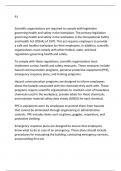
Scientific organizations are required to comply with legislation
governing health and safety in the workplace. The primary legislation
governing health and safety in the workplace is the Occupational Safety
and Health Act (OSHA) of 1970. This act requires employers to provide
a safe and healthy workplace for their employees. In addition, scientific
organizations must comply with other federal, state, and local
regulations governing health and safety.
To comply with these regulations, scientific organizations must
implement various health and safety measures. These measures include
hazard communication programs, personal protective equipment (PPE),
emergency response plans, and training programs.
Hazard communication programs are designed to inform employees
about the hazards associated with the chemicals they work with. These
programs require scientific organizations to maintain a list of hazardous
chemicals used in the workplace, provide labels for these chemicals,
and maintain material safety data sheets (MSDS) for each chemical.
PPE is equipment worn by employees to protect them from hazards
that cannot be eliminated through engineering or administrative
controls. PPE includes items such as gloves, goggles, respirators, and
protective clothing.
Emergency response plans are designed to ensure that employees
know what to do in case of an emergency. These plans should include
procedures for evacuating the building, contacting emergency services,
and providing first aid.
, Under the Management of Health and Safety at Work Regulations,
laboratories, prep rooms and stores are likely to be classified as danger
areas. This means that access should be restricted to those with
appropriate training; unauthorized persons should not be allowed
access.
P2
Biological hazards can significantly endanger human health in labs
working with organisms like bacteria, viruses, fungi, or toxins. In some
cases, exposure to these materials can result in infections or diseases
that are fatal. To prevent exposure, appropriate safety measures are
required, including the use of containment facilities that are
appropriate, wearing personal protective equipment (PPE), and
complying with standard operating procedures (SOPs).
Preparation rooms often contain various chemicals such as cleaning
agents, disinfectants, and laboratory reagents. These chemicals can be
hazardous if not handled properly. Exposure to these chemicals can
cause skin irritation, respiratory problems, and even chemical burns. It
is important to store chemicals properly and use them only as directed.
Preparation rooms may also pose physical hazards such as sharp
objects, hot surfaces, and electrical equipment. Accidents can occur if
these hazards are not properly managed. It is important to keep the
Scientific organizations are required to comply with legislation
governing health and safety in the workplace. The primary legislation
governing health and safety in the workplace is the Occupational Safety
and Health Act (OSHA) of 1970. This act requires employers to provide
a safe and healthy workplace for their employees. In addition, scientific
organizations must comply with other federal, state, and local
regulations governing health and safety.
To comply with these regulations, scientific organizations must
implement various health and safety measures. These measures include
hazard communication programs, personal protective equipment (PPE),
emergency response plans, and training programs.
Hazard communication programs are designed to inform employees
about the hazards associated with the chemicals they work with. These
programs require scientific organizations to maintain a list of hazardous
chemicals used in the workplace, provide labels for these chemicals,
and maintain material safety data sheets (MSDS) for each chemical.
PPE is equipment worn by employees to protect them from hazards
that cannot be eliminated through engineering or administrative
controls. PPE includes items such as gloves, goggles, respirators, and
protective clothing.
Emergency response plans are designed to ensure that employees
know what to do in case of an emergency. These plans should include
procedures for evacuating the building, contacting emergency services,
and providing first aid.
, Under the Management of Health and Safety at Work Regulations,
laboratories, prep rooms and stores are likely to be classified as danger
areas. This means that access should be restricted to those with
appropriate training; unauthorized persons should not be allowed
access.
P2
Biological hazards can significantly endanger human health in labs
working with organisms like bacteria, viruses, fungi, or toxins. In some
cases, exposure to these materials can result in infections or diseases
that are fatal. To prevent exposure, appropriate safety measures are
required, including the use of containment facilities that are
appropriate, wearing personal protective equipment (PPE), and
complying with standard operating procedures (SOPs).
Preparation rooms often contain various chemicals such as cleaning
agents, disinfectants, and laboratory reagents. These chemicals can be
hazardous if not handled properly. Exposure to these chemicals can
cause skin irritation, respiratory problems, and even chemical burns. It
is important to store chemicals properly and use them only as directed.
Preparation rooms may also pose physical hazards such as sharp
objects, hot surfaces, and electrical equipment. Accidents can occur if
these hazards are not properly managed. It is important to keep the