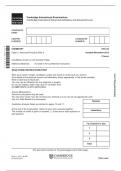
AQA_2024: AS Psychology - Paper 2
Psychology in Context.
(Merged Question Paper and Marking Scheme)
Please write clearly in block capitals.
Centre number Candidate number
Surname
Forename(s)
Candidate signatu re
I declare this is my own work.
AS
PSYCHOLOGY
Paper 2 Psychology in context
Tuesday 21 May 2024 Afternoon Time allowed: 1 hour 30 minutes
Materials
For Examiner’s Use
For this paper you may use:
a calculator. Section Mark
A
Instructions
Use black ink or black ball-point pen. B
Fill in the boxes at the top of this page. C
Answer all questions.
TOTAL
You must answer the questions in the spaces provided. Do not write
outside the box around each page or on blank pages.
If you need extra space for your answer(s), use the lined pages at the end
of this book. Write the question number against your answer(s).
Do all rough work in this book. Cross through any work you do not want
to be marked.
Information
The marks for questions are shown in brackets.
The maximum mark for this paper is 72.
You will be assessed on your ability to:
– use good English
– organise information clearly
– use specialist vocabulary where appropriate.
,For AS Psychology Paper 2 (Psychology in Context), focus on these key areas:
1. Approaches in Psychology:
o Behaviourist: Understand classical (Pavlov) and operant conditioning (Skinner), and their real-life
applications (e.g., therapy and education).
o Cognitive: Study the information processing model, memory (e.g., Baddeley), and its application in
Cognitive Behavioral Therapy (CBT).
o Biological: Focus on neurotransmitters, brain structure, and functions like the fight or flight response.
Key research includes studies on serotonin and dopamine.
o Psychodynamic: Review Freud’s unconscious mind, defence mechanisms, and psychosexual stages.
Understand its therapeutic applications (e.g., psychoanalysis).
o Humanistic: Study Maslow’s hierarchy of needs and Rogers’ client-centred therapy, focusing on
self-actualization and free will.
2. Research Methods:
o Types of Research: Understand experiments, correlations, observations, and surveys, and their
strengths/weaknesses.
o Sampling: Review methods like random, stratified, and convenience sampling.
o Data Analysis: Be familiar with quantitative and qualitative data, and measures like mean, median,
and standard deviation.
o Ethics: Focus on principles like informed consent, confidentiality, and protection from harm.
3. Biopsychology:
o Nervous and Endocrine Systems: Study the brain and spinal cord (CNS), peripheral nervous system
(PNS), and hormones (e.g., adrenaline). Review how these systems influence behaviour.
o Neurotransmission: Understand synaptic transmission and the role of neurotransmitters in regulating
mood and behaviour.
4. Psychological Therapies:
o Cognitive Behavioural Therapy (CBT): Focus on techniques like cognitive restructuring for
treating disorders like depression.
o Psychodynamic Therapy: Study Freud’s methods like free association and dream analysis.
o Biological Therapies: Review pharmacological treatments (e.g., antidepressants) and
Electroconvulsive Therapy (ECT).
5. Issues and Debates:
o Key debates include nature vs. nurture, free will vs. determinism, reductionism vs. holism, and
ethical considerations in research.
IB/G/Jun24/G4002/V7 7181/2
, 2
Do not write
outside the
Section A box
Approaches in Psychology
Answer all questions in this section.
0 1 Outline the emergence of psychology as a science.
[4 marks]
Extra space
IB/G/Jun24/7181/2
, 3
Do not write
outside the
0 2 Describe how Bandura investigated social learning. box
[4 marks]
Extra space
0 3 Briefly explain one limitation of the way Bandura investigated social learning.
[2 marks]
Turn over for the next question
Turn over ►
IB/G/Jun24/7181/2
Psychology in Context.
(Merged Question Paper and Marking Scheme)
Please write clearly in block capitals.
Centre number Candidate number
Surname
Forename(s)
Candidate signatu re
I declare this is my own work.
AS
PSYCHOLOGY
Paper 2 Psychology in context
Tuesday 21 May 2024 Afternoon Time allowed: 1 hour 30 minutes
Materials
For Examiner’s Use
For this paper you may use:
a calculator. Section Mark
A
Instructions
Use black ink or black ball-point pen. B
Fill in the boxes at the top of this page. C
Answer all questions.
TOTAL
You must answer the questions in the spaces provided. Do not write
outside the box around each page or on blank pages.
If you need extra space for your answer(s), use the lined pages at the end
of this book. Write the question number against your answer(s).
Do all rough work in this book. Cross through any work you do not want
to be marked.
Information
The marks for questions are shown in brackets.
The maximum mark for this paper is 72.
You will be assessed on your ability to:
– use good English
– organise information clearly
– use specialist vocabulary where appropriate.
,For AS Psychology Paper 2 (Psychology in Context), focus on these key areas:
1. Approaches in Psychology:
o Behaviourist: Understand classical (Pavlov) and operant conditioning (Skinner), and their real-life
applications (e.g., therapy and education).
o Cognitive: Study the information processing model, memory (e.g., Baddeley), and its application in
Cognitive Behavioral Therapy (CBT).
o Biological: Focus on neurotransmitters, brain structure, and functions like the fight or flight response.
Key research includes studies on serotonin and dopamine.
o Psychodynamic: Review Freud’s unconscious mind, defence mechanisms, and psychosexual stages.
Understand its therapeutic applications (e.g., psychoanalysis).
o Humanistic: Study Maslow’s hierarchy of needs and Rogers’ client-centred therapy, focusing on
self-actualization and free will.
2. Research Methods:
o Types of Research: Understand experiments, correlations, observations, and surveys, and their
strengths/weaknesses.
o Sampling: Review methods like random, stratified, and convenience sampling.
o Data Analysis: Be familiar with quantitative and qualitative data, and measures like mean, median,
and standard deviation.
o Ethics: Focus on principles like informed consent, confidentiality, and protection from harm.
3. Biopsychology:
o Nervous and Endocrine Systems: Study the brain and spinal cord (CNS), peripheral nervous system
(PNS), and hormones (e.g., adrenaline). Review how these systems influence behaviour.
o Neurotransmission: Understand synaptic transmission and the role of neurotransmitters in regulating
mood and behaviour.
4. Psychological Therapies:
o Cognitive Behavioural Therapy (CBT): Focus on techniques like cognitive restructuring for
treating disorders like depression.
o Psychodynamic Therapy: Study Freud’s methods like free association and dream analysis.
o Biological Therapies: Review pharmacological treatments (e.g., antidepressants) and
Electroconvulsive Therapy (ECT).
5. Issues and Debates:
o Key debates include nature vs. nurture, free will vs. determinism, reductionism vs. holism, and
ethical considerations in research.
IB/G/Jun24/G4002/V7 7181/2
, 2
Do not write
outside the
Section A box
Approaches in Psychology
Answer all questions in this section.
0 1 Outline the emergence of psychology as a science.
[4 marks]
Extra space
IB/G/Jun24/7181/2
, 3
Do not write
outside the
0 2 Describe how Bandura investigated social learning. box
[4 marks]
Extra space
0 3 Briefly explain one limitation of the way Bandura investigated social learning.
[2 marks]
Turn over for the next question
Turn over ►
IB/G/Jun24/7181/2