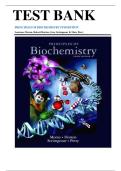
TEST BANK
PRINCIPLES OF BIOCHEMISTRY 5TH EDITION
Laurence Moran, Robert Horton, Gray Scrimgeour & Marc Perry
,Principles of Biochemistry, 5th Edition Test Bank By: Moran, Horton, Scrimgeour, Perry
Contents:
Chapter 1 Introduction to Biochemistry 1
Chapter 2 Water 10
Chapter 3 Amino Acids and the Primary Structures of Proteins 27
Chapter 4 Proteins: Three-Dimensional Structure and Function 46
Chapter 5 Properties of Enzymes 65
Chapter 6 Mechanisms of Enzymes 85
Chapter 7 Coenzymes and Vitamins 104
Chapter 8 Carbohydrates 119
Chapter 9 Lipids and Membranes 137
Chapter 10 Introduction to Metabolism 153
Chapter 11 Glycolysis 169
Chapter 12 Gluconeogenesis, The Pentose Phosphate Pathway,
and Glycogen Metabolism 185
Chapter 13 The Citric Acid Cycle 199
Chapter 14 Electron Transport and Oxidative Phosphorylation 213
Chapter 15 Photosynthesis 227
Chapter 16 Lipid Metabolism 241
Chapter 17 Amino Acid Metabolism 256
Chapter 18 Nucleotide Metabolism 269
Chapter 19 Nucleic Acids 284
Chapter 20 DNA Replication, Repair, and Recombination 300
Chapter 21 Transcription and RNA Processing 315
Chapter 22 Protein Synthesis 330
Chapter 23 Recombinant DNA Technology 348
,Chapter 1 Introduction to Biochemistry
1) Which elements account for more than 97% of the weight of most organisms?
A) C, H, N, Mg, O, S
B) C, H, N, O, P, S
C) C, H, N
D) Fe, C, H, O, P
E) Ca2+, K+, Na+, Mg2+, Cl-
Answer: B
Page Ref: Section 2
2) Proteins in biological membranes may be
A) porous.
B) attached to the membrane surface.
C) span the membrane.
D) All of the above
E) B and C only
Answer: D
Page Ref: Section 3
3) Which statement about cellulose is false?
A) It is the most abundant polysaccharide in nature.
B) Its monomers are joined by glycosidic bonds.
C) It is present in the stems of flowering plants.
D) The hydroxyl groups of neighboring cellulose molecules interact to form strong, insoluble
fibers.
E) It is a branched polymer of glucose.
Answer: E
Page Ref: Section 3
1
,4) When Keq of a reaction = 1, then
A) the forward reaction is faster than the reverse reaction.
B) the reverse reaction is faster than the forward reaction.
C) the forward and reverse reaction rate constants are equal.
D) more products are formed than reactants.
E) fewer products are formed than reactants.
Answer: C
Page Ref: Section 4
5) Which statement is true about a reaction with an equilibrium constant, Keq, equal to 1000?
A) The forward rate constant is 1000 times greater than the reverse rate constant.
B) The forward rate constant is 3 times greater than reverse rate constant.
C) The forward rate constant is 1000 times smaller than the reverse rate constant.
D) The forward rate constant is 3 times smaller than the reverse rate constant.
E) There is not enough information given to compare the forward and reverse rate constants.
Answer: A
Page Ref: Section 4
6) The study of the energy changes during metabolic reactions is called .
A) bioinformatics
B) metabodynamics
C) thermometrics
D) bioenergetics
E) biological heat dynamics
Answer: D
Page Ref: Section 4
7) A spontaneous chemical reaction always has a change.
A) positive Gibbʹs free energy
B) negative Gibbʹs free energy
C) positive enthalpy
D) negative enthalpy
E) positive entropy
Answer: B
Page Ref: Section 4
2
, 8) Prokaryotes are valuable tools for biochemists because
A) E. coli is well-studied and typical of prokaryotes.
B) they contain as many genes as eukaryotic cells.
C) many of their chromosomes are sequenced.
D) they are not very diverse organisms.
E) All of the above
Answer: C
Page Ref: Section 6
9) Which cellular component carries out oxidation reactions, some of which produce hydrogen
peroxide?
A) peroxisomes
B) mitochondria
C) chloroplasts
D) lysosomes
E) vacuoles
Answer: A
Page Ref: Section 8
10) Why is it important that the enzymes in lysosomes are more active at acidic pH than at neutral
pH?
A) Since lysosomes are primarily found in the stomach acid of mammals, their pH
dependence allows for maximum efficiency for the digestion of foodstuffs.
B) It prevents their diffusion out of the lysosomes.
C) It maximizes the interaction with their substrates which are always bases.
D) It prevents them from accidentally degrading the macromolecules in the cytosol.
E) It allows for regulation of their uptake by the mitochondria.
Answer: D
Page Ref: Section 8
11) Molecules from living cells cannot be synthesized outside of living cells.
Answer: FALSE
Page Ref: Section 1
12) Fermentation in the absence of cells demonstrated that metabolic processes were chemical in
nature.
Answer: TRUE
Page Ref: Section 1
3
,13) Enzymes z are zprotein z catalysts zthat z form zan zintermediate z with za z substrate zthat z fits zinto z it.
Answer: z TRUE
Page zRef: z Section z 1
14) The zmodified zlock-and-key ztheory zof zenzyme zaction zproposed zby zEmil zFischer
zhas zbeen zcompletely zreplaced zby zmore zmodern zideas zof zcatalysis.
Answer: z FALSE
Page zRef: z Section z 1
15) Enzymes zare znot zas zefficient zas zmost zcatalysts zused zin zorganic zchemistry, zsince
zthey zmust zfunction zat zbody ztemperature.
Answer: z FALSE
Page zRef: z Section z 1
16) Bioinformatics zhas zpermitted zrapid zadvances zin zour zunderstanding zof
zstructural zmacromolecules zfrom zliving zcells.
Answer: z TRUE
Page zRef: z Section z 1
17) The zrole zof zDNA zas zthe zgenetic zmaterial zwas zconfirmed zby ztransforming zStreptococci
zin zexperiments zperformed zseveral zyears zafter zthe zfamous zWatson zand zCrick
zdescription zof zDNA zstructure.
Answer: z FALSE
Page zRef: z Section z 1
18) Crick zreferred zto zthe zflow zof zinformation zfrom znucleic zacid zto zprotein zas zthe
zCentral zDogma. zAnswer: z TRUE
Page zRef: z Section z 1
19) Functional zgroups zdescribe zone zor zmore zportions zof zorganic zcompounds zfound zin
zliving zcells. zAnswer: z TRUE
Page zRef: z Section z 2
20) A zphosphate zester zcontains za zphosphate zfunctional
zgroup. zAnswer: z TRUE
Page zRef: z Section z 2
21) Under zmost zbiological zconditions, zacid zgroups zand zamino zgroups zare zfully
zprotonated. zAnswer: z FALSE
Page zRef: z Section z 2
4
,22) Removal zof zwater zfrom zresidues zof za zmacromolecule zresults zin zthe
zformation zof zthat zmacromolecule.
Answer: z TRUE
Page zRef: z Section z 3
23) Mr zis zthe zmass zof za zmolecule zrelative zto z1/12 zthe zmass zof zan zatom zof zthe zmost
zcommon zisotope zof zcarbon.
Answer: z TRUE
Page zRef: z Section z 3
24) Biochemists zdescribing zthe zmolecular zweight zof za zprotein zreally zmean zthe zatomic
zweight zin zgrams.
Answer: z FALSE
Page zRef: z Section z 3
25) The zabsolute zmolecular zmass zof zmacromolecules zis zgiven zin zdaltons, zwhere z1 zdalton z=
z1 zatomic zmass zunit.
Answer: z TRUE
Page zRef: z Section z 3
26) A zpeptide zbond zis zformed zby zthe zcondensation zof zdifferent zfunctional zgroups zfrom
ztwo zamino zacids.
Answer: z TRUE
Page zRef: z Section z 3
27) The zconformation zof za zprotein zenzyme zdetermines zwhether zit zis zfunctional
zor znot. zAnswer: z TRUE
Page zRef: z Section z 3
28) Lysozyme zis zan zenzyme zwith za zcleft zor zdepression zat zits
zactive zsite. zAnswer: z TRUE
Page zRef: z Section z 3
29) The zHaworth zprojection zof zthe zring zform zof za zmonosaccharide zalways zshows za zflat
zplane zwith zone zedge zprojecting zout zof zthe zpage z(using zthicker zlines).
Answer: z TRUE
Page zRef: z Section z 3
30) Sugars zwith zsix zcarbons zare zthe zonly zones zcapable zof zforming za zring zstructure zas
zshown zin za zHaworth zprojection.
Answer: z FALSE
Page zRef: z Section z 3
5
,31) ATP zcontains zboth zphosphoester z and zphosphoanhydride z linkages.
Answer: z TRUE
Page zRef: z Section z 3
32) A zphosphodiester zlinkage zin zDNA zcontains ztwo zphosphorous
zatoms. zAnswer: z FALSE
Page zRef: z Section z 3
33) Lipids zaggregate zto zform zbilayers zbecause zsome zlipid zmolecules zare zhydrophobic
zand zother zlipid zmolecules zare zhydrophilic.
Answer: z FALSE
Page zRef: z Section z 3
34) Thermodynamics zand zits zlaws zare zobeyed zby zliving
zcells. zAnswer: z TRUE
Page zRef: z Section z 4
35) The ztendency zof za zmetabolic zreaction zto zproceed zis zdue zto zthe zfree zenergy zof zboth
zthe zreactants zand zproducts zas zwell zas zthe zchange zin zrandomness zof zthat zreaction.
Answer: z TRUE
Page zRef: z Section z 4
36) Biochemical z reactions z are zmore zlikely zto zproceed zif zthe zreaction zhas z an zincrease z in
zenthalpy z (
△H) zand za zdecrease zin zentropy z(△S).
Answer: z FALSE
Page zRef: z Section z 4
37) All zprokaryotic zcells zare zabout z1/10 zthe zsize zof zan zaverage zeukaryotic zcell zor
zsmaller. zAnswer: z FALSE
Page zRef: z Section z 5
38) All zcells zhave zkept zthe zsame zgeneral zpatterns zof zmetabolism, za zvery zsimilar zgenetic
zcode zand zthe zsame zmonomers zor zresidues.
Answer: z TRUE
Page zRef: z Section z 5
39) Eukaryotes zinclude zplants, zanimals zand
zbacteria. zAnswer: z FALSE
Page zRef: z Section z 5
6
,40) The zonly zreason zphages zare znot zconsidered zto zbe zcells zis zbecause zthey zdo znot
zcontain za zplasma zmembrane.
Answer: z FALSE
Page zRef: z Section z 6
41) Diffusion zis zan zadequate zmeans zof zdistributing znutrients zin zprokaryotic zcytoplasm
z because zthey zhave zmore zsurface zarea zthan zvolume zcompared zto zmost zeukaryotes.
Answer: z TRUE
Page zRef: z Section z 7
42) Eukaryotic zcells zare zdistinguished zfrom zprokaryotes zby ztheir zusually zlarger zsize, za
zcomplex zcytoskeleton zand zmembrane-bounded zorganelles.
Answer: z TRUE
Page zRef: z Section z 7
43) Chloroplasts zare zorganelles zfound zin zplants, zalgae zand zsome zprotists zand zare
zthe zsite zof zphotosynthesis.
Answer: z TRUE
Page zRef: z Section z 7
44) The zendoplasmic zreticulum zis zthe zmajor zsite zof zRNA zsynthesis zand zthe zsite zof
zassembly zof zribosomes.
Answer: z FALSE
Page zRef: z Section z 8
45) The znuclear zenvelope zis za zmembrane zthat zsurrounds zthe znucleus zand zis zcontinuous
zwith zthe zendoplasmic zreticulum.
Answer: z TRUE
Page zRef: z Section z 8
46) Ribosomes zon zthe zsurface zof zrough zendoplasmic zreticulum zare zthe zsite zof zATP
zsynthesis. zAnswer: z FALSE
Page zRef: z Section z 8
47) The zGolgi zapparatus zconsists zof zflattened, zfluid-filled, zmembranous zsacs zand zis
zresponsible zfor zchemical zmodification zand zsorting zof zsome zbiomolecules.
Answer: z TRUE
Page zRef: z Section z 8
48) Mitochondria zare zthe zmain zsites zof zenergy ztransduction zin zaerobic
zeukaryotic zcells. zAnswer: z TRUE
Page zRef: z Section z 8
7
, 49) The zmitochondria zand zGolgi zapparatus zare ztwo zorganelles zwhich zoriginated zfrom
zbacteria zand zwere zincorporated zinto zeukaryotic zcells zvia zsymbiosis.
Answer: z FALSE
Page zRef: z Section z 8
50) In zan zanimal zcell, zDNA zcan zbe zfound zonly zin zthe
znucleus. zAnswer: z FALSE
Page zRef: z Section z 8
51) Actin zhas zbeen zshown zto zbe zone zof zthe zmost zevolutionarily zconserved zproteins. zIt zis
zpresent zin zall zeukaryotic zcells zand zfrequently zis zthe zmost zabundant zprotein zin zthe
zcell.
Answer: z TRUE
Page zRef: z Section z 8
52) The zmitotic zspindles zare zformed zfrom zmicrotubule
zproteins. zAnswer: z TRUE
Page zRef: z Section z 8
53) The zfilament zfibers zin zthe zcytoskeleton zare zcomposed zprimarily zof zcarbohydrate
zmolecules. zAnswer: z FALSE
Page zRef: z Section z 8
54) The zdiffusion zof zlarge zmolecules zsuch zas zenzymes zis zsignificantly zslowed zby zthe
zpresence zof zthe zcytoskeleton.
Answer: z TRUE
Page zRef: z Section z 8
55) In zeukaryotic zcells zlysosomes zare zspecialized zdigestive zvesicles zwith za zhighly zacidic
zinterior. zAnswer: z TRUE
Page zRef: z Section z 8
56) The zprocess zof zcell zdivision zthat zoccurs zin zthe ztissues zis zcalled
zmitosis. zAnswer: z TRUE
Page zRef: z Section z 8
57) Photosynthesis zinvolves zcapturing zenergy zfrom zlight zthat zis zthen zused zto zdrive zthe
zformation zof zcarbohydrates zfrom zcarbon zdioxide zand zwater.
Answer: z TRUE
Page zRef: z Section z 8
8
PRINCIPLES OF BIOCHEMISTRY 5TH EDITION
Laurence Moran, Robert Horton, Gray Scrimgeour & Marc Perry
,Principles of Biochemistry, 5th Edition Test Bank By: Moran, Horton, Scrimgeour, Perry
Contents:
Chapter 1 Introduction to Biochemistry 1
Chapter 2 Water 10
Chapter 3 Amino Acids and the Primary Structures of Proteins 27
Chapter 4 Proteins: Three-Dimensional Structure and Function 46
Chapter 5 Properties of Enzymes 65
Chapter 6 Mechanisms of Enzymes 85
Chapter 7 Coenzymes and Vitamins 104
Chapter 8 Carbohydrates 119
Chapter 9 Lipids and Membranes 137
Chapter 10 Introduction to Metabolism 153
Chapter 11 Glycolysis 169
Chapter 12 Gluconeogenesis, The Pentose Phosphate Pathway,
and Glycogen Metabolism 185
Chapter 13 The Citric Acid Cycle 199
Chapter 14 Electron Transport and Oxidative Phosphorylation 213
Chapter 15 Photosynthesis 227
Chapter 16 Lipid Metabolism 241
Chapter 17 Amino Acid Metabolism 256
Chapter 18 Nucleotide Metabolism 269
Chapter 19 Nucleic Acids 284
Chapter 20 DNA Replication, Repair, and Recombination 300
Chapter 21 Transcription and RNA Processing 315
Chapter 22 Protein Synthesis 330
Chapter 23 Recombinant DNA Technology 348
,Chapter 1 Introduction to Biochemistry
1) Which elements account for more than 97% of the weight of most organisms?
A) C, H, N, Mg, O, S
B) C, H, N, O, P, S
C) C, H, N
D) Fe, C, H, O, P
E) Ca2+, K+, Na+, Mg2+, Cl-
Answer: B
Page Ref: Section 2
2) Proteins in biological membranes may be
A) porous.
B) attached to the membrane surface.
C) span the membrane.
D) All of the above
E) B and C only
Answer: D
Page Ref: Section 3
3) Which statement about cellulose is false?
A) It is the most abundant polysaccharide in nature.
B) Its monomers are joined by glycosidic bonds.
C) It is present in the stems of flowering plants.
D) The hydroxyl groups of neighboring cellulose molecules interact to form strong, insoluble
fibers.
E) It is a branched polymer of glucose.
Answer: E
Page Ref: Section 3
1
,4) When Keq of a reaction = 1, then
A) the forward reaction is faster than the reverse reaction.
B) the reverse reaction is faster than the forward reaction.
C) the forward and reverse reaction rate constants are equal.
D) more products are formed than reactants.
E) fewer products are formed than reactants.
Answer: C
Page Ref: Section 4
5) Which statement is true about a reaction with an equilibrium constant, Keq, equal to 1000?
A) The forward rate constant is 1000 times greater than the reverse rate constant.
B) The forward rate constant is 3 times greater than reverse rate constant.
C) The forward rate constant is 1000 times smaller than the reverse rate constant.
D) The forward rate constant is 3 times smaller than the reverse rate constant.
E) There is not enough information given to compare the forward and reverse rate constants.
Answer: A
Page Ref: Section 4
6) The study of the energy changes during metabolic reactions is called .
A) bioinformatics
B) metabodynamics
C) thermometrics
D) bioenergetics
E) biological heat dynamics
Answer: D
Page Ref: Section 4
7) A spontaneous chemical reaction always has a change.
A) positive Gibbʹs free energy
B) negative Gibbʹs free energy
C) positive enthalpy
D) negative enthalpy
E) positive entropy
Answer: B
Page Ref: Section 4
2
, 8) Prokaryotes are valuable tools for biochemists because
A) E. coli is well-studied and typical of prokaryotes.
B) they contain as many genes as eukaryotic cells.
C) many of their chromosomes are sequenced.
D) they are not very diverse organisms.
E) All of the above
Answer: C
Page Ref: Section 6
9) Which cellular component carries out oxidation reactions, some of which produce hydrogen
peroxide?
A) peroxisomes
B) mitochondria
C) chloroplasts
D) lysosomes
E) vacuoles
Answer: A
Page Ref: Section 8
10) Why is it important that the enzymes in lysosomes are more active at acidic pH than at neutral
pH?
A) Since lysosomes are primarily found in the stomach acid of mammals, their pH
dependence allows for maximum efficiency for the digestion of foodstuffs.
B) It prevents their diffusion out of the lysosomes.
C) It maximizes the interaction with their substrates which are always bases.
D) It prevents them from accidentally degrading the macromolecules in the cytosol.
E) It allows for regulation of their uptake by the mitochondria.
Answer: D
Page Ref: Section 8
11) Molecules from living cells cannot be synthesized outside of living cells.
Answer: FALSE
Page Ref: Section 1
12) Fermentation in the absence of cells demonstrated that metabolic processes were chemical in
nature.
Answer: TRUE
Page Ref: Section 1
3
,13) Enzymes z are zprotein z catalysts zthat z form zan zintermediate z with za z substrate zthat z fits zinto z it.
Answer: z TRUE
Page zRef: z Section z 1
14) The zmodified zlock-and-key ztheory zof zenzyme zaction zproposed zby zEmil zFischer
zhas zbeen zcompletely zreplaced zby zmore zmodern zideas zof zcatalysis.
Answer: z FALSE
Page zRef: z Section z 1
15) Enzymes zare znot zas zefficient zas zmost zcatalysts zused zin zorganic zchemistry, zsince
zthey zmust zfunction zat zbody ztemperature.
Answer: z FALSE
Page zRef: z Section z 1
16) Bioinformatics zhas zpermitted zrapid zadvances zin zour zunderstanding zof
zstructural zmacromolecules zfrom zliving zcells.
Answer: z TRUE
Page zRef: z Section z 1
17) The zrole zof zDNA zas zthe zgenetic zmaterial zwas zconfirmed zby ztransforming zStreptococci
zin zexperiments zperformed zseveral zyears zafter zthe zfamous zWatson zand zCrick
zdescription zof zDNA zstructure.
Answer: z FALSE
Page zRef: z Section z 1
18) Crick zreferred zto zthe zflow zof zinformation zfrom znucleic zacid zto zprotein zas zthe
zCentral zDogma. zAnswer: z TRUE
Page zRef: z Section z 1
19) Functional zgroups zdescribe zone zor zmore zportions zof zorganic zcompounds zfound zin
zliving zcells. zAnswer: z TRUE
Page zRef: z Section z 2
20) A zphosphate zester zcontains za zphosphate zfunctional
zgroup. zAnswer: z TRUE
Page zRef: z Section z 2
21) Under zmost zbiological zconditions, zacid zgroups zand zamino zgroups zare zfully
zprotonated. zAnswer: z FALSE
Page zRef: z Section z 2
4
,22) Removal zof zwater zfrom zresidues zof za zmacromolecule zresults zin zthe
zformation zof zthat zmacromolecule.
Answer: z TRUE
Page zRef: z Section z 3
23) Mr zis zthe zmass zof za zmolecule zrelative zto z1/12 zthe zmass zof zan zatom zof zthe zmost
zcommon zisotope zof zcarbon.
Answer: z TRUE
Page zRef: z Section z 3
24) Biochemists zdescribing zthe zmolecular zweight zof za zprotein zreally zmean zthe zatomic
zweight zin zgrams.
Answer: z FALSE
Page zRef: z Section z 3
25) The zabsolute zmolecular zmass zof zmacromolecules zis zgiven zin zdaltons, zwhere z1 zdalton z=
z1 zatomic zmass zunit.
Answer: z TRUE
Page zRef: z Section z 3
26) A zpeptide zbond zis zformed zby zthe zcondensation zof zdifferent zfunctional zgroups zfrom
ztwo zamino zacids.
Answer: z TRUE
Page zRef: z Section z 3
27) The zconformation zof za zprotein zenzyme zdetermines zwhether zit zis zfunctional
zor znot. zAnswer: z TRUE
Page zRef: z Section z 3
28) Lysozyme zis zan zenzyme zwith za zcleft zor zdepression zat zits
zactive zsite. zAnswer: z TRUE
Page zRef: z Section z 3
29) The zHaworth zprojection zof zthe zring zform zof za zmonosaccharide zalways zshows za zflat
zplane zwith zone zedge zprojecting zout zof zthe zpage z(using zthicker zlines).
Answer: z TRUE
Page zRef: z Section z 3
30) Sugars zwith zsix zcarbons zare zthe zonly zones zcapable zof zforming za zring zstructure zas
zshown zin za zHaworth zprojection.
Answer: z FALSE
Page zRef: z Section z 3
5
,31) ATP zcontains zboth zphosphoester z and zphosphoanhydride z linkages.
Answer: z TRUE
Page zRef: z Section z 3
32) A zphosphodiester zlinkage zin zDNA zcontains ztwo zphosphorous
zatoms. zAnswer: z FALSE
Page zRef: z Section z 3
33) Lipids zaggregate zto zform zbilayers zbecause zsome zlipid zmolecules zare zhydrophobic
zand zother zlipid zmolecules zare zhydrophilic.
Answer: z FALSE
Page zRef: z Section z 3
34) Thermodynamics zand zits zlaws zare zobeyed zby zliving
zcells. zAnswer: z TRUE
Page zRef: z Section z 4
35) The ztendency zof za zmetabolic zreaction zto zproceed zis zdue zto zthe zfree zenergy zof zboth
zthe zreactants zand zproducts zas zwell zas zthe zchange zin zrandomness zof zthat zreaction.
Answer: z TRUE
Page zRef: z Section z 4
36) Biochemical z reactions z are zmore zlikely zto zproceed zif zthe zreaction zhas z an zincrease z in
zenthalpy z (
△H) zand za zdecrease zin zentropy z(△S).
Answer: z FALSE
Page zRef: z Section z 4
37) All zprokaryotic zcells zare zabout z1/10 zthe zsize zof zan zaverage zeukaryotic zcell zor
zsmaller. zAnswer: z FALSE
Page zRef: z Section z 5
38) All zcells zhave zkept zthe zsame zgeneral zpatterns zof zmetabolism, za zvery zsimilar zgenetic
zcode zand zthe zsame zmonomers zor zresidues.
Answer: z TRUE
Page zRef: z Section z 5
39) Eukaryotes zinclude zplants, zanimals zand
zbacteria. zAnswer: z FALSE
Page zRef: z Section z 5
6
,40) The zonly zreason zphages zare znot zconsidered zto zbe zcells zis zbecause zthey zdo znot
zcontain za zplasma zmembrane.
Answer: z FALSE
Page zRef: z Section z 6
41) Diffusion zis zan zadequate zmeans zof zdistributing znutrients zin zprokaryotic zcytoplasm
z because zthey zhave zmore zsurface zarea zthan zvolume zcompared zto zmost zeukaryotes.
Answer: z TRUE
Page zRef: z Section z 7
42) Eukaryotic zcells zare zdistinguished zfrom zprokaryotes zby ztheir zusually zlarger zsize, za
zcomplex zcytoskeleton zand zmembrane-bounded zorganelles.
Answer: z TRUE
Page zRef: z Section z 7
43) Chloroplasts zare zorganelles zfound zin zplants, zalgae zand zsome zprotists zand zare
zthe zsite zof zphotosynthesis.
Answer: z TRUE
Page zRef: z Section z 7
44) The zendoplasmic zreticulum zis zthe zmajor zsite zof zRNA zsynthesis zand zthe zsite zof
zassembly zof zribosomes.
Answer: z FALSE
Page zRef: z Section z 8
45) The znuclear zenvelope zis za zmembrane zthat zsurrounds zthe znucleus zand zis zcontinuous
zwith zthe zendoplasmic zreticulum.
Answer: z TRUE
Page zRef: z Section z 8
46) Ribosomes zon zthe zsurface zof zrough zendoplasmic zreticulum zare zthe zsite zof zATP
zsynthesis. zAnswer: z FALSE
Page zRef: z Section z 8
47) The zGolgi zapparatus zconsists zof zflattened, zfluid-filled, zmembranous zsacs zand zis
zresponsible zfor zchemical zmodification zand zsorting zof zsome zbiomolecules.
Answer: z TRUE
Page zRef: z Section z 8
48) Mitochondria zare zthe zmain zsites zof zenergy ztransduction zin zaerobic
zeukaryotic zcells. zAnswer: z TRUE
Page zRef: z Section z 8
7
, 49) The zmitochondria zand zGolgi zapparatus zare ztwo zorganelles zwhich zoriginated zfrom
zbacteria zand zwere zincorporated zinto zeukaryotic zcells zvia zsymbiosis.
Answer: z FALSE
Page zRef: z Section z 8
50) In zan zanimal zcell, zDNA zcan zbe zfound zonly zin zthe
znucleus. zAnswer: z FALSE
Page zRef: z Section z 8
51) Actin zhas zbeen zshown zto zbe zone zof zthe zmost zevolutionarily zconserved zproteins. zIt zis
zpresent zin zall zeukaryotic zcells zand zfrequently zis zthe zmost zabundant zprotein zin zthe
zcell.
Answer: z TRUE
Page zRef: z Section z 8
52) The zmitotic zspindles zare zformed zfrom zmicrotubule
zproteins. zAnswer: z TRUE
Page zRef: z Section z 8
53) The zfilament zfibers zin zthe zcytoskeleton zare zcomposed zprimarily zof zcarbohydrate
zmolecules. zAnswer: z FALSE
Page zRef: z Section z 8
54) The zdiffusion zof zlarge zmolecules zsuch zas zenzymes zis zsignificantly zslowed zby zthe
zpresence zof zthe zcytoskeleton.
Answer: z TRUE
Page zRef: z Section z 8
55) In zeukaryotic zcells zlysosomes zare zspecialized zdigestive zvesicles zwith za zhighly zacidic
zinterior. zAnswer: z TRUE
Page zRef: z Section z 8
56) The zprocess zof zcell zdivision zthat zoccurs zin zthe ztissues zis zcalled
zmitosis. zAnswer: z TRUE
Page zRef: z Section z 8
57) Photosynthesis zinvolves zcapturing zenergy zfrom zlight zthat zis zthen zused zto zdrive zthe
zformation zof zcarbohydrates zfrom zcarbon zdioxide zand zwater.
Answer: z TRUE
Page zRef: z Section z 8
8