Nagelhout Pharmacology Exam 1
Review Questions and Answers
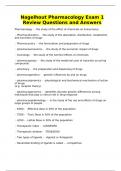
Pharmacology - -the study of the effect of chemicals on living tissue
- Pharmacokinetics - -the study of the absorption, distribution, metabolism
and excretion of drugs
- Pharmaceutics - -the formulation and preparation of drugs
- pharmacoeconomics - -the study of the economic impact of drugs
- toxicology - -the study of the harmful effects of chemicals
- pharmacognosy - -the study of the medicinal uses of naturally occurring
compounds
- pharmacy - -the preparation and dispensing of drugs
- pharmacogenetics - -genetic influences by and on drugs
- pharmacodynamics - -physiological and biochemical mechanism of action
of drugs
(e.g. receptor theory)
- pharmacogenomics - -identifies discrete genetic differences among
individuals that play a critical role in drug response
- pharmacoepidemiology - -is the study of the use and effects of drugs on
large groups of people
- ED50 - -Effective dose in 50% of the population
- TD50 - -Toxic Dose in 50% of the population
- LD50 - -Lethal Dose in 50% of the population
- Therapeutic index - -LD50/ED50
- Therapeutic window - -TD50/ED50
- Two types of ligands - -Agonist or Antagonist
- Reversible binding of ligands is called - -competitive
, - non-reversible binding of ligands is called - -noncompetitive
- 5 types of chemical bonds in order of increasing strength - -van der waals,
hydrophobic, hydrogen, ionic, covalent
- 5 types of chemical bonds in order of decreasing strength - -covalent,
ionic, hydrogen, hydrophobic, van der waals
- Occupation of receptors by ligands is governed by: - -affinity
- Activation of receptors by ligands is governed by: - -efficacy
- A dose response curve can show: - -Affinity (potency), Efficacy, Variability,
Slope
- Up regulation - -an increase in receptor proteins as a response to chronic
blockade
- Down regulation - -Desensitization (refractoriness) following continued
stimulation (agonists). Chronic beta stimulant use for asthma resulting in
increased dose necessary is an example
- Drug Interaction - -Alteration in the therapeutic action of a drug by
concurrent administration of other exogenous chemicals
- 1+1 = 2 - -Addition; The combined effect of two drugs acting via the same
mechanism is equal to that expected by simple addition of their individual
actions
Ex) midazolam + diazepam
- 1+1=3 - -synergism; The combined effect of two drugs is greater than the
sum of their individuals effects
Ex) Midazolam + Propofol
- 1+0=3 - -potentiation; The enhancement of the action of one drug by a
second that has no detectable action of its own.
Ex) Penicillin + probenacid
- antagonism - -1+1=0; The action of one drug opposes the action of
another
Ex) fentanyl + naloxone
Review Questions and Answers
Pharmacology - -the study of the effect of chemicals on living tissue
- Pharmacokinetics - -the study of the absorption, distribution, metabolism
and excretion of drugs
- Pharmaceutics - -the formulation and preparation of drugs
- pharmacoeconomics - -the study of the economic impact of drugs
- toxicology - -the study of the harmful effects of chemicals
- pharmacognosy - -the study of the medicinal uses of naturally occurring
compounds
- pharmacy - -the preparation and dispensing of drugs
- pharmacogenetics - -genetic influences by and on drugs
- pharmacodynamics - -physiological and biochemical mechanism of action
of drugs
(e.g. receptor theory)
- pharmacogenomics - -identifies discrete genetic differences among
individuals that play a critical role in drug response
- pharmacoepidemiology - -is the study of the use and effects of drugs on
large groups of people
- ED50 - -Effective dose in 50% of the population
- TD50 - -Toxic Dose in 50% of the population
- LD50 - -Lethal Dose in 50% of the population
- Therapeutic index - -LD50/ED50
- Therapeutic window - -TD50/ED50
- Two types of ligands - -Agonist or Antagonist
- Reversible binding of ligands is called - -competitive
, - non-reversible binding of ligands is called - -noncompetitive
- 5 types of chemical bonds in order of increasing strength - -van der waals,
hydrophobic, hydrogen, ionic, covalent
- 5 types of chemical bonds in order of decreasing strength - -covalent,
ionic, hydrogen, hydrophobic, van der waals
- Occupation of receptors by ligands is governed by: - -affinity
- Activation of receptors by ligands is governed by: - -efficacy
- A dose response curve can show: - -Affinity (potency), Efficacy, Variability,
Slope
- Up regulation - -an increase in receptor proteins as a response to chronic
blockade
- Down regulation - -Desensitization (refractoriness) following continued
stimulation (agonists). Chronic beta stimulant use for asthma resulting in
increased dose necessary is an example
- Drug Interaction - -Alteration in the therapeutic action of a drug by
concurrent administration of other exogenous chemicals
- 1+1 = 2 - -Addition; The combined effect of two drugs acting via the same
mechanism is equal to that expected by simple addition of their individual
actions
Ex) midazolam + diazepam
- 1+1=3 - -synergism; The combined effect of two drugs is greater than the
sum of their individuals effects
Ex) Midazolam + Propofol
- 1+0=3 - -potentiation; The enhancement of the action of one drug by a
second that has no detectable action of its own.
Ex) Penicillin + probenacid
- antagonism - -1+1=0; The action of one drug opposes the action of
another
Ex) fentanyl + naloxone