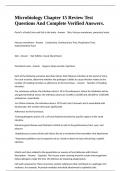
Microbiology Chapter 15 Review Test
Questions And Complete Verified Answers.
Portal`s of both Entry and Exit in the body - Answer Skin, Mucous membrane, parenteral route
Mucous membrane - Answer Conjunctiva, Genitourinary Tract, Respiratory Tract,
Gastrointestinal Tract
Skin - Answer Hair follicles, Sweat Gland Ducts
Parenteral route - Answer Surgery, Deep wounds, Injections
Each of the following scenarios describes factors that influence infection at the portal of entry.
For each scenario, determine whether the pathogen's ability to cause infection relates to the
number of invading microbes or adherence to the host tissue. - Answer Number of invading
microbes:
-for cutaneous anthrax, the infectious dose is 10 to 50 endospores, wheas for inhalation antrax
and gastrointestinal antrax, the infectious doses are 10,000 to 20,000 and 250,000 to 1,000,000
endospores, respectively
-For Vibrio cholerae, the infectious dose is 10^8 cells, but if stomach acid is neutralized with
bicarbonate, this number decreases significantly
Adherence to the host tissue:
-Enteropathogenic strains of E. coli have fimbriae that bind to specific regions of the small
intestine
Neisseria gonorrhoeae uses fimbriae to attach to cells in the genitourinary tract, eyes, and
pharynx
-Staphylococcus aureus binds and infects skin by a mechanism that resembles viral attachment
-Treponema pallidum uses its tapered end as a hook to attach to host cells during a syphilis
infection
Match each item related to the penetration or evasion of host defenses with its best
description. - Answer Capsules: This viscous outer covering found in certain microorganisms
helps pathogens evade the host 19s defenses by impairing phagocytosis.
Cell wall components: These structures contain substances that contribute to a pathogen 19s
virulence; for example, M protein mediates microbial attachment to epithelial cells.
, Invasins: These microbial surface proteins rearrange the host cell 19s actin filaments, allowing
pathogens to enter and move in and between cells.
Match each item related to damage to host cells with its description. - Answer Siderophores:
These proteins bind up iron obtained from the host cell 19s iron-transport proteins and
transport this iron to bacteria through interactions with cell surface receptors.
Direct Damage: This occurs as a result of nutrient depletion, accumulation of waste products,
pathogen entry and exit, and ruptured host cells.
Toxins: These poisonous substances cause most of the damage to host cells; they can be
transported by the blood or lymph and may produce far-reaching effects.
Lysogenic conversion: This results in a change in microbe characteristics due to the presence of
prophage genes that confer new properties.
Cytopathic effects: These describe the visible effects of viral infections that results in host cell
damage.
Reviewing the overall microbial mechanisms of pathogenicity (Figure 15.9), predict the ability of
the pathogen to cause infection in each of the following scenarios. - Answer Likely to cause
infection:
- A pathogen that causes gastrointestinal infections is accidentally ingested in contaminated
food
- A population of microbes less than the infectious dose is introduced in a compromised human
host
- A healthy individual inhales droplets from a person infected with a respiratory virus
- A pathogen in quantities more than double its infectious dose is introduced at the appropriate
portal of entry
Not likely to cause infection:
- A population of microbes greater than the infectious dose is introduced in a healthy individual,
but these microbes are unable to adhere to hose tissues
- A pathogen that causes urinary tract infections is accidentally ingested in contaminated water
-A pathogen with multiple virulence, factors is introduced in a healthy host, but in quantities far
below its infectious dose
Endotoxins are also known as - Answer Lipid A
When would endotoxins be released from a bacterial cell? - Answer When the cell dies
Questions And Complete Verified Answers.
Portal`s of both Entry and Exit in the body - Answer Skin, Mucous membrane, parenteral route
Mucous membrane - Answer Conjunctiva, Genitourinary Tract, Respiratory Tract,
Gastrointestinal Tract
Skin - Answer Hair follicles, Sweat Gland Ducts
Parenteral route - Answer Surgery, Deep wounds, Injections
Each of the following scenarios describes factors that influence infection at the portal of entry.
For each scenario, determine whether the pathogen's ability to cause infection relates to the
number of invading microbes or adherence to the host tissue. - Answer Number of invading
microbes:
-for cutaneous anthrax, the infectious dose is 10 to 50 endospores, wheas for inhalation antrax
and gastrointestinal antrax, the infectious doses are 10,000 to 20,000 and 250,000 to 1,000,000
endospores, respectively
-For Vibrio cholerae, the infectious dose is 10^8 cells, but if stomach acid is neutralized with
bicarbonate, this number decreases significantly
Adherence to the host tissue:
-Enteropathogenic strains of E. coli have fimbriae that bind to specific regions of the small
intestine
Neisseria gonorrhoeae uses fimbriae to attach to cells in the genitourinary tract, eyes, and
pharynx
-Staphylococcus aureus binds and infects skin by a mechanism that resembles viral attachment
-Treponema pallidum uses its tapered end as a hook to attach to host cells during a syphilis
infection
Match each item related to the penetration or evasion of host defenses with its best
description. - Answer Capsules: This viscous outer covering found in certain microorganisms
helps pathogens evade the host 19s defenses by impairing phagocytosis.
Cell wall components: These structures contain substances that contribute to a pathogen 19s
virulence; for example, M protein mediates microbial attachment to epithelial cells.
, Invasins: These microbial surface proteins rearrange the host cell 19s actin filaments, allowing
pathogens to enter and move in and between cells.
Match each item related to damage to host cells with its description. - Answer Siderophores:
These proteins bind up iron obtained from the host cell 19s iron-transport proteins and
transport this iron to bacteria through interactions with cell surface receptors.
Direct Damage: This occurs as a result of nutrient depletion, accumulation of waste products,
pathogen entry and exit, and ruptured host cells.
Toxins: These poisonous substances cause most of the damage to host cells; they can be
transported by the blood or lymph and may produce far-reaching effects.
Lysogenic conversion: This results in a change in microbe characteristics due to the presence of
prophage genes that confer new properties.
Cytopathic effects: These describe the visible effects of viral infections that results in host cell
damage.
Reviewing the overall microbial mechanisms of pathogenicity (Figure 15.9), predict the ability of
the pathogen to cause infection in each of the following scenarios. - Answer Likely to cause
infection:
- A pathogen that causes gastrointestinal infections is accidentally ingested in contaminated
food
- A population of microbes less than the infectious dose is introduced in a compromised human
host
- A healthy individual inhales droplets from a person infected with a respiratory virus
- A pathogen in quantities more than double its infectious dose is introduced at the appropriate
portal of entry
Not likely to cause infection:
- A population of microbes greater than the infectious dose is introduced in a healthy individual,
but these microbes are unable to adhere to hose tissues
- A pathogen that causes urinary tract infections is accidentally ingested in contaminated water
-A pathogen with multiple virulence, factors is introduced in a healthy host, but in quantities far
below its infectious dose
Endotoxins are also known as - Answer Lipid A
When would endotoxins be released from a bacterial cell? - Answer When the cell dies